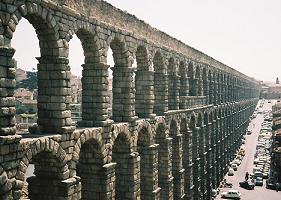
The Aqueduct of Segovia is one of the greatest surviving monuments of Roman engineering, a colossal double-tiered arcade of 167 granite arches soaring 28 metres above the Plaza del Azoguejo in the heart of the Spanish city of Segovia, constructed without a single drop of mortar nearly 2,000 years ago and still standing in magnificent condition. A UNESCO World heritage site and the symbol of Segovia, this extraordinary hydraulic masterpiece transported water over 15 kilometres from the Sierra de Guadarrama to the Roman city, and its sheer scale and perfection continue to astonish engineers and visitors alike.
In This Article
Quick Facts: Aqueduct of Segovia, Spain
- Best time to visit: Year-round; early morning for the best light and fewest crowds; spring and autumn for pleasant temperatures
- Top attraction: The 28-metre-high arcade in the Plaza del Azoguejo, the most photographed section of the aqueduct
- How to get there: ~1 hour from Madrid by high-speed AVE train to Segovia-Guiomar (then 20 min bus/taxi to the old town); ~1.5 hours by car
- Entry fee: Free, the aqueduct is a public monument in the city centre
- Combine with: The Alcázar of Segovia (the fairy-tale castle said to have inspired Walt Disney) and Segovia Cathedral
Roman Engineering Mastery: How the Aqueduct Was Built
The Aqueduct of Segovia stands as one of the most remarkable achievements of Roman engineering, a testament to the skill and precision of Roman builders nearly two millennia ago. The aqueduct consists of approximately 25,000 granite blocks, each weighing up to several tonnes, carefully cut and fitted together without the use of mortar. The blocks are held in place by gravity alone, with the weight of the structure and the precise angles of the cuts providing the necessary stability. This technique, known as opus quadratum, required extraordinary skill from the stonecutters, who had to shape each block to fit perfectly with its neighbours. The aqueduct was built in two tiers of arches, with the upper tier carrying the water channel and the lower tier providing the necessary height to cross the valley of the Plaza del Azoguejo. The total length of the aqueduct is 813 metres at its most visible section, though the complete system extended for 17 kilometres from the Río Frío in the Sierra de Guadarrama to the city. The gradient of the water channel was just 1 percent, meaning that for every 100 metres of length, the channel dropped only 1 metre. Achieving this precision over 17 kilometres using only the surveying tools available to Roman engineers is an extraordinary feat that continues to amaze modern engineers.
The Aqueduct Through History: Survival and Restoration
The Aqueduct of Segovia has survived nearly 2,000 years of history, including the fall of the Roman Empire, the Moorish conquest of Spain, centuries of conflict, and the natural forces of erosion and weathering. Remarkably, the aqueduct continued to function as a working water supply system into the 20th century, providing water to the city of Segovia for almost two millennia. It was only in the late 20th century that the aqueduct was retired from its original function and designated as a purely historical monument. The survival of the aqueduct is due in large part to the quality of its construction, but also to the care that successive generations have taken to preserve it. The most serious threat came from traffic, as vehicles passing through the arches caused vibrations that weakened the structure. In the 1990s, the area beneath the aqueduct was pedestrianised, and a comprehensive restoration programme was undertaken to clean the stone, repair damage, and ensure the structural integrity of the monument. Today, the aqueduct is maintained by the Segovia city council in cooperation with Spanish heritage authorities, and it is monitored continuously for any signs of movement or deterioration. The aqueduct was inscribed on the UNESCO World heritage List in 1985, together with the old town of Segovia, ensuring its protection for future generations.
Visiting Segovia: Combining the Aqueduct with the City’s Other Treasures
While the Aqueduct of Segovia is the city’s most famous monument, Segovia is blessed with an extraordinary concentration of historic attractions that make it one of the most rewarding day trips from Madrid. The Alcázar of Segovia, a fairy-tale castle perched on a rocky promontory at the confluence of two rivers, is said to have been the inspiration for Walt Disney’s Cinderella Castle. Its distinctive ship-like silhouette, with towers that resemble the prows of a ship, makes it one of the most photographed castles in Spain. The interiors are richly decorated, and the views from the tower are spectacular. Segovia Cathedral, built in the 16th century in the Gothic style, is known as the Lady of Cathedrals for its elegance and proportions. The old town of Segovia is a labyrinth of narrow medieval streets, charming plazas, and historic buildings that invite exploration. The cuisine of Segovia is dominated by the famous cochinillo asado, roast suckling pig that is so tender it is traditionally carved with a plate. Restaurants near the aqueduct serve this local speciality alongside Segovian wine and other regional dishes. Segovia is easily reached from Madrid in just one hour by high-speed AVE train, making it one of the most popular day trips from the Spanish capital. Many visitors combine Segovia with the nearby city of Ávila, famous for its perfectly preserved medieval walls.
Have you stood beneath the Aqueduct of Segovia or explored Spain’s Roman heritage? Share your favourite Roman ruins in the comments! 🏛️
Explore all our Spain travel guides, from Barcelona Gaudí to Andalusia plazas.
Explore More
If you enjoyed this article, you might also like:
