
The cathedral of Notre-Dame d’Amiens is not just the largest Gothic cathedral in France. It is a masterwork of medieval engineering, a towering expression of faith and ambition that can hold Notre-Dame de Paris inside it twice over. The cathedral rises 42 metres to its vaulted ceiling, with a spire that reaches 112 metres into the sky above the city of Amiens in northern France. Built between 1220 and 1270, this UNESCO World heritage Site represents the culmination of the Gothic style, with a coherence of design, a lightness of structure, and a wealth of sculptural decoration that few other cathedrals can match.
In This Article
The Western Facade and the Sculpture
The western facade of Amiens Cathedral is one of the finest examples of Gothic sculpture anywhere in Europe. The three portals are decorated with hundreds of figures, including the famous Beau Dieu, or Beautiful God, a statue of Christ blessing the faithful from the central doorway. The sculpted scenes depict the Last Judgement, the life of the Virgin Mary, and the lives of local saints, all arranged in a carefully structured theological programme that would have served as a Bible in stone for the largely illiterate medieval population. The Portal of Saint Firmin, named after the city’s first bishop, is particularly notable for its intricate carving of the calendar of labours, showing peasants engaged in the seasonal tasks of farming and fishing that sustained the medieval economy.
The Interior and the Labyrinth
Inside, the cathedral’s soaring vaults, slender columns, and vast expanses of stained glass create a space that is at once grand and intimate, filled with a soft, coloured light that changes throughout the day. The choir stalls, carved in the 16th century, are masterpieces of woodcarving, featuring over 3,600 figures depicting scenes from the Bible, the lives of the saints, and the daily life of the Renaissance. The labyrinth, a black-and-white geometric pattern set into the floor of the nave, was laid in 1288 and originally contained the names of the cathedral’s architects. Worshippers would follow the labyrinth on their knees as a symbolic pilgrimage, a practice that fell out of use during the 18th century but was restored in the 19th.
The Birthplace of Jules Verne
Amiens is also famous as the home of Jules Verne, the pioneering science fiction author who lived in the city for the last 34 years of his life. His house, now the Maison de Jules Verne museum, is a beautifully restored 19th-century townhouse that offers insight into the author’s life and work. Each room is furnished in period style, with personal artefacts, manuscripts, and an impressive collection of objects from around the world that Verne collected and used as inspiration for his novels. The house overlooks the canal that runs through the city, and it is easy to imagine Verne standing at his window, drawing inspiration from the river traffic and the distant cathedral spire for stories that would take readers around the world and beyond.
Have you stood beneath the soaring vaults of Amiens Cathedral and marvelled at the engineering skill of medieval builders? What was your impression of the largest Gothic cathedral in France?
In northern France, in the Somme River valley lies one beautiful town of Amiens. It is located in the French region of Picardie and has about 135,000 inhabitants. Its history dates far back. It was inhabited by the Gallic tribe Albiano already before the arrival of the Romans. The Romans then built a city here called Samarobriva. In late 54 and 53 BC, even Claire Caesar spent here some time, who was trying to get Gaul. In these times, Amiens was considered one of the most important Roman cities in Gaul. In 287 the bishopric was established there. The city is also linked with the legend of Saint Martin, who allegedly shared half of his clothing with the beggar. In medieval times, Amiens, was known worldwide for its textiles. On 25 March 1802 was in City Hall signed the peace agreement between England and France.
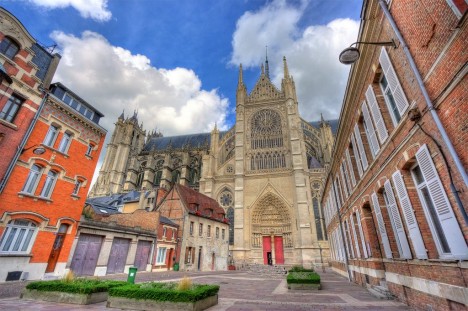
Amiens Cathedral / Maurice
The destruction and bombing of the city during the First and Second World War, miraculously didn’t destroyed the great Cathédrale de Notre-Dame, which is the main reason for visiting Amiens. It is a wonderful representative of the French Gothic style and it is also the highest cathedral in all of France. It stands on the place of the burnt Romanesque basilica. It was built between 1220 – 1236 and at that time it was the largest in France. The building is 145 meters long, 112 meters high. Arches inside the vault measured 42,3 meters. The cathedral was not built just to their astonishing height, but also as a place to be imposed on the head of John the Baptist brought from a failed crusade. The construction involved three architects, the most famous of them was Robert de Luzarches.
The city tour can proceed in the district St. Leu, which is the oldest and most attractive part of Amiens. It extends north from the cathedral and you can get into it through one of the bridges over the river Somme. You will find the narrow cobbled streets with flowers, restaurants, cafes, as well as antique markets and small art studios. The local squares are lined with canals, and therefore this area is often called Little Venice – La Petite Venice. If you will be tired, you can get into a boat and get a ride on the canal between the flowering gardens. The streets around the cathedral have beautifully renovated building, such as the medieval bell tower or a house, which houses the Museo de Picardie. This museum has a wide focus, you will find here something from each side, plus a few hidden archaeological pieces. Here you can see the works from the Roman period up to the 20th century, but excels mainly in the collection of French paintings and sculptures. Statues of glowing white marble from the 19th century are very charming, as well as works by Picasso and Balthus located on the second floor.
Another interesting museum is located in the building of the Hotel de Berny from 17th century.
One of the famous people that were born in Amiens was the writer Jules Verne (1828 – 1905), whose house Maison á la Tour you can visit here. Verne wrote a large part of his fantasy novels right here.
Other sights include the Perret tower standing next to the station from August Peretti, or a number of churches, such as Ste Jeanne d’Arc, St Acheul, Sainte Anne or Saint Firmin. In 1970, the University of Jules Verne was founded here in Amiens.
View Amiens – beautiful city in France and the birthplace of Jules Verne in a larger map
Have you explored the natural wonders and historic treasures described here? Share your favourite European travel memory in the comments below!
Explore all our France travel guides, from Parisian boulevards to Provence lavender.
Explore More
If you enjoyed this article, you might also like:
