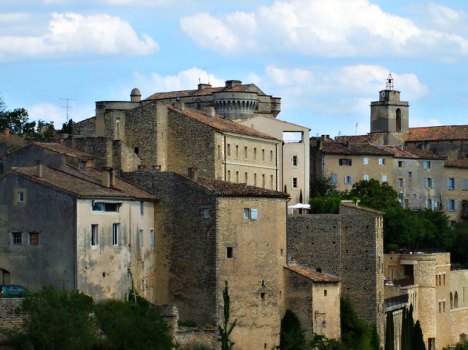
Gordes – one of the most beautiful villages in France

June 10, 2026 by europeexplored No Comments

The village clings to a limestone cliff 250 metres above the Coulon Valley. The houses are honey-coloured stone, stacked so tightly that one rooftop serves as the terrace for the house above. Gordes has been a Provence postcard since the 1950s, when artists and writers, including Marc Chagall and Victor Vasarely, settled here. The village is classified as one of “Les Plus Beaux Villages de France” and it earns the title through stone, light, and a position that controls the entire Luberon valley.

\n\n

The Castle at the Top

\n

The Chateau de Gordes, built between the 11th and 16th centuries, sits at the highest point of the village. The original fortress was built in 1031 by the Lords of Gordes. The current structure dates from 1525, rebuilt after the Wars of Religion by Bertrand de Simiane, who added the Renaissance windows and the grand staircase. The castle houses the Musee Pol Mara, a gallery of 20th century Flemish art, and the Vasarely Museum, dedicated to the optical art pioneer Victor Vasarely. The castle terrace overlooks the entire Provencal landscape, including the Luberon mountains and the Plateau de Vaucluse. Entry is 5 euros.

\n\n

The Village: Walking the Rueles

\n

The narrow streets, called rueles, are the original medieval lanes, some no wider than 1.5 metres. The Rue de la Comtesse leads from the castle to the Place du Chateau, the main square where the weekly market sets up every Tuesday morning. The Church of Saint-Firmin, built in the 18th century on the site of a 10th century Benedictine priory, contains a 17th century wooden statue of Saint Firmin. The village has roughly 2,000 permanent residents. In July and August, it receives over 5,000 visitors per day. The best time to walk the rueles without the crowds is at 8am, when the shop shutters are being raised and the only sound is brooms on stone.

\n\n

Abbaye Notre-Dame de Senanque: Cistercian Silence

\n

Four kilometres east of Gordes, the Abbaye Notre-Dame de Senanque sits at the base of a narrow valley. The abbey was founded in 1148 by Cistercian monks from Burgundy. The Romanesque church, the cloister, and the chapter house were built between 1170 and 1210. The abbey was closed during the French Revolution in 1789 and sold as a private property. In 1854, the Cistercians returned. The abbey’s lavender fields, which bloom from mid-June to mid-July, are the most photographed in Provence. The monks produce a lavender honey, lavender oil, and herbal teas sold in the gift shop. The entrance fee is 7.50 euros. The guided tour lasts 45 minutes.

\n\n

Was Gordes the Provence village you imagined, or did a smaller village in the Luberon leave a stronger impression on you?

\n


\n

Looking for more French travel inspiration? Check out our other guides to France and start planning your next European adventure!

On the hills of Provence, in the middle of the limestone mountains of Lubéron, you can find a picturesque French village of Gordes. It has quite a dramatic location on a rocky outcropping, which gives it an irresistible Provencal character. From Gordes you can also enjoy a wonderful view of the whole region. That’s one of the reasons why it is considered one of the most beautiful places in Provence.

\n

Gordes - one of the most beautiful villages in France
\nPhoto licensed under the Creative Commons, created by Christine Jewell

\n

The village is built around white rocky hills and has a terraced structure. This strategically advantageous location has been inhabited since prehistoric times. During the Roman occupation, Oppidum was built here and in the Middle Ages the local fort became a haven for people from far afield. The village has never been conquered, even during the bloody religious wars in the 16th century. The worst period for Gordes was the beginning of the 20th century, when many of its inhabitants moved to work out in industrial cities.

\n

The village has been finally saved from decline thanks to the modern art. In 1938 Gordes has been discovered by André Lhote – a French sculptor and painter, who invited here well-known artists such as Marc Chagall, Victor Vasarely and other involved in contemporary art. All of them spent a lot of time here, however their quiet creative period was interrupted by war. In 1944 the village was invaded by German troops, who wanted to revenge for the attack of the French resistance, and thus they destroyed more than a half of the village with its monuments. One monk from the nearby Sénanque monastery tried to intervene against this destruction, but he was killed.

\n

Gordes - one of the most beautiful villages in France
\nPhoto licensed under the Creative Commons, created by Giovanni

\n

Anyway the village managed to retain its ancient charm. Gordes is in fact a labyrinth of cobbled streets that are lined with beautiful houses. Many of them are souvenir shops, but also cafes and wine bars, where the more affluent tourists can enjoy the right muscat wine. All houses in the village were built of the traditional Provencal materials – stone and terracotta plate used on the roofs.

\n

At the highest point of the village there is a Renaissance castle, which was built on the site of the original medieval fortress. From the outside of the castle you can explore beautiful Renaissance windows. In the past, the only access to this point was through very steep, almost vertical stairs carved into the rock. The castle now houses a museum of contemporary French art. If you want to see the beautiful Renaissance fireplace in the main hall, you must purchase a ticket to the Musée Pol Mara. Pol Mara was an important Flemish artist.

\n

Gordes - one of the most beautiful villages in France
\nPhoto licensed under the Creative Commons, created by Thierry

\n

Not far away there is the Eglise Saint-Firmin Church from the 18th century. You can then proceed down the aisle Rue de l’Eglise, which will take you to the Rue du Belvédère – a lookout offering a spectacular view of the surroundings.

\n

The beauty of this place attracted famous people, film directors, painters, musicians and of course the crowds of tourists. However in the main summer season it is better to avoid it. The roads are usually totally congested and it is almost impossible to get here. The best time for a visit is spring or autumn.

\n

Near Gordes, you can visit Sénanque monastery, one of the three great Cistercian abbeys in Provence. It is well known for its Romanesque architecture and the cultivation of lavender.

\n

\n

\n\n

Explore More

\n

If you enjoyed this article, you might also like:

\n

\n

Tags: , , , , , , , , , , , , , , , , , , , , , , ,

Categories: France, Sights

Leave a Reply

Your email address will not be published. Required fields are marked *