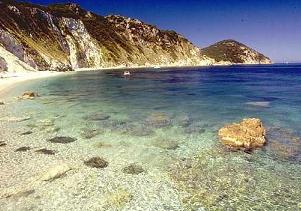
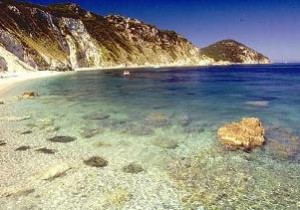
Elba is one of the most beautiful islands of Italy with crystal clear water. It is the third largest island of Italy – after Sicily and Sardinia. Its capital city is Portoferraio which is the largest city of Elba. The island is situated about 20km west from the Italian costal town of Piombino and about 50km east from French island of Corsica.
Elba is located between Liguria Sea and Tyrrhenian Sea and is often called as The Pearl of the Tuscan Archipelago.
Elba offers wonderful natural sceneries and beautiful mountains. Sandy beaches are very popular here and many tourists prefer to visit Portoferraio for its National Park activities. The island of Elba is about 150km long and covers the area of 224 km2. The Monte Cappane – the highest mountain on Elba (1019m) is very popular for hiking and it is also called “roof of the Tuscan Archipelago”.
In This Article
Exploring Elba’s Beaches and Coastal Gems
Elba’s coastline is a treasure trove of beaches, coves, and rocky inlets, each with its own character. The northern coast, sheltered from the prevailing winds, features long sandy beaches such as Biodola and Procchio, where the water is calm and crystal clear, perfect for families and swimmers. The southern coast is more rugged, with dramatic cliffs dropping into deep turquoise waters and small pebble beaches accessible only by boat or steep trails. Spiaggia di Fetovaia in the southwest is one of the most celebrated beaches on the island, with fine white sand and a backdrop of Mediterranean scrub. Cavoli Beach offers excellent snorkelling opportunities, with rocky outcrops teeming with marine life just metres from the shore. For those seeking solitude, the coves near Capo Bianco and the beaches of the Golfo di Marina di Campo provide quieter alternatives. The clear waters around Elba are part of the Tuscan Archipelago National Park, a protected marine area where fishing is regulated and the underwater ecosystem flourishes. Snorkellers and divers can explore sea grass meadows, rocky reefs, and even a few submerged Roman amphorae that attest to the island’s ancient maritime history.
Napoleon’s Legacy on Elba
No visit to Elba is complete without exploring the island’s most famous historical connection: the exile of Napoleon Bonaparte. After his abdication in 1814, Napoleon was granted sovereignty over Elba, and he spent ten months on the island before escaping to begin his Hundred Days campaign. During his stay, Napoleon resided in two residences: the Palazzina dei Mulini in Portoferraio, a modest but elegant townhouse, and the Villa San Martino, a more rural retreat set among olive groves and vineyards. The Palazzina dei Mulini has been preserved as a museum and contains original furnishings, Napoleon’s library, and personal effects that offer a glimpse into his daily life on the island. Villa San Martino, located about four kilometres from Portoferraio, served as his summer residence and was later expanded by his nephew into a neoclassical mansion. Visitors can see the famous “Salone Egizio,” an Egyptian-inspired hall decorated with frescoes and hieroglyphic motifs. Beyond the imperial residences, traces of Napoleon’s brief rule appear in Elba’s infrastructure, including new roads and agricultural reforms that improved the island’s economy.
Hiking Monte Capanne and Inland Adventures
The interior of Elba is dominated by Monte Capanne, the highest peak on the island at 1,019 metres above sea level. A cable car runs from Marciana to the summit, offering panoramic views that stretch across the entire Tuscan Archipelago to Corsica and the Italian mainland on clear days. For those who prefer to earn the view, hiking trails wind through chestnut forests and Mediterranean maquis, past granite outcrops and ancient hermitages. The trail from Poggio to the summit is one of the most popular, taking about two hours and passing through scented pine groves. The summit itself is a rocky plateau dotted with wildflowers in spring and early summer. Elba’s inland also harbours charming hilltop villages such as Capoliveri, Marciana Alta, and Rio nell’Elba, where narrow streets wind between stone houses and trattorias serve local specialities. The island’s cuisine reflects its maritime and agricultural heritage: fresh fish, anchovies, and octopus feature alongside wild boar, chestnuts, and the famous Elba Aleatico dessert wine. Many agriturismi offer cooking classes and wine tastings, making Elba as much a destination for food lovers as for beachgoers and hikers.
Since Portoferraio has the historical value, many scholars are doing research in the island. About thirty thousand people are living in this island and about eleven thousand persons are staying in Portoferraio city. On Elba you can find lots of monuments.
You can enjoy here the sunbathing, fishing, the pirate ship battle, hiking, visiting Napoleon’s palace (Napoleon was here in exile as governor), or even sitting in pubs and tasting excellent local cuisine.
Regular boat services are available from Piombino. Our tip is to rent a boat and discover the coast of Elba where you can find lots of unknown and empty wonderful beaches.
Tourists visiting Italy should not miss to visit Elba, as we think it is one of few places, which have to be visited, at least once in a life.
View Island of Elba – pearl of the Tuscan Archipelago in a larger map
Explore all our Italy travel guides, from the Dolomites to Sicily.
Explore More
If you enjoyed this article, you might also like:
