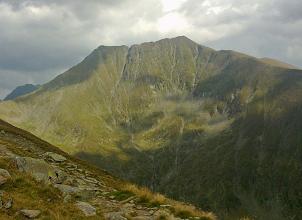
Moldoveanu Peak is the roof of Romania, at 2,544 metres it crowns the Făgăraș Mountains, the country’s highest and most dramatic range. Often called ‘the Transylvanian Alps’, the Făgăraș offer some of the most spectacular ridge hiking in Europe, with Moldoveanu as the ultimate prize for anyone seeking the peak of Romanian adventure travel.
In This Article
Quick Facts
- Best time to climb: July, September (snow-free trails and stable weather)
- height: 2,544 metres (8,346 feet), the highest point in Romania
- How to get there: ~3 hours from Bucharest to the trailhead at Bâlea Lac by car (via the Transfăgărășan highway)
- Climbing difficulty: Challenging, 8, 10 hours round trip from Bâlea Lac; some exposed ridge sections requiring sure-footedness
- Entry fee: Free (Făgăraș Mountains are open access)
Trekking to Moldoveanu
The most common approach starts from Bâlea Lac (2,034m), which can be reached dramatically via the Transfăgărășan highway, a winding alpine road that Top Gear once called “the best road in the world.” From the lake, the trail traverses the main Făgăraș ridge via several intermediate peaks, including the challenging scrambling section over Vistea Mare.
Moldoveanu sits about 5km off the main ridge and requires a dedicated approach. The summit itself is a surprisingly modest rocky knoll marked by a simple metal cross, but the 360-degree panorama, stretching from the Piatra Craiului massif in the south to the Carpathian peaks of Transylvania in the north, is unforgettable.
The Făgăraș wilderness is home to brown bears, wolves, and chamois. It’s not uncommon to spot chamois on the high ridges above the tree line.
Moldoveanu is the highest mountain of Romania located in Făgăraş Mountains in Transylvania.
Moldoveanu peak is 2544 m high. There are many hiking trails leading from the villages in the valley to the top of Moldoveanu, but they are mainly very steep. Therefore the most popular trail, however it is longer, leads over the Viştea Mare (2527m), by coming from Podragu, Sambata, or by the Vistea Valley.
From the top of Moldoveanu you can enjoy beautiful views of the Făgăraş Mountains and the valley. Below the peak there is a tourist lodge where you can sleep for free and take the water for the following hike.
Trekking Routes to the Summit
The most popular route to Moldoveanu Peak begins at Bâlea Lac, a glacial lake at 2,034 metres that is accessible via the famous Transfăgărășan highway. From the lake, the trail follows the main Făgăraș ridge eastward, passing over several intermediate peaks including Vistea Mare at 2,527 metres. This section of the ridge is one of the most spectacular in the Carpathians, with the trail hugging the crest and offering vertiginous views in both directions. The approach to Moldoveanu itself involves a detour south from the main ridge, adding approximately 5 kilometres to the round trip. The total journey from Bâlea Lac to Moldoveanu and back typically takes between 8 and 10 hours for fit hikers. Alternative routes start from the villages of Victoria or Cârțișoara on the northern side of the range, following valleys that ascend through forests and alpine meadows before reaching the ridge. These routes are longer and steeper but offer a more wilderness-oriented experience with fewer fellow hikers.
Wildlife and Natural environment
The Făgăraș Mountains represent one of Europe’s last remaining wilderness areas, and the region around Moldoveanu Peak is home to an impressive array of wildlife. Brown bears are present throughout the range, though they are rarely seen on the high ridges during daylight hours. Wolves and lynx also inhabit the forests at lower elevations, but sightings are extremely rare. The most commonly encountered large mammal is the chamois, which can often be spotted on the rocky slopes above the tree line, particularly in the early morning and late evening. Birdlife includes golden eagles, peregrine falcons, and the alpine chough, a distinctive black bird with a yellow beak that often approaches hikers looking for scraps. The alpine flora is equally remarkable, with hundreds of species adapted to the harsh conditions above 2,000 metres. Edelweiss, the iconic white alpine flower, can be found on rocky ledges, while gentians, saxifrages, and alpine asters carpet the meadows in summer. The fragile alpine ecosystem requires visitors to stay on marked trails and avoid disturbing the plant life.
Practical Advice for the Ascent
Climbing Moldoveanu Peak is a serious undertaking that requires proper preparation. The best months for the ascent are July through September, when the snow has melted and the weather is most stable. Even in summer, conditions can change rapidly, and warm sunny weather can give way to cold rain, fog, or even snow within hours. Essential equipment includes sturdy waterproof boots, warm layers, rain gear, plenty of water, food, a map, and a compass or GPS device. The trails are generally well marked with red and white paint stripes, but fog can reduce visibility to just a few metres, making navigation challenging. Several mountain huts along the main ridge provide basic shelter and water, but they are not staffed and offer only the most primitive facilities. Many hikers choose to break the ascent into two days, staying overnight at one of the huts or camping near the ridge. Acclimatisation to the altitude is recommended, as the summit at 2,544 metres can cause symptoms of altitude sickness in those who ascend too quickly from lower elevations.
View Moldoveanu Peak (2544m), the highest mountain of Romania in a larger map
Have you visited Moldoveanu Peak (2544m), the highest mountain of Romania? I’d love to hear about your experience and any travel tips in the comments below!
Discover more destinations in our sitemap or explore by destination.
Explore all our Romania travel guides, from Transylvania castles to the Danube Delta.
Explore More
If you enjoyed this article, you might also like:
