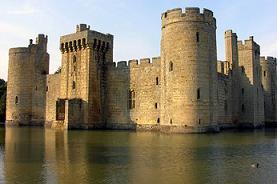

In the county of East Sussex in south-eastern part of England, you can find allegedly the most romantic place in the United Kingdom. It is a magnificent Bodiam castle from the 14th century, which is surrounded by the gleaming moat. Around it lies a beautiful green park inviting to walk, sit and picnic.
Bodiam castle is situated in the undulating countryside of southern England and was originally built as a protection against possible invasions of French during the The Hundred Years’ War. However French army has never come here. So today, more likely version is that the castle was built by Sussex Knight as his headquarters. The castle was inhabited until the 17th century, when it was during the civil war (which began in 1642), damaged in an attack by parliamentary troops. The roof has been destroyed which made it useless and non-recoverable. In 1664 thus became unoccupied and remained abandoned.
Fortunately, thanks to the sandstone, which was used as its building material, it has withstood the ravages of time and remained preserved until today. In 1919, Bodiam Castle was restored by Lord Curzon, who later gave it to the state.
Now the castle is open to the public and is one of the major attractions of the region. From the outside it looks perfectly intact and you will find also impressive interior remains which show you how the castle was equipped.
View Bodiam Castle – the most romantic place in the United Kingdom in a larger map
The Architecture and Defensive Design of Bodiam Castle
Bodiam Castle is a masterpiece of 14th-century military architecture, designed to impress as much as to defend. The castle follows a quadrangular plan, with four round corner towers connected by curtain walls that rise directly from the surrounding moat. The moat itself is one of the castle most distinctive features, measuring approximately 60 metres wide on each side and reflecting the stone walls so perfectly that the castle appears to float on water. The entrance is through a twin-towered gatehouse on the north side, protected by a drawbridge, portcullis, and murder holes through which defenders could drop stones or boiling oil on attackers. The towers contain multiple levels of living quarters, with the largest and most comfortable rooms reserved for the lord and his family in the south-eastern tower. The castle was equipped with latrines that emptied directly into the moat, a chapel on the first floor of the gatehouse, and a great hall that occupied the entire first floor of the south range. The kitchen was located in the north-eastern corner, with a vast fireplace measuring six metres across that could roast whole oxen for feasts. The battlements are decorated with machicolations, projecting stone galleries with floor openings that allowed defenders to drop missiles while remaining protected. Despite its formidable appearance, Bodiam Castle was built in a period when the Hundred Years War with France was ongoing, but the architecture served as much as a status symbol as a practical fortification, signalling the wealth and importance of its builder, Sir Edward Dalyngrigge.
The History and Restoration of Bodiam Castle
Sir Edward Dalyngrigge, a former knight of Edward III who had fought in France, received a licence to crenellate his existing manor house in 1385, a royal permission that effectively authorised the construction of a castle. The chosen site was a low-lying area near the River Rother, where a natural spring was dammed to create the broad moat that surrounds the castle. The Dalyngrigge family occupied the castle until the 15th century, after which it passed through marriage to the Lewknor family, who held it during the Wars of the Roses. During the English Civil War in the 1640s, the castle was held for the Royalist cause and was partially dismantled by Parliamentary forces after its capture, with the roof removed and the interior stripped of valuables. The castle remained roofless and abandoned for over 250 years, exposed to the elements, with vegetation growing from the walls and the moat silting up. In 1919, Lord Curzon, a former Viceroy of India and a passionate preservationist, purchased the castle and undertook a comprehensive restoration. His team cleared the moat, repaired the stonework, and stabilised the walls, ensuring that the castle would survive for future generations. Lord Curzon bequeathed Bodiam Castle to the National Trust upon his death in 1925, and the trust has maintained the property ever since, preserving it as a romantic ruin rather than attempting a full restoration of the interior. Today, the castle receives over 200,000 visitors annually and is one of the most photographed castles in England, particularly popular for picnics on the surrounding green lawns and walks through the adjoining woodland.
Explore all our United Kingdom travel guides, from London landmarks to the Scottish Highlands.
Explore More
If you enjoyed this article, you might also like:

Spot on with this guide. The best time to visit Bodiam Castle is early morning — we arrived at sunrise and had the place to ourselves. The light was incredible and by 10am the crowds started rolling in. Worth getting up early for.