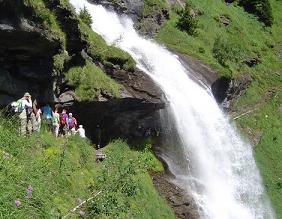
Walcher Waterfall (Walcher Wasserfall) is the highest waterfall in Austria, a dramatic series of cascades plunging over 500 metres in total drop down the steep eastern slopes of the Hohe Tauern National Park near the Grossglockner High Alpine Road. Fed by the Walcherbach stream, this multi-tiered giant thunders through a wild alpine gorge surrounded by the towering peaks of Austria’s highest mountain range, making it one of the most spectacular waterfall experiences in the Alps.
In This Article
The Three Main Cascades of Walcher Waterfall
Walcher Waterfall consists of three principal cascades with individual drops of approximately 50, 100, and 100 metres, separated by a series of smaller rapids and stepped cascades that together create a total descent of roughly 500 metres over a distance of 1,500 metres. The lowest and most accessible cascade is the one most visitors see first, as the trail leads to a viewing platform at its base where the spray creates rainbows on sunny days. The middle cascade is reached by a steeper section of the trail that climbs through a narrow gorge carved directly into the bedrock, offering dramatic views of the water plunging through the constricted channel.
The uppermost cascade is the most challenging to reach, requiring a sustained climb through alpine terrain, but the reward is a vantage point that looks down the entire length of the falls with the peaks of the Hohe Tauern range rising in the background. The volume of water varies dramatically with the seasons: late spring and early summer bring the most powerful flow as snowfields in the high mountains melt, while late summer and autumn reveal the intricate rock formations of the gorge that are hidden during the peak flow.
The Grossglockner High Alpine Road Experience
The Walcher Waterfall is ideally visited as part of a journey along the Grossglockner High Alpine Road, one of Europe’s most scenic drives. This 48-kilometre toll road winds through the heart of the Hohe Tauern National Park with 36 hairpin turns and views of Austria’s highest peak, the Grossglockner at 3,798 metres. The road climbs to 2,504 metres at the Edelweißspitze viewpoint and passes through dramatic alpine landscapes of glaciers, snowfields, and wildflower meadows. Driving the full road with stops at the Kaiser-Franz-Josefs-Höhe visitor centre, the glacier viewpoint, and the Walcher Waterfall trailhead can easily fill an entire day.
The toll for the Grossglockner High Alpine Road is approximately 40 euros for a standard car, but this fee grants access to the entire road network within the park, including all viewpoints, hiking trailheads, and visitor centres. The road is typically open from early May to late October, with exact dates depending on snow conditions. Electric and hybrid vehicles enjoy a reduced toll rate, and there are charging stations at the main visitor centres. The combination of the most scenic alpine drive in Austria with one of its most impressive waterfalls makes for an unforgettable alpine adventure.
Nearby Attractions in the Hohe Tauern National Park
Beyond Walcher Waterfall, the Hohe Tauern National Park offers a wealth of natural attractions. The Wildpark Ferleiten, located just a few kilometres from the waterfall trailhead, is a wildlife park where visitors can observe native alpine species including ibex, marmots, golden eagles, and the elusive lynx in naturalistic enclosures. The park is particularly popular with families, as the animals are accustomed to visitors and often approach the viewing platforms. Also nearby is the Kitzlochklamm Gorge, a dramatic limestone canyon with a series of waterfalls, suspension bridges, and a via ferrata route for adventurous hikers.
For those with more time, the village of Heiligenblut at the southern end of the Grossglockner Road is a picture-perfect alpine settlement dominated by the Gothic pilgrimage church of St. Vincent, whose distinctive onion-domed spire is one of the most photographed church towers in Austria. The village serves as the starting point for numerous hiking trails into the highest reaches of the park, including the route to the base of the Grossglockner glacier. Several mountain huts along the trails offer overnight accommodation and traditional Austrian cuisine, making multi-day hiking trips possible without carrying camping equipment.
Have you driven the Grossglockner High Alpine Road or hiked to Walcher Waterfall? Share your Austrian Alpine road trip experiences in the comments! ⛰️
Explore all our Austria travel guides, from Vienna coffeehouses to Alpine peaks.
Explore More
If you enjoyed this article, you might also like:

What a fantastic write-up. We followed your itinerary for Walcher Waterfall almost to the letter and it was one of the best travel experiences we have ever had. The balance of famous sights and hidden corners was perfect.