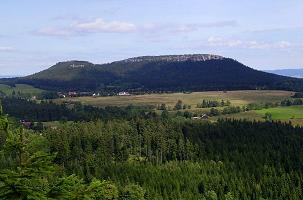
Góry Stołowe (Table Mountains) are one of Poland’s most unusual and photogenic landscapes, a sprawling natural park of flat-topped sandstone mountains, fantastical rock labyrinths, and deep forested gorges on the Czech border in Lower Silesia. Part of the Central Sudetes range and the only plate-structured mountains in Poland, the Table Mountains offer hiking through terrain that feels like nature’s own theme park: mushroom-shaped rocks, narrow slot canyons, and surreal eroded formations that have inspired legends for centuries.
In This Article
The Geology Behind the Table Mountains’ Unique Shape
The Table Mountains are the only mountains of their kind in Poland, formed from layers of sandstone deposited during the Cretaceous period when this region lay beneath a shallow sea. Over millions of years, tectonic uplift raised the seabed, and subsequent erosion carved the soft sandstone into the distinctive flat-topped plateaus and fantastical rock formations visible today. Unlike the typical sharp ridges of the adjacent Sudetes range, the Table Mountains resemble a giant staircase, with flat summits separated by steep escarpments. This unusual structure gives the range its name: “Stołowe” means “table” in Polish, and the flat summits do indeed resemble table tops rising above the surrounding forest.
The hardest sandstone layers formed protective caps over softer rock beneath, creating the mushroom-shaped formations known as “rock fungi” that dot the landscape. Erosion along vertical fractures produced the narrow slot canyons and labyrinths that make the Table Mountains a paradise for hikers. The most famous of these formations include the Wielbłąd (Camel Rock), the Małpa (Monkey Rock), and the Słoń (elephant Rock), each sculpted by millions of years of wind, water, and frost action into shapes that spark the imagination.
Szczeliniec Wielki and the Błędne Skały Labyrinth
The highest peak, Szczeliniec Wielki at 919 metres, is also the highest sandstone peak in Central Europe and the centrepiece of any visit to the Table Mountains. The ascent involves climbing 665 steps carved directly into the steep rock face, a challenging but rewarding climb that takes approximately 30 to 45 minutes. At the summit, a one-way loop trail winds through a surreal labyrinth of massive sandstone blocks, crevices, and narrow passages, with names like the Kitchen, the Organ, and the Pulpit reflecting the imaginative interpretations of early visitors. The summit plateau offers sweeping views across the entire Sudetes range, with the Czech Krkonoše Mountains visible on clear days and the distinctive shape of Mount Śnieżka on the horizon.
Equally impressive is the Błędne Skały, or Errant Rocks, a natural sandstone labyrinth located on the slopes of Szczeliniec. Unlike the summit plateau, the Błędne Skały is a maze of narrow corridors between towering rock walls, with passages so tight in places that only a single person can squeeze through. The experience of walking through these ancient rock corridors, where the walls rise 10 to 15 metres on either side and the only sound is your footsteps on the sandy floor, is genuinely atmospheric. The labyrinth can be explored on a 40-minute loop trail that requires no special equipment, though sturdy shoes and a head for tight spaces are recommended.
Seasonal Highlights and Border-Crossing Adventures
The Table Mountains National Park is beautiful in every season. Spring brings carpets of wildflowers, including rare orchids, to the forest floor. Summer offers the most reliable weather for hiking, with warm temperatures and long daylight hours that allow for extended exploration of the trail network. Autumn is arguably the most spectacular season, as the beech forests that cover the lower slopes turn brilliant shades of gold and copper, contrasting with the grey-white sandstone formations. Winter transforms the rock labyrinths into a frozen wonderland, and the park’s lower slopes offer excellent cross-country skiing trails, though the summit areas can be icy and require caution.
The Table Mountains straddle the Polish-Czech border, and several trails cross into Czech territory, connecting with the Broumovsko Protected Landscape Area on the Czech side. The Rock City (Skalne Miasto) trail on the Czech side offers a five-kilometre loop through equally impressive sandstone formations, often with fewer crowds than the Polish sections. The nearby spa towns of Kudowa-Zdrój and Polanica-Zdrój offer traditional health resorts, mineral water springs, and elegant 19th-century architecture, making them ideal bases for exploring the region. The area is well-served by hiking trails of varying difficulty, and the entire national park can be explored on well-marked routes suitable for families with children.
Have you explored Góry Stołowe or hiked the Errant Rocks labyrinth? Share your favourite Lower Silesia hiking trails in the comments! 🪨
Explore all our Poland travel guides, from Kraków square to the Tatra Mountains.
Explore More
If you enjoyed this article, you might also like:
