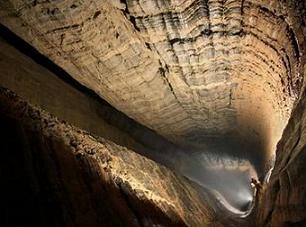
Plunging a staggering 1,733 metres into the Earth’s crust, Gouffre Mirolda is the deepest known cave in France and the third deepest on the planet. hidden beneath the Savoy Alps near the Swiss and Italian borders, this subterranean giant represents one of the most extraordinary feats of modern speleology, an extreme vertical labyrinth that few humans will ever see. While recreational access is strictly limited to experienced cavers, Gouffre Mirolda stands as a monument to the mysterious world beneath our feet.
In This Article
The Discovery and Exploration of Gouffre Mirolda
Gouffre Mirolda was first discovered in 1971 by members of the Groupe Spéléologique de Savoie, but it took nearly three decades of sustained effort to reach its deepest point. The breakthrough came in 1998, when a French-English expedition team descended to a depth of 1,626 metres after spending 103 hours underground, making it the deepest cave in the world at that time. Further explorations in January 2003 extended the known depth to 1,733 metres, securing its position as the deepest cave in France and the third deepest globally. The descent requires negotiating a series of vertical shafts connected by narrow passages, flooded sections, and unstable rock formations, making it one of the most technically demanding cave systems on Earth.
The name Mirolda combines the first letters of the names of four cavers involved in the original exploration: Michel, Roland, Daniel, and the expedition leader, whose names were immortalised in the cave’s designation. The cave system continues to yield new passages: in 2008, explorers discovered an additional 200 metres of galleries at the bottom of the system, and survey teams continue to map new connections that may extend the depth further.
Understanding the extreme Conditions
Descending into Gouffre Mirolda is not a casual undertaking. Expeditions typically last three to five days, with cavers carrying all their supplies, including food, water, sleeping bags, climbing equipment, and emergency medical gear, on their backs. The cave maintains a constant temperature of 4 to 6 degrees Celsius, and many passages are partially flooded, requiring wetsuits and dry bags. The vertical shafts range from 20 to over 100 metres in freefall, demanding expert ropework and familiarity with single-rope techniques. Cavers must be prepared for the psychological challenges of prolonged confinement in total darkness, as well as the physical demands of climbing back up the entire 1,733-metre ascent at the end of the expedition.
The cave’s geology is equally challenging. The limestone of the Savoy Alps is heavily fractured, and sections of the cave pass through unstable breakdown zones where large boulders are precariously balanced. Water flow can change rapidly after rain or snowmelt, turning dry passages into torrents within hours. Expedition teams maintain surface support and follow strict safety protocols, including phased communications and pre-arranged emergency rescue plans. Despite these precautions, Gouffre Mirolda has claimed no lives, a testament to the professionalism of the speleologists who explore it.
Accessible Alternatives for Cave Enthusiasts
While Gouffre Mirolda remains off-limits to recreational visitors, the French Alps offer numerous accessible show caves that provide a taste of the underground world. The Grotte de Choranche in the Vercors massif is famous for its soda-straw stalactites, thousands of needle-fine mineral formations that hang from the ceiling like a frozen chandelier. The Grotte de la Draye Blanche and the Grotte de Gournier in the same region offer guided tours through vast chambers decorated with glittering calcite formations. For a truly alpine cave experience, the Glacier Cave at the foot of the Mer de Glace near Chamonix allows visitors to walk inside an actual glacier, a reminder of the immense forces that have shaped the Alps.
Elsewhere in Europe, the Škocjan Caves in Slovenia offer a UNESCO-listed underground river canyon experience that rivals anything in France, with a footbridge suspended 45 metres above a roaring subterranean river. The Postojna Cave, also in Slovenia, combines a train ride through five kilometres of illuminated passages with some of the most spectacular stalagmite formations in the world. These accessible alternatives allow every visitor to appreciate the wonder of the underground world without the extreme commitment required by Gouffre Mirolda.
Are you fascinated by caves and underground adventures? Share your favourite cave experiences across Europe in the comments below, I’m always looking for new subterranean wonders to explore! 🦇
Explore all our France travel guides, from Parisian boulevards to Provence lavender.
Explore More
If you enjoyed this article, you might also like:
