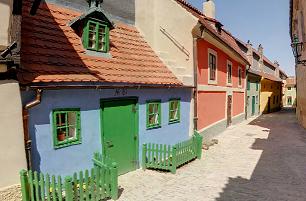
Zlatá ulička (Golden Lane) is the most romantic and famous part of Prague Castle, a tiny, impossibly picturesque street of miniature 16th-century houses built directly into the castle fortifications, originally home to the castle’s goldsmiths (hence the name), later to Kafka (who lived at number 22 in 1916-1917 and wrote much of his early work here), and now preserved as a museum of a medieval street that looks like it has been lifted from a fairy tale. The tiny, brightly coloured houses, each one a different hue, with low doorways and leaded windows, are now shops, exhibitions, and a museum of everyday life, and the street is one of the most photographed locations in Prague.
In This Article
The History and Architecture of Golden Lane
The Golden Lane was created after the construction of the northern ramparts of Prague Castle in the 16th century. The area of the northern moat was used to build modest homes for the castle’s servants, including goldsmiths, marksmen, and various artisans. The name Golden Lane derives from the goldsmiths who once worked here, though alternative theories suggest it may refer to the golden glow of the afternoon sun on the houses. The tiny houses, built directly into the archways of the castle fortifications, are the last surviving examples of small-scale medieval and Renaissance architecture within Prague Castle.
Each house is painted a different colour, creating the cheerful, fairy-tale appearance that makes the street so instantly recognisable. The houses were occupied until the Second World War, though the area was protected even then, and no changes that would alter the character of the street were permitted. The last residents moved out in 1948, leaving with protests despite being offered high-quality replacement housing. After a year of reconstruction, the street was reopened to the public on 1 June 2011, and today it stands as one of the most beloved attractions in Prague. The houses now contain shops selling traditional crafts, exhibitions of medieval armour and historical photography, and a museum of everyday castle life.
Franz Kafka and Practical Tips
The most famous resident of Golden Lane was Franz Kafka, who lived in house number 22 from 1916 to 1917. Kafka rented the tiny house as a writing retreat, escaping the noise of his family home in the Old Town. It was here that he wrote many of his early short stories and worked on The Trial. The house has been preserved as a museum dedicated to Kafka’s life and work, complete with original furnishings and displays of his writings, making it a pilgrimage site for literature lovers from around the world.
Golden Lane is included in the Prague Castle circuit B ticket, costing approximately 250 Czech koruna (about 10 euros), which also covers the Old Royal Palace, St. George’s basilica, and St. Vitus Cathedral. The best time to visit is in the late afternoon around 4 to 5 pm, when the crowds thin considerably. After the museum houses close at 5 pm, the lane itself remains open and visitors can walk through free of charge, providing excellent photo opportunities without the crowds. The lane can also be explored via a virtual tour at the Prague Castle website, which offers a unique night-time perspective of this enchanting street.
Nearby Attractions at Prague Castle
Golden Lane is just one of the many attractions within the vast Prague Castle complex, which is the largest ancient castle in the world according to the Guinness Book of Records. While visiting the lane, make sure to explore the rest of the castle grounds, including the magnificent St. Vitus Cathedral with its stunning stained glass windows and soaring Gothic arches, the Old Royal Palace with its impressive Vladislav Hall, and St. George’s basilica, one of the best-preserved Romanesque buildings in Prague. The castle complex also includes several beautiful gardens and courtyards that offer peaceful retreats from the crowds.
The castle’s eastern gate, which you will pass through after visiting Golden Lane, provides one of the best views over the Old Town of Prague, with its sea of red rooftops and church spires stretching to the horizon. The walk down from the castle to the Old Town via Nerudova Street is one of the most scenic walks in the city, passing beautiful historic buildings and offering glimpses of the castle behind you. For the complete Prague Castle experience, allow at least half a day to explore the complex thoroughly, and consider taking one of the guided tours that provide fascinating insights into the thousand-year history of this remarkable UNESCO World heritage site.
View Zlata ulicka (Golden Lane) – the most romantic and famous part of Prague Castle Czech Republic in a larger map
Have you visited Kafka’s house on Golden Lane or discovered Prague Castle’s fairy-tale street? Share your Golden Lane memories in the comments! 🏨
Explore all our Czech Republic travel guides, from Prague spires to Moravian wine country.
Explore More
If you enjoyed this article, you might also like:
- Jindřichův Hradec – unique Gothic and Renaissance town in Czech republic – Czech Republic
- Karlovy Vary – biggest spa town in the Czech Republic – Czech Republic
- Orlické hory – a mountain ideal for skiing and hiking in the Czech Republic – Czech Republic
