\n
\n
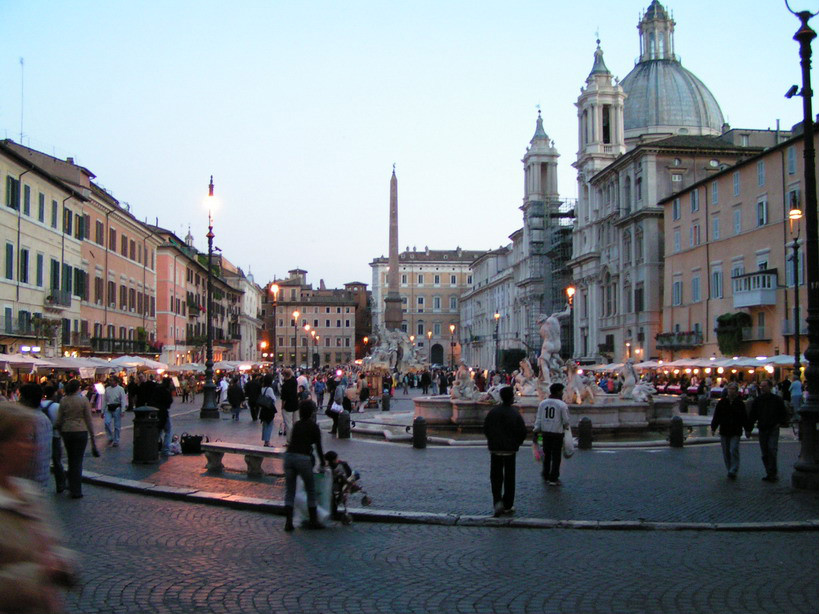
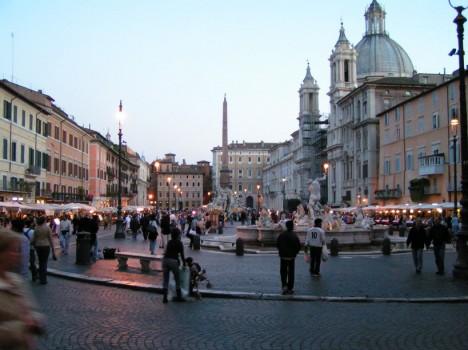
Piazza Navona in Rome is considered by many as the most beautiful square, not only in the capital of Italy, but throughout the world. This bustling area, having the shape of an ellipse, shows two thousand years old history of Rome to its visitors. It copies the original stadium Circus Agonalis, which was standing here in ancient times. Today, the piazza is a vibrant hub of street artists, restaurants, and Baroque masterpieces, drawing visitors from every corner of the globe. The sound of laughter and conversation fills the air from morning until late at night, mingling with the splash of the fountains.
\n\n
\nPiazza Navona, Rome | Italy / Photo by admin
\n
The stadium was inaugurated by the Emperor Domitian in the year of 86 on the occasion of the Games in the Greek style. At the time of its completion could carry up to 30,000 spectators. In 1377 the current Pope began with a large urban development of this area. Later in 1477, Pope Sixtus IV moved the Central Market here, which operated for 390 years long. Even today you can see the traditional Christmas markets with toys and Christmas decorations here.
\n
Square undergone the greatest change in 1644, when Pope Innocent X initiated an extensive program of turning the city into Baroque style. And it was nothing else than Piazza Navona that he took for his new family residence. His plan was to build up a fountain and the church, and it was done within the next ten years.
\n
Beautiful baroque square Piazza Navona is now a big tourist attraction, it is full of visitors during the day as well as night. In the shadow of the beautiful works of art you can sit for a cup of coffee, enjoy a glass of wine or enjoy some of Italian great specialities.
\n
\nFontana del Moro, Piazza Navona, Rome, Italy by Abir Anwar
\n
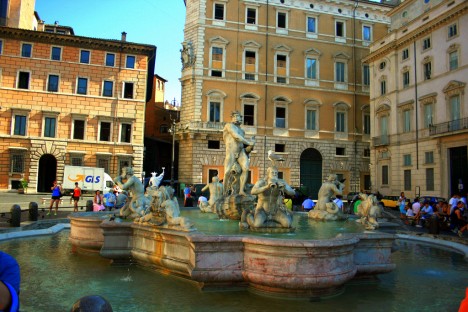
Among the most important monuments in the square include two magnificent fountains made by sculptor Bernini. At the southern end of the square is the Fontana del Moro (Fountain of the Moors), which construction started by Giacomo della Porta, but was finished by Bernini.
\n
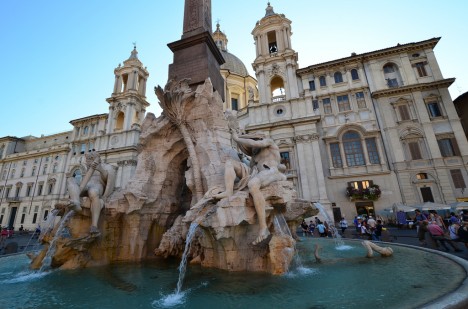
In the middle of the square you can see the Fontana dei Quattro Fiumi (Fountain of the Four Rivers), showing the four rivers, as symbols of the four continents known at that time. In each corner is a statue of the man, that represent four different rivers (Nile in Africa, Ganges in Asia, Danube in Europe and Rio de la Plata in America). The fountain was completed in 1651. In the northern part of the Piazza Navona is another smaller fountain – Fontana del Nettuno (Neptune fountain), which is another work of the sculptor Giacomo della Porta.
\n
\nFontana dei Quattro Fiumi, Piazza Navona, Rome, Italy by Ruben Charles
\n
A beautiful monument is also the Church of St. Agnes (Sant’Agnese in Agone) standing on the west side of the square. It was built on the place where the Saint Agnes was martyred. This only thirteen years old Christian girl was stripped naked on the square because she did not want to marry a pagan, the son of a Roman official. But according to the legend, a miracle happened as she prayed, her hair grew and covered her body.
\n
Agnes was, however, later in 304 AD, executed by Diocletian during the persecution of Christianity. The church now boasts facade from 1653, which is the work of Bernini’s big rival, Francesco Borromini.
\n
In the neighbourhood of the church is one of the many palaces of Innocent X, spacious Palazzo Pamphili with 1,000 rooms, which is currently occupied by the Brazilian embassy. In one part of the palace is private art collection of Pamphili family, which belonged to the most patrician families in medieval Rome. Pope Innocent X was an important member of this family.
\n
Piazza Navona is now a popular place for street artists and musicians, coming alive with tourists in the evening for a typical Italian night.
\n
The Three Fountains of Piazza Navona
\n
The three fountains form an extraordinary sculptural ensemble that defines the square. The central Fountain of the Four Rivers, designed by Bernini and completed in 1651, features four marble figures representing the Nile, the Ganges, the Danube, and the Rio de la Plata. The Nile figure veils his head because the source was unknown. The centre is crowned by an Egyptian obelisk honouring Emperor Domitian. At the southern end, the Fountain of the Moor depicts a figure wrestling a dolphin. At the northern end, the Neptune Fountain shows the sea god fighting an octopus.
\n
Sant’Agnese in Agone and Palazzo Pamphili
\n
The Church of Sant’Agnese in Agone stands on the west side of Piazza Navona, built on the site where Saint Agnes was martyred in 304 AD. The church was designed by Francesco Borromini, Bernini’s great rival, and his concave facade creates a dramatic sense of depth and movement. Inside, the dome rises 40 metres above the floor, decorated with frescoes. Adjacent to the church, the Palazzo Pamphili is a vast Baroque palace built for Pope Innocent X, with over 1,000 rooms. The palace now houses the Brazilian embassy, but the Galleria Pamphili, a private art collection open by appointment, includes works by Caravaggio, Raphael, and Titian. The combination of the church, the palace, and the three fountains makes Piazza Navona an open-air museum of Baroque art and architecture unrivaled anywhere in Rome.
\n\n
Which Roman piazza would you choose for an evening espresso? ☕
\n
Explore all our Italy travel guides, from the Dolomites to Sicily.
Explore More
If you enjoyed this article, you might also like:
