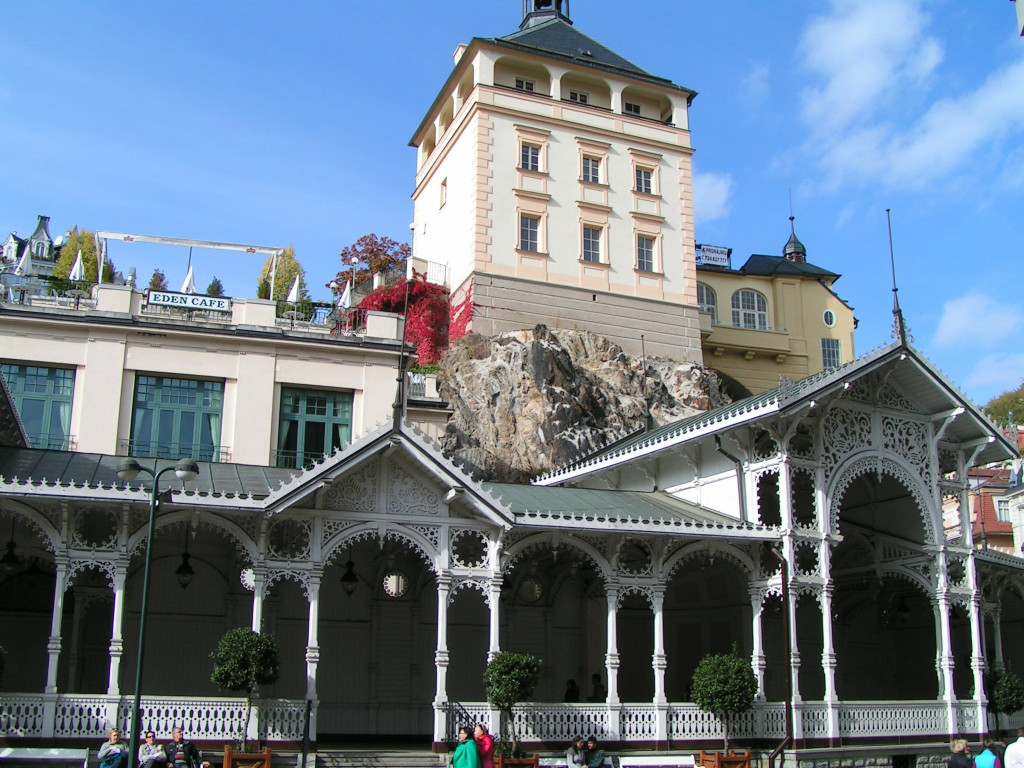
Hot mineral water rises from twelve springs at temperatures that steam in the cool mountain air, each one tasting of iron, sodium, or carbon dioxide. Karlovy Vary unfurls along the narrow valley of the Tepla River, its pastel colonnades and wrought-iron balconies evoking a century when the European aristocracy came here to drink the waters and waltz. Visitors carry porcelain cups embossed with spring scenes, sipping from the spouts as they promenade past the grand colonnades and the soaring Sprudel geyser. The air smells of spa wafers and rose perfume. Behind the ornate facades, massage tables and thermal baths await, offering the same cure that has drawn visitors for six hundred years.
The world-famous spa town of Karlovy Vary (known as Carlsbad in English) is situated about 120 km west of Prague near the German border. The uniqueness of Karlovy Vary is mainly in a spa treatment and the local mineral springs. But Spas is not the only asset of this city which is located in the heart of Europe.
Karlovy Vary, Czech Republic / Photo by admin
Karlovy Vary is also a city of festivals, conferences and seminars, meeting place of important people from the world of politics, science and culture. Since 1946, the year’s most prestigious film festival of the Czech Republic takes place here. It is the most important international film festival of category A in Central and Eastern Europe.
The Best of Karlovy Vary
The most famous concepts of Karlovy Vary certainly includes herbal liqueur Becherovka, Mattoni mineral water, Moser glass, spa wafers and Thun porcelain. Karlovy Vary is the biggest spa town in the Czech Republic and Elizabeth’s Spa (Alzbetiny lazne) is one of the largest spa facilities in the country. Spas in Karlovy Vary has more than 600-years old tradition, visited by guests from more than 80 countries. Mill Colonnade (Mlynska kolonada) is the best known and the most popular promenade.
Karlovy Vary, Czech Republic / Photo by admin
The best known source of natural healing is Carlsbad’s Hot Spring (karlovarske Vridlo). Beautiful view of the city you can enjoy from the observation tower Diana, which serves since 1914 and offers amazing views of the whole town of Karlovy Vary. You can get there on foot, or by a cable car.
The History of Spas
The spa town was founded in 1349 by Czech King and Roman Emperor Charles IV. The fame, the emergence and development of Carlsbad has been inseparably linked to the therapeutic effects of its warm mineral springs. Hot springs on the territory of today’s Karlovy Vary were used for healing long before the establishment of Karlovy Vary. However the first treatment was carried out at the end of the 14th century, when Charles IV bathed his ill feet in one of the mineral water springs.
Famous hot spring in Karlovy Vary, Czech Republic / Photo by admin
Spa enjoyed the favor of many noble families and wealthy burghers already in the 16th century. Due to a series of natural disasters from that time only a few buildings survived. The most devastating was the Carlsbad Fire (1604), when only 3 houses were saved. Therefore the majority of architectural monuments are from the 18th and 19th century, when the city experienced prosperity.
There are 13 mineral springs with temperatures ranging from 30 C to 72 C that are used for spa. The composition of mineral water is unique, as well as its unique beneficial effects on the human organism. It is used for drinking and bathing. Sources have the same mineral content, differing only in temperature and the amount of carbon dioxide.
Elizabeth’s Spa and Other Attractions
One of the most beautiful architectural landmarks of Karlovy Vary is Elizabeth’s Spa, located in the Smetana Park. The spa was founded in 1906 and named after Empress Elizabeth Sissi. Although it is located right in the heart of the city, the spas are an oasis of calm, which creates a park with a fountain.
The most important religious monument is the Church of St. Mary Magdalene made by the architect Kilian Dientzenhofer. The baroque church was built on the site of a former Gothic church. You cannot miss also the Orthodox Church of St. Peter and Paul from 1898, with its rich decoration and a relief of Tsar Peter the Great.
No visit is complete without tasting Becherovka at the Jan Becher Museum. First manufactured in 1807 by Jan Becher, the exact recipe remains a family secret known to only two people today. Besides walks on colonnades, you can explore 180 kilometers of forest trails surrounding the spa town, most named after famous guests.
