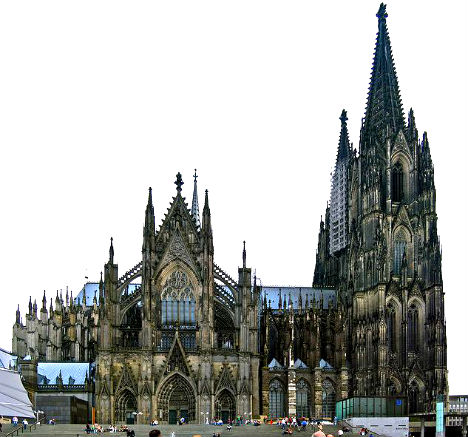
The twin spires of Cologne Cathedral rise 157 metres above the city, visible from the Rhine bridges long before you reach the old town. This Gothic masterpiece took 632 years to complete, from the laying of the foundation stone in 1248 to the final topping-out ceremony in 1880. The cathedral survived 14 bombing hits during the Second World War while the entire city around it was reduced to rubble. The structure leans slightly, 2.4 centimetres out of true at the top of the south tower, a tilt that engineers monitor constantly. The blackened stone of the exterior, stained by coal smoke and weather, gives the cathedral a brooding presence that contrasts with the bright interior lit by the largest stained-glass windows in Europe.
Close to the left bank of the River Rhine rises a massive construction of Cologne Cathedral (Kölner Dom). It is a Gothic cathedral built in the French style. It is a symbol of the city of Cologne and one of the largest cathedrals in Germany. More than a hundred columns support an extremely steep arch with the amount of colored light windows. The most valuable treasure is a magnificent reliquary of the Three Kings containing the relics of the Holy Three Kings. More than 500 steps leads to the South Tower, where you can enjoy a unique panoramic view of the city.
Photo licensed under the Creative Commons, created by Jannis Andrija Schnitzer
The cathedral was built over 600 years. Its eastern part with the chorus and part of the two towers were built in the year 1300. In the 15th century there was added the second floor to the south tower where was placed a bell. Towers were connected with the chorus through a long low building. Cathedral, as we know it today, was built in the 19th century of neo-Gothic style.
View Cologne Cathedral – one of the best-known architectural monuments in Germany in a larger map
Its official name is Hohen Dom zu Köln. The total length of the cathedral is 144.58 m, width is 86.25 m, and height of tower is 157 m. The median nave is 119 meters long and over 45 m wide, the higher one is the only cathedral in Beauvais, France (48.5 m). The church could accommodate 4,000 people and all windows cover an area of 10,000 m².
Everything that was newly built since 1842, was built according to the original medieval plans.
View Cologne Cathedral – one of the best-known architectural monuments in Germany in a larger map
In This Article
The Interior Treasures and Stained Glass
The interior of Cologne Cathedral is as impressive as its exterior, with a nave length of 144 metres and a height of 43 metres under the vaulted ceiling. The choir stalls, carved from oak between 1308 and 1311, are among the finest examples of Gothic woodcarving in Europe, with 104 seats decorated with biblical scenes and mythical creatures. The high altar, consecrated in 1322, is made from black marble and features a predella of the Adoration of the Magi carved in 1330. The Shrine of the Three Kings, located behind the high altar, is a gilded sarcophagus measuring 2.2 metres long and 1.5 metres wide, created by the goldsmith Nicholas of Verdun between 1190 and 1225. According to tradition, the shrine contains the relics of the three Magi, brought to Cologne from Milan by Emperor Frederick Barbarossa in 1164. The Gero Cross, carved from oak in the 10th century and dating to approximately 970, is the oldest surviving monumental crucifix north of the Alps, standing 1.88 metres tall. The stained-glass windows include the modern Bayeux window installed in 2007, a work of abstract art by the German artist Gerhard Richter composed of 11,500 squares of coloured glass in 72 colours, arranged randomly by computer algorithm. The window measures 19 metres by 9 metres and fills the south transept with a kaleidoscope of colour. The treasury museum beneath the cathedral displays liturgical objects including the silver-gilt monstrance of St Peter from the 14th century and the staff of St Peter, a 9th-century ivory carving.
Climbing the South Tower and Views
The south tower of Cologne Cathedral is open to visitors who are willing to climb the 533 spiral steps to the viewing platform at 97 metres. The climb takes approximately 15 to 20 minutes at a steady pace, passing through the bell chamber where St Peters Bell, the largest free-swinging bell in the world, hangs weighing 24 tonnes. The bell was cast in 1923 and rings only on major religious occasions. The viewing platform offers panoramic views across Cologne, the Rhine River, the Hohenzollern Bridge, and the surrounding region. On clear days, the view extends to the Bergisches Land hills to the east and the Eifel mountains to the southwest. Entry to the tower costs 5 euros for adults and includes access to the cathedral treasury. The tower closes during severe weather. The cathedral also offers guided audio tours in 12 languages, available at the information desk near the main entrance. The combined ticket for tower climb and treasury costs 8 euros. The cathedral crypt, the oldest surviving part of the structure, contains the remains of Roman and medieval bishops and displays archaeological finds from the site.
Practical Information and Nearby Attractions
Cologne Cathedral is located directly outside the Cologne Hauptbahnhof, the main railway station, making it one of the most accessible major landmarks in Europe. The cathedral is open daily from 6am to 7.30pm, with free admission to the main nave. The best time to visit is early morning before 10am or late afternoon after 4pm to avoid the largest crowds. The Roman-Germanic Museum, located adjacent to the cathedral, displays the Roman Dionysus mosaic discovered during the construction of an air-raid shelter in 1941, covering 70 square metres of floor space. The museum also exhibits Roman glassware, jewellery, and the largest collection of Roman funerary monuments north of the Alps. The Museum Ludwig, across the square, houses one of the most important collections of 20th-century art in Europe, including the third largest collection of Picassos works in the world. The Hohenzollern Bridge, the railway bridge crossing the Rhine next to the cathedral, is covered in love locks placed by couples, numbering over 500,000 as of 2026. The bridge offers the classic view of the cathedral that appears on postcards and travel guides. The Cologne Chocolate Museum, 1.5 kilometres south along the riverbank, traces the history of chocolate from the Aztecs to modern production. The Altstadt, the old town, is a 10-minute walk from the cathedral and offers traditional Brauhaus pubs serving Kolsch beer in 0.2-litre glasses.
Have you ever stood inside a Gothic cathedral and felt the weight of centuries above you? Which one left the strongest impression?
Explore all our Germany travel guides, from Berlin buzz to Bavaria castles.
Explore More
If you enjoyed this article, you might also like:
