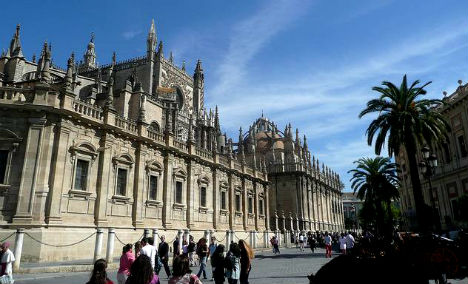
The builders of Seville Cathedral had a single ambition when they began construction in 1401. They declared that they would build a church so magnificent that future generations would call them mad. The result is the largest Gothic cathedral in the world and the third largest church of any kind, covering 11,520 square metres of floor space. The cathedral was built on the site of the Great Mosque of Seville, and the minaret was preserved and converted into the Giralda bell tower. The interior houses the largest altarpiece in Christendom, carved from 3.5 tonnes of gilded wood, and the tomb of Christopher Columbus is carried by four allegorical kings. The sheer scale overwhelms every visitor who steps through the doors.
Seville Cathedral, known also as The Cathedral of Saint Mary of the See (Catedral de Santa María de la Sede) was built on the site of the Grand Mosque, but its architect left the minaret serving as a belfry and the Patio de los Naranjos as unusual paradise garden. Construction of the Seville Cathedral began in 1402 in Gothic style according to the model of French cathedrals. It is the third largest cathedral in the world, just after St. Peter’s basilica in Vatican City, Rome, and basilica of the National Shrine of Our Lady of Aparecida in Brazil. It is 130 meters long, 76 meters wide, contains 140 massive supporting pillars and 93 huge windows, thousands of figures and statues of marble, iron, wood and stone. There are domes, altars and tombs.
Photo licensed under the Creative Commons, created by Tom Anderson
Five naves cathedral rises to a height of 36 meters and there are also 45 side chapels. Most important element in the interior is incredible golden altar Capilla Mayor containing the biggest altarpiece in the world. At its 220 m2 containing more than 1000 figures depicting the biblical history worked 26 artists.
View Seville Cathedral – the largest cathedral in Spain and 3rd largest in the world in a larger map
Its middle part was completed in 1521, side parts in the years 1550 to 1564. The altar consists of 45 paintings of the life of Christ and the Virgin Mary and is accompanied by paintings of the major Saints of Seville. Capilla Real (Royal Chapel) was built at the north-east corner in the years 1551 to 1575. There are tombs of prominent ruling figures of Seville like Alfonso X (King of Castile, León and Galicia) and his mother Beatrice of Swabia and Holy Roman Emperor Charles V and his mother. There is also a symbolic tomb of Christopher Columbus from Melide Arthur, which was moved here in 1899 from Havana. Patio de los Naranjos is the only paradise garden of the cathedral. In the middle of which you can find a fountain from Visigothic cathedral.
View Seville Cathedral – the largest cathedral in Spain and 3rd largest in the world in a larger map
In This Article
The Main Altarpiece and the Interior
The main altarpiece of Seville Cathedral, the Retablo Mayor, is a masterpiece of Gothic woodcarving that took 83 years to complete, from 1482 to 1565. The altarpiece contains 45 carved panels depicting scenes from the life of Christ and the Virgin Mary, each panel framed by intricately carved Gothic canopies and pinnacles. The work was created by a succession of master carvers including Pyeter Dancart, Jorge Fernandez, and Alejo Fernandez. The altarpiece reaches a height of 27 metres and a width of 18 metres, making it the largest in the Christian world. The choir stalls, carved in the 15th century, feature 117 seats decorated with biblical scenes and coats of arms. The vaulted ceiling rises to 37 metres above the nave, and the 45 stained-glass windows, mostly from the 16th century, fill the interior with coloured light. The cathedral houses over 80 chapels, each with its own altarpiece, paintings, and sculptures. The Chapter House contains a collection of paintings by Francisco de Zurbaran, Bartolome Esteban Murillo, and Francisco de Goya. The Sagrario, the parish church attached to the cathedral, is a Baroque structure completed in 1662 that serves as the main entrance for worshippers. The Patio de los Naranjos, the orange tree courtyard, survives from the original mosque and provides a shaded space where visitors can rest before entering.
The Giralda Tower and the Tomb of Columbus
The Giralda, the bell tower of Seville Cathedral, was originally the minaret of the Almohad mosque, built between 1184 and 1198. The tower rises to 104 metres and has a side length of 13.6 metres. Visitors ascend via 35 gentle ramps rather than stairs, designed so that the muezzin could ride a horse to the top to call the faithful to prayer. The ramps are wide enough for two people to walk side by side, and the total ascent distance inside the tower is approximately 600 metres. The Renaissance belfry at the top, added in 1568, houses 24 bells and is crowned by a bronze weathervane known as the Giraldillo, a figure of Faith holding a banner that weighs 1,200 kilograms. The views from the top extend across the entire city of Seville, the Guadalquivir River, and the surrounding countryside. The tomb of Christopher Columbus, placed in the cathedral in 1899, is carried by four allegorical figures representing the four kingdoms of Spain: Castile, Leon, Aragon, and Navarre. The tomb was originally intended for the Cathedral of Havana but was transferred to Seville after the Spanish-American War in 1898. The casket contains remains that DNA testing in 2006 confirmed with high probability to be those of Christopher Columbus. The monument was designed by the sculptor Arturo Melida and is one of the most visited features of the cathedral. The Royal Chapel, closed by a wrought-iron grille, contains the remains of King Ferdinand III of Castile, who conquered Seville from the Moors in 1248, and his son Alfonso X.
Planning Your Visit to Seville Cathedral
Seville Cathedral is open Monday to Saturday from 10.45am to 5pm and on Sundays from 2pm to 7pm, with reduced hours during religious services. Admission costs 11 euros for adults and includes access to the cathedral, the Giralda tower, and the Chapter House. Skip-the-line tickets, available online, cost 14 euros and save significant waiting time during peak season. The best time to visit is early morning when the cathedral opens, as queue lengths can exceed one hour by late morning. The cathedral is located in the centre of Seville, a 10-minute walk from the Alcazar palace and 15 minutes from the Plaza de Espana on the opposite bank of the Guadalquivir. Seville can be reached by high-speed AVE trains from Madrid in approximately two and a half hours. The city also has an international airport with connections to major European cities. Seville is famously hot in summer, with temperatures exceeding 40 degrees Celsius in July and August, making the air-conditioned cathedral interior welcome relief. The best months for visiting are March to May and October to November, when the weather is pleasant and the crowds are thinner. The nearby Barrio de Santa Cruz, the old Jewish quarter, offers narrow streets lined with orange trees, tapas bars, and whitewashed houses with flower-filled courtyards. The Feria de Abril, Seville April Fair, is one of the most important festivals in Spain, with flamenco dancing, bullfights, and horse parades filling the city for a full week.
Which European cathedral has made you feel the smallest and the most inspired? Tell us about it.
Explore all our Spain travel guides, from Barcelona Gaudí to Andalusia plazas.
Explore More
If you enjoyed this article, you might also like:
