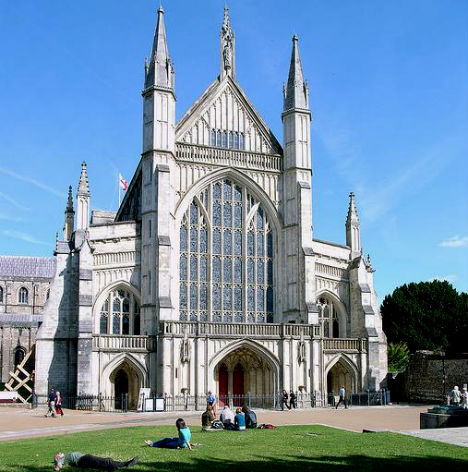
The longest Gothic cathedral in Europe stretches over 170 metres from its west front to the eastern Lady Chapel, a testament to the ambition and faith of its medieval builders. Winchester Cathedral is one of the greatest churches in the world, a repository of over a thousand years of English history. It was here that William the Conqueror was crowned King of England in 1066, and it is here that the mortal remains of Saint Swithun, the Saxon bishop, have rested since the 10th century. The cathedral has witnessed coronations, royal weddings, and the dissolution of the monasteries, and its walls bear the scars and additions of every century since the Norman Conquest.
In This Article
The magnificent Interior
Stepping inside Winchester Cathedral is an overwhelming experience. The nave, with its soaring rib-vaulted ceiling and massive Norman columns, is the longest medieval nave in Europe at 77 metres. The stained glass, much of which was destroyed during the English Civil War and painstakingly reassembled in the 17th century, fills the vast space with coloured light. The 14th-century wooden choir stalls are carved with exquisite misericords, depicting everything from mythical beasts to scenes of daily medieval life. The floor of the presbytery is paved with Cosmati mosaic, a rare Italian technique that adds a note of Mediterranean colour to the otherwise restrained English Gothic interior. The retrochoir, built in the Perpendicular Gothic style, contains the shrine of Saint Swithun, once one of the most important pilgrimage sites in medieval England.
The Winchester Bible and the Library
The cathedral’s library houses one of the greatest treasures of medieval manuscript illumination: the Winchester Bible, created in the 12th century. This magnificent illuminated manuscript, comprising 468 vellum leaves, was produced in the cathedral’s scriptorium by a team of scribes and artists. The initials are decorated with intricate designs in gold leaf and vibrant pigments, many of which remain as bright today as when they were painted over 800 years ago. The library also contains over 8,000 other books and manuscripts, including a rare copy of the Magna Carta and the earliest known map of the British Isles. The library is open to visitors during limited hours, and a small exhibition tells the story of the Bible’s creation and the scribes who laboured over it.
Jane Austen and Practical Information
Jane Austen, one of England’s most beloved novelists, died in Winchester in 1817 and is buried in the north aisle of the cathedral. Her simple gravestone makes no mention of her literary achievements, which were only recognised posthumously. A memorial window installed in 1900 pays a more fitting tribute, and her house in the nearby village of Chawton is now a museum dedicated to her life and work. The cathedral is located in the heart of Winchester, a historic city that was the capital of England under King Alfred the Great. Regular trains from London Waterloo reach Winchester in just over an hour. Admission to the cathedral costs approximately 10 pounds for adults, and guided tours are available throughout the day. The best time to visit is during the spring or autumn months when the choir is in residence and the daily evensong service fills the nave with music.
Have you walked the length of Winchester Cathedral’s nave and felt the weight of a thousand years of English history? What detail of this magnificent building caught your eye?
>
A History Written in Stone
Winchester Cathedral stands on ground that has been a Christian worship site for over 1,800 years. According to historical records, a church was built here as early as AD 164, when Lucius, the king of the Britons, converted to Christianity. This makes Winchester one of the oldest continuous Christian sites in England, predating Canterbury by several centuries and giving it a profound sense of historical continuity that few other buildings in the country can match.
The present building was begun in 1079 under Bishop Walkelin, shortly after the Norman Conquest. Constructed in the Romanesque style, it was designed to impress both the native Saxons and visiting dignitaries with the authority of the new Norman rulers. Over the following centuries, the cathedral was expanded and modified, with the addition of Perpendicular Gothic vaulting, elaborate chapels, and the magnificent great west window. The building measures 170 metres in length, making it the longest medieval cathedral in Europe.
The Legacy of Saint Swithin
The most famous figure associated with Winchester Cathedral is Saint Swithin, who served as bishop from 852 to 862. Known for his humility and generosity toward the poor, he requested to be buried outside the cathedral where rain could fall on his grave and passersby could walk over him. When his remains were moved inside in 971, a heavy storm allegedly struck, giving rise to the legend that rain on Saint Swithin Day (15 July) means forty more days of wet weather.
Saint Swithin shrine once drew pilgrims from across Europe. Though the original shrine was destroyed during the Reformation, a modern memorial marks its location behind the high altar. The cathedral also houses the tombs of several English monarchs, including King William II, and the writer Jane Austen, who lived in Winchester and died there in 1817.
Architectural Highlights You Cannot Miss
The cathedral interior is a study in architectural evolution. The sturdy Norman columns of the nave support soaring Gothic rib vaults added in the 14th century. The elaborate choir stalls feature intricate misericords carved with medieval scenes ranging from biblical stories to everyday life. The retrochoir, completed in the 15th century, is a masterpiece of late Gothic design with its fan vaulting and large windows that flood the space with light.
Look for the magnificent 12th-century Winchester Bible, displayed in the library. This illuminated manuscript, produced in the cathedral own scriptorium, is one of the finest examples of Romanesque book artistry in existence. The library also houses a collection of medieval manuscripts and early printed books that span over 800 years of scholarship.
Planning Your Visit to Winchester Cathedral
The cathedral is located in central Winchester, a short walk from the railway station. It is open daily for sightseeing, with guided tours available that explain the building rich history and architectural features. Admission fees help support the ongoing conservation of this historic structure. Check the cathedral official website for current opening times and special event schedules.
Allow at least two hours to explore the interior, including the crypt, the chapels, and the surrounding Close. The nearby Winchester City Museum and the ruins of Wolvesey Castle provide additional context about the city Anglo-Saxon and medieval heritage. The cathedral shop offers a selection of books, souvenirs, and locally produced gifts.
Have you experienced the quiet majesty of Winchester Cathedral on your travels through southern England?
Explore all our United Kingdom travel guides, from London landmarks to the Scottish Highlands.
Explore More
If you enjoyed this article, you might also like:
- A Weekend in Cool Brighton – United Kingdom
- Moving to London? Here are Four of the Finest Neighbourhoods – United Kingdom
- Britain’s Best Winter Gardens and Nature Escapes – United Kingdom
