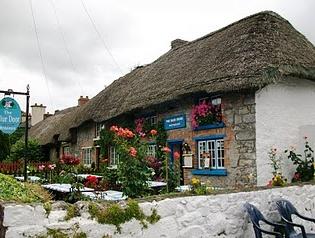
Thatched roofs curve like golden crowns over whitewashed cottages as you stroll through Adare, a village so perfectly picturesque it feels like stepping into a postcard. Clusters of wildflowers spill from window boxes while the River Maigue winds gently through the village centre. Medieval ruins stand alongside beautifully preserved thatched homes, creating a layered landscape of Irish history visible at every turn. The village green stretches out beneath ancient oak trees, inviting quiet contemplation. Adare has earned its reputation as Ireland’s most beautiful village through the quiet charm of its everyday details.
Adare is regarded as being the most beautiful village in the whole Ireland. It is located in the western part of the country on the banks of the River Maigue, about 20 km from the city of Limerick. Today, it has approx. 2,000 residents.
Historical monuments
Adare is a quaint village that inspires everyone. Its main street is surrounded by a neat stone buildings with beautiful thatched roofs. There are also some preserved remains of religious buildings such as Trinity Church and two abbeys. Above the bridge over the river you can see the remains of the Desmond castle from the 13th century.
Tourist services and entertainment
Adare has very good, though not too wide range of accommodation and in total there are 9 restaurants. The village is suitable also for golf players as there is an internationally known golf course Adare Golf. Those who would like to relax can visit the local park.
View Adare – the most beautiful village in Ireland in a larger map
The most important event in the village is Adare Village Festival. It takes place at the beginning of July. During the festival you can enjoy musical performances and taste of Irish specialties. It includes also a program for children, live music, theatre, food and craft markets, art and heritage exhibitions.
History
Adare is an ancient village, and experienced its biggest boom in the Middle Ages, when it was an important market place. It boasted three monasteries and already mentioned Desmond Castle.
Adare won the first place in national Irish Tidy Towns Competition in 1976.
View Adare – the most beautiful village in Ireland in a larger map
In This Article
The History and Architecture of Adare Village
Adare traces its origins to the early medieval period, when a settlement grew around a crossing point on the River Maigue. The village experienced its golden age in the Middle Ages, serving as an important market town where local farmers traded livestock, grain, and textiles. The Desmond Castle, built in the 13th century by the Earls of Desmond, controlled the river crossing and defended the surrounding lands. Today only fragments of the castle remain, including parts of the curtain wall and a tower, but they provide a striking silhouette against the sky when viewed from the bridge. The thatched cottages that give Adare its distinctive character date largely from the 19th century, when the Earl of Dunraven undertook a comprehensive village improvement scheme. He commissioned local builders to construct homes in a vernacular style with steeply pitched roofs of wheat straw or reed thatch, colour-washed lime render walls, and small-paned windows set in painted frames. Each cottage was designed with slight variations in roofline and window placement, creating a harmonious but not uniform streetscape that feels organic rather than manufactured. The thatching tradition is maintained by a small number of skilled craftsmen who use traditional techniques passed down through generations, replacing sections of roof every 15 to 20 years using locally grown materials.
The Abbeys and Adare Manor
Adare is remarkable for having three medieval abbeys within its boundaries, a concentration unusual for a village of its size. The Trinitarian Abbey, founded in 1230 by the Order of the Most Holy Trinity, is the oldest and was used for the ransom of Christian captives taken during the Crusades. After the dissolution of the monasteries in the 16th century, the abbey church was adapted for use as the local Church of Ireland parish church, which it remains today. The Augustinian Priory, established in 1315, occupies a riverside setting and retains its original Gothic windows and a beautifully carved sedilia. The Franciscan Friary, built in 1464, is the most complete ruin, with its bell tower, cloister arcade, and church nave still standing. Adare Manor, a Gothic Revival mansion built between 1832 and 1862 for the Earl of Dunraven, sits on 840 acres of parkland landscaped to include a lake, walled garden, and extensive woodland walks. The manor was designed by James Pain and later extended by the architect Philip Charles Hardwick, featuring crenellated towers, oriel windows, and intricate stone carving. The interior includes a magnificent great hall with a hammerbeam roof, a library with over 10,000 volumes, and a dining room that can seat 80 guests. Since 1987, the manor has operated as a five-star hotel and golf resort, with the Adare Golf Club hosting the Irish Open in 2007 and 2008.
Adare Village and Surrounding Attractions
Adare thatched cottages date from the 19th century when the Earl of Dunraven redesigned the village in a picturesque style. The Adare Manor, a Gothic Revival mansion now a luxury hotel, sits in 840 acres of parkland. The village has three abbeys: the Trinitarian Abbey (13th century), the Franciscan Friary (15th century), and the Augustinian Priory (14th century), all within walking distance. The Adare heritage Centre provides historical exhibits and guided walking tours. Bunratty Castle and Folk Park, a 30-minute drive, offers a restored 15th-century tower house and a living history village.
Does a thatched cottage village appeal more to you than a bustling city break? 🏡
Explore all our Ireland travel guides, from Dublin pubs to the Wild Atlantic Way.
Explore More
If you enjoyed this article, you might also like:
- Aran Islands – Experience the Real Ireland – Ireland
- Ireland: Touring By Car – Ireland
- Outdoor Activities In West Ireland This Summer – Ireland
