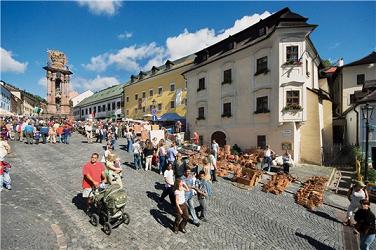
In the heart of Slovakia lies a town built on silver and gold. Banská Štiavnica was once the richest mining centre in the Kingdom of Hungary, and its wealth is written in the architecture. Renaissance houses line narrow cobblestone streets. The Holy Trinity Square opens like a grand courtyard framed by a plague column and pastel facades. Artificial lakes called tajchy dot the surrounding hills, built centuries ago to power the mines with hydraulic energy. The old town glows warm in the afternoon light. Every corner hides a doorway that leads underground into tunnels that funded empires.
One of Slovak sights which are included in UNESCO World heritage List is a town of Banská Štiavnica, lying in the valley of Štiavnica Hills. Its growth and wealth are linked to the mining industry, mainly in the mining of silver and gold. Evidence of this is the city’s coat of arms, fortifications and mining tools.
The history of Banská Štiavnica has deep roots. Precious metals were mined here as early as ancient times, when Celts settled the area. The first written evidence of mining dates back to 1217. In 1238 Banská Štiavnica got the privilege of royal city, and already at that time there were two basilicas. From then until the 18th century the city and surrounding areas belonged to the most productive mining areas of silver and gold in Europe. The peak was reached in 1690, when it produced a total of 29 tons of silver and 605 kg of gold. Similar results also brought the year 1740 with 23 tons of silver and 600 kg of gold. However the worst years were 1442-43, when the city was attacked by troops of Bishop Šimon Rozgoň and was also damaged by a strong earthquake.
In This Article
The Tajchy: An Ingenious System of Artificial Lakes
Traces of mining we can find also in the surrounding countryside. There arose an interesting system of artificial lakes and canals used for drainage down and moving various devices. About 60 water tanks are now used primarily for recreation. Although ponds were created artificially, they fit remarkably well into the landscape. These reservoirs, known locally as tajchy, were a remarkable feat of hydraulic engineering built between the 15th and 18th centuries. They collected rainwater and snowmelt from the surrounding hills and channeled it through a sophisticated network of canals and tunnels to power water wheels and stamp mills in the mines below. The system was so advanced for its time that it attracted engineers from across Europe who came to study its design. Today, many of the tajchy have been restored and are used for swimming, fishing, and boating during the summer months. The largest among them, such as the Richňavské tajchy and the Hodrušské tajchy, are popular recreational spots that offer beautiful walking trails around their shores. The sight of these serene artificial lakes nestled among the forested hills serves as a peaceful reminder of the ingenuity of the generations who built them.
The World’s First Mining Academy
In addition to architecture and culture Banská Štiavnica was a place of developing science, technology and education. In 1762 there was established Mining Academy, which became the first technically-oriented school in the world. To the mining was added later also forestry. Academy Buildings have been preserved until today. The Mining Academy attracted students from across Europe and beyond, including future leaders of the industrial revolution who came to learn the latest techniques in mining engineering, metallurgy, and geology. The curriculum was remarkably comprehensive, covering everything from mineralogy and chemistry to mine surveying and machinery design. The academy’s library still houses an impressive collection of historic mining texts and maps that document centuries of technological progress. Visitors can tour the preserved academy buildings, which include lecture halls, laboratories, and a mineralogical collection that displays samples from the region’s legendary mines. The legacy of the academy continues today, as the town remains a centre for mining education and research, with modern institutions building on the foundations laid more than 250 years ago.
Exploring the historic Town Centre
The city centre is full of churches and public buildings, but also rich houses of miners, merchants and craftsmen. The urban protected area, the original historic core of the city, now includes 360 buildings. Major attractions include the Plaza of St. Trinity with the plague column, rich townsmen houses, town hall and the church of St. Catherine, Kammerhof, the Church of the Assumption of the Virgin Mary, Old and New Castle, Piargská gateway etc. The Old Castle, originally a Gothic town castle, now houses the Slovak Mining Museum, which offers an excellent introduction to the region’s mining history. The New Castle, built in the 16th century as a watchtower against Ottoman incursions, provides panoramic views over the town and the surrounding hills. The surrounding Štiavnica Hills offer many interesting and outstanding tours with rich flora and fauna. Several marked hiking trails lead from the town centre into the forests and up to viewpoints that overlook the entire region. The town also hosts cultural events throughout the year, including the popular Banská Štiavnica Gold Festival and the Salamander Days, which celebrate the town’s mining heritage with parades, music, and traditional crafts.
View Banská Štiavnica in a larger map
Which hidden town surprised you with its history and beauty? 💰
Explore all our Slovakia travel guides, from the High Tatras to Bratislava charm.
Explore More
If you enjoyed this article, you might also like:
