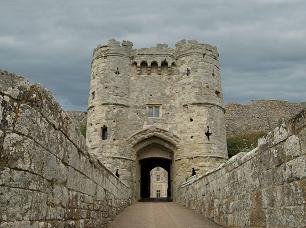
The heavy iron gate groans as it swings open, echoing through centuries of English history within Carisbrooke Castle’s walls. This formidable Norman fortress on the Isle of Wight holds a singular distinction: it served as the prison of King Charles I during the final months before his execution. Walking the battlements where a king once paced in confinement, you can feel the weight of his despair. The well house, where donkeys draw water in a wooden wheel, connects you to daily life in medieval times. Every stone tells a story of royalty, rebellion, and power.
Carisbrooke Castle is situated on the outskirts of Newport, Isle of Wight in England. Castle, which history is more than a thousand years old, offers an unforgettable experience in the form of preserved buildings, interesting museums and inspiring gardens.
In This Article
A Thousand Years of Fortification and Royal History
Carisbrooke Castle’s history stretches back to the Saxon period, when a simple fortification occupied the strategic hilltop. Archaeological excavations have uncovered remnants of a Roman-style building from the 3rd century, indicating the site’s military importance long before the Norman conquest. In the 10th century, the Anglo-Saxons built a defensive wall to protect against Viking raids. After 1066, the Normans recognised the tactical value of the location and constructed a stone keep on the central mound, replacing the earlier wooden defences. Over the following centuries, each generation of owners added to the castle’s strength. The Redvers family held the castle for much of the medieval period, extending the walls and building the residential quarters. Countess Isabella, the last Redvers descendant, sold the castle to King Edward I in 1293, bringing it under royal ownership. The constant threat of French and Spanish invasions throughout the Tudor period drove further fortification, culminating in the completion of a powerful artillery bastion in 1601. Remarkably, despite all these defensive preparations, the castle never faced a direct assault, which explains why it was repurposed as a prison for high-value captives.
Carisbrooke Castle is located in a strategically advantageous small hill. In the castle grounds were found remnants of a building of 3rd century, which had Roman style. In the 10th century, the fortification was built around the hills to protect from attacks of the Vikings. In the 11th century, the Normans used this fortification and built a strong castle. Over the next few centuries, the castle was extended and gradually grew.
The last descendant of the Redvers family, Countess Isabella, sold the Carisbrooke Castle to King Edward I in 1293, and so the castle became a royal property. The constant fear of French or Spanish invasions forced more and more owners to build more and more stronger castle. In 1601, a strong fortification has been completed. But there was never any assault occurred at Carisbrooke. Therefore, the castle was used as prison. The most famous prisoner was King Charles I, who was imprisoned for nearly a year here, and at least twice he tried to escape. Charles I was finally executed in London on the 30th January 1649.
King Charles I and His Failed Escape Attempts
The imprisonment of King Charles I at Carisbrooke Castle is the most dramatic chapter in the fortress’s long history. Charles arrived in November 1647, having been handed over to the English Parliament by the Scottish army. He was housed in comfortable apartments within the castle, but his freedom was severely restricted. The king made two determined escape attempts. The first involved attempting to squeeze through the bars of his bedroom window, a plan that failed because his shoulders became stuck. The second was more elaborate: he planned to lower himself from the window using a rope, with accomplices waiting outside the castle walls. Unfortunately for Charles, the rope was too short, and the guards discovered the plot. After the second failed attempt, his confinement was tightened, and he was kept under constant watch. He remained at Carisbrooke until September 1648, when he was transferred to Hurst Castle and ultimately to London for trial and execution. Visitors today can see his former rooms and the window through which he attempted his escape, preserved as they were in the 17th century.
The Castle Museum and Donkey Wheel
Carisbrooke Castle museum displays English Civil War exhibits including King Charles I embroidered waistcoat and silver writing set. The well house features a working donkey wheel, with demonstrations running daily in summer. The castle walls offer a complete circuit with views across the Isle of Wight. Entry costs 12 pounds. The castle bowling green is maintained in its original 17th-century layout. The Isle of Wight ferry from Portsmouth takes 40 minutes, return fares from 25 pounds.
Carisbrooke Castle was the seat of governor of the island until 1944.
Today the castle houses an exhibition on the history of the Isle of Wight. Museum was first opened in 1898 by Princess Beatrice, who was the youngest daughter of Queen Victoria. Her husband became governor of the island, and after his death, Beatrice took over this function. She opened the museum in memory of her husband. The first exhibition was dedicated to King Charles I. In the 20 century, the collection gradually grew to archaeological finds on the island and another, mainly medieval artifacts. Visitors will love the beautiful and colorful garden of Princess Beatrice. In 2009 a garden was restored.
Donkeys at the castle
For hundreds of years, donkeys helped get water to the Carisbrooke Castle, so you can also see the demonstrations of the donkeys at work here.
View Carisbrooke Castle – the place where King Charles I was imprisoned United Kingdom in a larger map
Would you visit the cell where a king was imprisoned before his execution? 👑
Explore all our United Kingdom travel guides, from London landmarks to the Scottish Highlands.
Explore More
If you enjoyed this article, you might also like:
