Chalk dust lingers in the air as you tighten your harness beneath a limestone cliff, the river roaring far below. Europe offers climbers a continent-wide playground spanning granite slabs in the Alps, sandstone towers in Saxon Switzerland, and overhanging limestone caves in Mallorca. Each crag has its own character: the rough gneiss of the Mont Blanc massif, the bullet-hard limestone of Kalymnos, the friction-perfect gritstone of the Peak District.
It is a little unfair to list climbing highlights in Europe, as other equally great destinations will be left out, but here is just a sample of the best places that you can climb in Europe. However this time we are going slightly beyond the boundaries of EU.
Photo licensed under the Creative Commons, created by Jason Blue-Smith
In This Article
Mount Elbrus and the Matterhorn: Iconic Summits
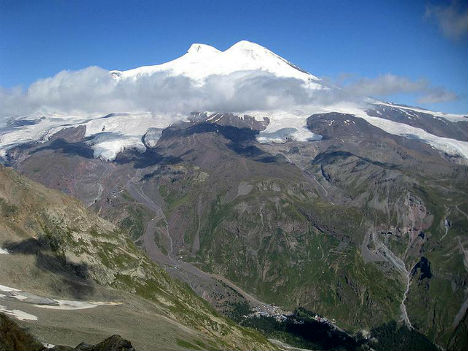
Mount Elbrus (5,642 m) is in the Caucasus Mountains in Russia. It is the highest mountain in Europe, and has more than one summit. For less experienced climbers there is the advantage of lift and cable chairs that take you up to 3,800 metres. If you have got reasonable climbing skills you can climb from here, but if not, you can do a walking tour from the top of the lift run. You can easily find accommodation in hotels and lodges in the local area. The mountain is a dormant volcano with two main summits separated by a saddle at 5,416 metres. The standard route follows the southern flank and is graded PD on the Alpine scale. The best months for climbing are June through September, when the weather is most stable.
Photo licensed under the Creative Commons, created by Martin F
At the borders between Switzerland and Italy, you can put on your climbing shoes to climb one of the most famous mountains in Europe, the Matterhorn (4,478 m). It stands out in the landscape like a giant rock pyramid and is considered by many to be the birthplace of mountaineering. As such, it is on most climbers must-climb lists. The Hörnli Ridge, the standard route, is a challenging mixed climb that typically takes two days with a night in the Hörnli Hut. The first ascent in 1865 ended in tragedy when four of seven climbers fell to their deaths, a story that still echoes through the mountain huts today.
Mount Olympus and Mont Blanc: Myths and Challenges
Photo licensed under the Creative Commons, created by stefg74
In Greece, the home of the ancient Greek gods, Mount Olympus is also a famous climbing spot. To get to the highest peak of Mytikas (2,918 metres) takes two days of climbing. Many people climb up in one day and rest overnight in their tents before descending the next day. The mountain was declared a UNESCO Biosphere Reserve in 1981, and its lower slopes are covered in dense forests of beech, fir, and black pine. The most popular route starts from Litochoro and follows the Prionia trail to the refuge. From there, the summit climb winds through the Plateau of the Muses, a stunning alpine plain dotted with rare wildflowers.
Photo licensed under the Creative Commons, created by Vasile Cotovanu
Mont Blanc is found on the border of Italy and France. The closest towns are Chamonix in France and Courmayeur in Italy. It is the second highest mountain in Europe, with a summit of 4,810.45 metres. Although it is not the highest, it is probably the most challenging climbing spot in Europe. Even though a cable car takes you up to 1,000 metres below the summit, the last thousand metres is a real challenge. You will need high levels of fitness and will have to acclimatise to the altitude before completing the ascent. Even people who go equipped with all the right rock climbing equipment can get into difficulty on Mont Blanc and the mountain rescue helicopter service is kept busy all summer recovering stranded climbers.
Ben Nevis: Britain Highest Summit
Photo licensed under the Creative Commons, created by Thierry Gregorius
The highest peak in the UK is Ben Nevis. The Scottish mountain summit is 1,344 metres and it is reached by thousands of climbers every year. It needs good fitness levels and climbing ability to attempt the day climb. The main Mountain Track ascends 1,280 metres over seven kilometres from Glen Nevis. While it is a strenuous hike for fit walkers rather than a technical climb in summer, the weather is notoriously unpredictable. For experienced mountaineers, the north face offers some of the finest winter climbing in the UK, with routes on the Tower Ridge and Carn Dearg. Ben Nevis attracts an estimated 150,000 ascents each year, making it the most climbed mountain in Britain.
View Climbing highlights of Europe in a larger map
Which European climbing destination sits at the top of your bucket list? 🧗
Explore all our France travel guides, from Parisian boulevards to Provence lavender.
Explore More
If you enjoyed this article, you might also like:
