Athens does not whisper. The city roars with the sound of scooters weaving through traffic, of plates clattering in outdoor tavernas, of argument and laughter spilling from crowded squares. Horns blare at every intersection. Music pours from open windows in competing keys. On the metro, tinny loudspeakers announce stations in two languages over the rumble of ancient trains. Even the Parthenon sits above it all in a kind of noisy silence, battered by wind and the constant thrum of three million people living their lives below. To be in Athens is to surrender to the chaos.
On the Attic peninsula, near the Saronic Gulf, you can find the Greek capital Athens. It has about 5 million people, which is almost a quarter of the whole Greek population. Greece’s capital city offers numerous cultural monuments and museums, nightlife and many tourist attractions. A major problem however is considerable traffic and its associated smog. But this beautiful city is still worth a visit. Athens is one of the oldest continuously inhabited cities in the world, with a recorded history spanning over 3,400 years, and its contribution to Western civilization in philosophy, democracy, theatre, and the arts is immeasurable.
Photo licensed under the Creative Commons, created by Bruce Tuten
In This Article
Ancient History and the Acropolis
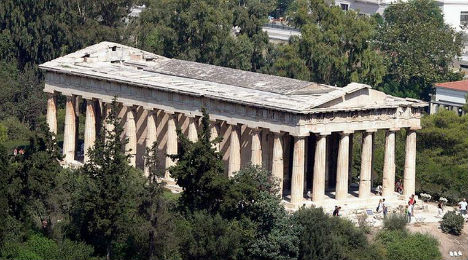
Athens was allegedly established in the 3rd millennium BC. Significant development started in 547 BC during the reign of Peisistratos, when he began to build a temple on the Acropolis, a flat-topped rock that rises 150 metres above sea level. Democracy reached its peak during the reign of Pericles. In this golden period, Athens was home to the philosopher Socrates and many representatives of ancient tragedy such as Sophocles, Aeschylus, and Euripides. When you visit Athens, you should definitely not miss its massive landmark, the Acropolis. Its top is decorated with the columns of the Parthenon. Acropolis (upper Town) can be found in a number of Greek cities, but that one in Athens is certainly the most famous in the world. Construction of the Parthenon, made of marble extracted from local quarries, lasted for 9 years and was completed in 438 BC. It has impressive dimensions (69.5 metres by 30.5 metres) and a simple and elegant Doric style. According to historians it once shone in colours – red, green, and blue – and its main item was a 12 metre high statue of the goddess Athena, after whom the city is named.
Photo licensed under the Creative Commons, created by drdcuddy
Museums, Neighbourhoods, and Modern Life
The architecture of Athens is very cosmopolitan, as is the city itself. There are countless monuments, therefore one of the main sources of income for the city is tourism. You can admire the original preserved ancient Greek monuments, relics of the Roman Empire period, Byzantine sanctuaries, as well as the development of modern Greek architecture. Many buildings constructed in the late 19th century were designed along the lines of ancient structures. Among the busiest places in the city is Omonoia Square, the centre of commerce and nightlife. The National Archaeological Museum is one of the leading institutions of its kind in the world. If you want to see all the parts and collections of the museum, one day would certainly not be enough. The Plaka district, at the foot of the Acropolis, offers charming narrow streets, traditional tavernas, and souvenir shops. Another attraction is the limestone hill Lykavittos, which reaches an altitude of 277 metres and is visible from any part of the Greek capital. From its top, where stands the Chapel of Agios Georgios, you can enjoy beautiful views of the city.
Challenges and Improvements in Athens
Athens is, in addition to its heritage, unfortunately also known as one of the noisiest cities in the world. It is among the cities with the lowest ratio of green space per capita in Europe – officially has only two square metres of greenery per capita. Also, the population density is very high. Through the streets run 4,000 buses, at least 14,000 taxis, and countless cars. So the main problem of the city is very busy traffic associated with never-ending smog. The Greek government took actions to reduce traffic, so the situation is improving. Great improvements in the infrastructure of the city were brought by the Summer Olympic Games hosted by Athens in 2004. The modern metro system, new highways, and the revitalised coastal area have all contributed to making Athens a more liveable and accessible city for both residents and visitors. The city also made progress in pedestrianising the historic centre, creating a pleasant archaeological promenade that connects the major ancient sites.
Would the noise of Athens overwhelm you, or would it feel like the heartbeat of a real city? 🏛️
Explore all our Greece travel guides, from ancient ruins to Aegean beaches.
Explore More
If you enjoyed this article, you might also like:

Athens gets called noisy and chaotic but that is exactly what gives it its character. We stayed in Plaka right under the Acropolis and the buzz of the city was part of the experience. The street food alone is worth the trip — souvlaki from a hole-in-the-wall joint in Monastiraki was the best meal we had in Greece. Give it a chance past the tourist traps and it rewards you.