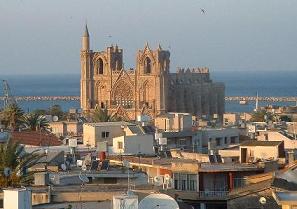
Ancient walls of Famagusta rise from the Cypriot coast like a story carved in golden stone, their Venetian ramparts still bearing the scars of centuries of siege. Beyond the fortifications, a ghost city of abandoned hotels stands frozen in time, a poignant reminder of a divided island. But the living city breathes through the Lala Mustafa Pasha Mosque, once the Cathedral of Saint Nicholas, where Gothic arches meet Islamic calligraphy.
Famagusta, located at north-eastern part of the island of Cyprus, was formerly one of the richest and most famous cities in the world. This can be prove for example by the fact that even William Shakespeare situated his drama Othello to this city. Tourists can visit many of impressive temples here from the 16th century, when the Famagusta was under Ottoman rule.
Famagusta was founded in 300 BC and its original name was Ammochostos – “burned down in the sand.” Large expansion of the city occurred in the late 13th century, when the first refugees settled here from the Holy Land. In this period, the first churches and mosques were built here in Famagusta.
Another boom came with Genoese and Venetians, and with their commercial potential. In 1571, Cyprus was controlled by the Ottomans. Today, the area of Famagusta is full of history and ancient architecture, but it also offers tourist services, beautiful beaches and romance. For sport lovers it is important to remind that Famagusta has quite a strong football team.
The city and surrounding worth a visit. Famagusta offers sights like the city walls with the most beautiful place of the Citadel, which offers a stunning view of the city.
You can also visit a mosque, Lala Mustafa Pasa Cami – former Cathedral of St. Nicholas from the late 13th century. As the whole Cyprus, also Famagusta boasts archaeological site – site of Salamis, where you can access gymnasium, baths, theaters, porticoes and the basilica from 4th century.
Very interesting is also the district Varosha with Greek Cypriots that live here. During the occupation in 1974 lots of people leaved, and many people are still unhappy to see the abandoned houses.
To the north of Famagusta you can visit the church of the Apostle Varnavas. The church serves as the Museum of icons and the Archaeological Museum. Close to the church there is a small fishing village Bogazi located about 24 km north of Famagusta.
Akrotiri and Dhekelia are two British military bases on the island of Cyprus. Great Britain kept those two areas after the declaration of independence of Cyprus in 1960. Akrotiri is located on the southern island of Cyprus, near Limassol, Dhekelia is in the southeast of the island between the towns of Larnaca and Famagusta. Akrotiri has an area of 123 km². Dhekelia has an area of 130 km². In both areas there live more than fifteen thousand people.
View Famagusta – one of the richest and most famous cities in the world Cyprus in a larger map
The Ghost City of Varosha
Perhaps the most haunting sight in all of Cyprus is Varosha, the once-glamorous beachfront suburb of Famagusta that has lain frozen in time since 1974. Before the Turkish invasion of Cyprus, Varosha was the most exclusive resort destination in the Mediterranean, hosting Elizabeth Taylor, Richard Burton, Brigitte Bardot, and the world’s elite at its high-rise hotels and golden sandy beaches. When the Turkish military advanced, the Greek Cypriot residents fled with nothing but the clothes they were wearing, expecting to return within days. They never did. The district was fenced off, sealed with barbed wire, and guarded by the Turkish military for nearly five decades.
Today, Varosha remains a ghost city of decaying hotels, rusting roller coasters, and crumbling apartment blocks where nature has reclaimed the streets. Palm trees grow through broken pavements. Sand drifts across roads where luxury cars once cruised. The John F. Kennedy Hotel, once the tallest building in Cyprus, stands empty with shattered windows staring out to sea. Since 2020, parts of Varosha have been partially opened to visitors, but access remains restricted and the vast majority of the district is still off-limits. Viewing platforms along the fence line offer glimpses into this urban time capsule. A guided tour explaining the political context and human stories behind the abandonment adds depth to what might otherwise be merely a spectacle. The future of Varosha remains uncertain, caught between diplomatic negotiations and competing claims.
Salamis Ruins and Othello Castle
Just 10 kilometres north of Famagusta lie the ancient ruins of Salamis, one of the most important archaeological sites in Cyprus. Founded in the 11th century BC, Salamis served as the capital of Cyprus under successive empires: Assyrian, Egyptian, Persian, Ptolemaic, and Roman. The sprawling site covers several square kilometres and includes a magnificent Roman theatre that once seated 15,000 spectators, restored gymnasium complex with column-lined palaestra, and extensive bath buildings with surviving mosaic floors. The theatre, partially reconstructed, is the most photogenic structure on the site, and its acoustics remain so good that summer concerts are still held there. The nearby Roman baths feature a remarkable collection of marble statues, including a colossal figure of a Roman emperor. Allow at least two hours to explore the main area, and bring water and sun protection, as shade is scarce.
Within the walls of Famagusta itself, Othello Castle stands at the northeastern corner of the fortifications, a 14th-century tower built by the Lusignan kings and later strengthened by the Venetians. The castle takes its name from Shakespeare’s Othello, which is set in the port of Famagusta, though the connection is more literary than historical. A plaque near the entrance bears the motto from the play: Keep up your bright swords, for the dew will rust them. The castle’s battlements offer excellent views of the harbour, the walled city, and the fence line of Varosha. The ground floor houses a small exhibition on the history of Famagusta’s fortifications. Combined with the Salamis ruins and the Varosha viewing area, the Famagusta region offers a full day of history that spans from ancient Greece to the unresolved politics of the present day.
Would you explore the ancient walls of Famagusta? 🏖️
Explore all our Cyprus travel guides, from Aphrodite birthplace to the divided capital.
Explore More
If you enjoyed this article, you might also like:
- Moving to Cyprus – What You Need to Know – Cyprus
- The UNESCO World Heritage Sites Of Cyprus – Cyprus
- Nicosia – the capital of Cyprus – Cyprus
