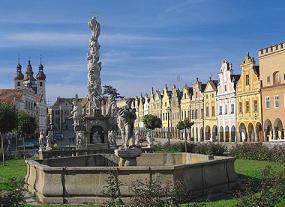
Pastel-coloured facades in shades of pink, yellow, and blue reflect in the still waters of a fishpond at Telc’s main square, creating a mirror image so perfect it looks like a hand-painted canvas. This tiny Czech town preserves an extraordinary collection of Renaissance and Baroque buildings that have changed little since the sixteenth century. The elegant arcades of the town hall, the ornate gables of burgher houses, and the towering chateau at the square’s edge form one of Central Europe’s most harmonious architectural ensembles.
The territory of Telc was, according to archaeological excavations, inhabited already from ancient times. Exact time when the settlement was founded is not clear. Local legend says that it happened after the victory of the Moravian Duke Otto II over the Czech Duke Bretislav in 1099. Impressed by this event, the victorious monarch founded the chapel and later also a church and a new settlement, the Old Town today.
However the first written document of Telc dates back to 1315. In 1334 Karel IV (at this time as Margrave of Moravia) paid the mortgage of this municipality, and a few years later (1339) he replaced it by the Castle of Banov, that belonged to Jindrich of Hradec.
The family of the new owner then established a new Telc. Unfortunately, the Memorandum has not preserved, but the first written report of Telc Burgess comes from 1353. It is assumed that it was Menhart of Hradec, who in 1354 built a castle, church, water fortification and Gothic houses (originally wooden) around the perimeter of a large marketplace. Other buildings and lake were built progressively.
In This Article
The Architectural Ensemble of the Main Square
Telc’s main square, Zacharias of Hradec Square, is the heart of the town’s UNESCO World heritage listing and one of the most beautiful civic spaces in Central Europe. The square is lined with preserved burgher houses, each with its own distinctive facade. The houses were originally Gothic, built of wood in the 14th century, but after a devastating fire in 1530 they were rebuilt in stone with Renaissance and Baroque features added over subsequent centuries. The most striking element is the row of stepped gables that crown the houses, decorated with sgraffito, frescoes, and sculptural details. House number 15, known as the House of the Black Ring, features particularly fine Renaissance graffiti. The square is anchored at its northern end by the chateau and at its southern end by the Church of Saint James, whose 60-metre tower dominates the skyline. Two stone fountains and a Marian column, erected in 1716 as a thanks offering for the end of a plague epidemic, occupy the centre of the square. The arcades that run along the ground floors of most houses provide shelter from rain and summer sun and house small shops, galleries, and cafes. Sitting at one of these cafes with a cup of coffee and a slice of traditional Czech kolac pastry while watching the changing light on the facades is one of the great pleasures of a visit to Telc.
Telc Chateau and Its Renaissance Interiors
The Telc Chateau, originally a Gothic fortress converted into a Renaissance palace in the 16th century, stands at the northwestern corner of the main square. The chateau’s most remarkable feature is the Golden Hall, a grand reception room with an ornate coffered ceiling painted in gold leaf and vibrant colours between 1560 and 1580. The ceiling panels depict scenes from classical mythology, biblical stories, and allegorical figures representing virtues and seasons. Tour guides in period costume lead visitors through the state apartments, which include the Knight’s Hall, the Blue Room, and the Picture Gallery, where portraits of the aristocratic families who owned the chateau line the walls. Original Renaissance furniture, including carved cabinets, upholstered chairs, and massive oak tables, fills the rooms. The chateau’s English-style park, covering five hectares, features a large carp pond, ancient trees, and flowerbeds that bloom from spring through autumn. Guided tours last approximately 45 minutes and cost around 7 euros. Audio guides are available in English, German, and Czech. The chateau is open from April through October, with reduced hours in the shoulder months. Winter visits are possible by appointment. Combined tickets with the Telc Museum of Technology are available at a discount.
Telc is a fascinating blend of architectural styles, and on many houses you can see a gradual evolution from Gothic style through Renaissance to Baroque style, in some cases also the later styles. The best example are the Gothic houses on the square, some with well-preserved typical pointed arches. They have Renaissance facades with beautiful gables, decorated with frescoes and paintings on the walls, or a baroque and rococo sculptures. The square is also decorated with two fountains and the Marian column.
until now, well-preserved are also the medieval walls and city gates, the castle and other monuments, such as the former Jesuit college from 1655 (now high school).
The town of Telc is listed on UNESCO World heritage List since 1992.
View The town of Telc – well-preserved Renaissance and Baroque houses in the Czech Republic in a smaller map
The Chateau and Surrounding Region
Telc chateau offers guided tours through Renaissance interiors with original furnishings. The Golden Hall features a gilded coffered ceiling. The tour costs 7 euros and lasts 45 minutes. The English park covers 5 hectares with a carp pond. Jihlava, 30 minutes north, has a 50-kilometre network of medieval cellars. The town of Dacice, 15 minutes east, claims the invention of the sugar cube in 1843 with a small museum dedicated to this innovation.
Which European town square left you speechless with its beauty? \u{1F3DB}\u{FE0F}
Explore all our Czech Republic travel guides, from Prague spires to Moravian wine country.
Explore More
If you enjoyed this article, you might also like:
- Karlovy Vary – biggest spa town in the Czech Republic – Czech Republic
- Lužnice – enjoy canoeing on the river in real nature paradise in Czech republic – Czech Republic
- Pravčická brána – largest natural rock arch in Europe | Czech Republic – Czech Republic

Spot on with this guide. The best time to visit Telc is early morning — we arrived at sunrise and had the place to ourselves. The light was incredible and by 10am the crowds started rolling in. Worth getting up early for.