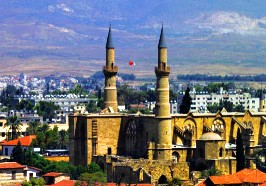
Nicosia (Lefkoşa) is the world’s last divided capital, a city split by the United Nations Buffer Zone (the Green Line) since 1974, where centuries of Venetian, Ottoman, British, Greek, and Turkish heritage collide in a fascinating urban landscape of medieval walls, Byzantine churches, Ottoman mosques, and a contemporary café culture that somehow thrives across the divide. Walking Nicosia’s Old City is one of the most unique urban experiences in Europe, cross Ledra Street checkpoint on foot and pass from the Republic of Cyprus into the Turkish Republic of Northern Cyprus in 60 seconds, passports and IDs checked by soldiers on both sides, and emerge into a city that feels simultaneously European and Middle Eastern.
Quick Facts: Nicosia, Cyprus
- Best time to visit: March–May and October–November for pleasant exploring temperatures; summer (June–September) is extremely hot, explore early in the morning and retreat to air-conditioned museums and cafés in the afternoon
- Top attractions: The Venetian Walls (a perfect 16th-century star fortification encircling the Old City), the Cyprus Museum (the finest collection of Cypriot antiquities in the world), the Selimiye Mosque (a 13th-century Gothic cathedral converted into a mosque), and the lively Laiki Geitonia pedestrian district
- How to get there: Larnaca International Airport (LCA) is ~40 minutes from Nicosia by car/bus; Paphos Airport (PFO) ~1.5 hours
- Border crossing: European citizens need a passport or national ID to cross between south and north at Ledra Street checkpoint (open daily 6am–10pm); the crossing is straightforward and takes a few minutes
The first city, which you should visit on the island of Cyprus, is the capital, Nicosia. The City has about 200,000 inhabitants and is located in the central part of the island on the river Pedieos. Outside of the city you will see the Troodos mountain peaks which is the biggest mountain range of Cyprus, with the highest peak Mount Olympus at 1,952m.
Right through the center of the city leads the line which divided Cyprus into two Republics. It is still the capital and largest city of both Cyprus and the Turkish Republic of Northern Cyprus. Even today, the Turks called the city Lefkoşa and the Greeks as Lefkosia. However at present, the situation is not so difficult as before.
What to see in Nicosia?
- Huge city walls that have been built in 16th century by Venetians to protect the city against Turks. The 4,5 metres thick wall used to have three gates. The Famagusta gate is now used as a cultural centre.
- The Archbishop’s Palace with a Byzantine museum
- Eleftheria (Freedom) Square – the centre of the city
- Mosques, e.g. the Selimiye Mosque – ancient church in the Turkish occupied part of Nicosia
View Nicosia – the capital of Cyprus in a larger map
Crossing the Green Line
The experience of crossing the Green Line at Ledra Street is one of the most unique urban experiences in Europe. The checkpoint, open daily from 06:00 to 22:00, requires a passport or national ID card for European citizens. The crossing takes approximately five minutes each way, with passport control on both sides. Once across, visitors enter the northern part of Nicosia, known as Lefkosa, where the architecture shifts noticeably and Ottoman-style buildings replace the Venetian and colonial architecture of the south. The Ledra Street crossing opened in 2008 and has become a symbol of the island’s gradual rapprochement. The buffer zone itself contains abandoned buildings and streets frozen in time since 1974, visible from observation points along the line.
historic Sites in the Old City
The Venetian Walls surrounding Nicosia’s old city form a perfect star-shaped fortification built between 1567 and 1570 to defend against Ottoman attack. The walls are 4.5 metres thick and originally had three gates, of which the Famagusta Gate survives as a cultural centre hosting exhibitions and events. The Archbishop’s Palace on the southern side houses the Byzantine Museum with one of the world’s finest collections of Byzantine icons and frescoes. The Selimiye Mosque, formerly the Cathedral of St. Sophia, dominates the northern skyline, built in the 13th century in French Gothic style and converted into a mosque after the Ottoman conquest of 1570. The Cyprus Museum just outside the walls is the island’s premier archaeological museum, with artefacts spanning 9,000 years of history.
Have you walked across the Green Line in Nicosia or discovered Cyprus’s divided capital? Share your Nicosia experiences in the comments! 🇨🇾
Explore all our Cyprus travel guides, from Aphrodite birthplace to the divided capital.
Explore More
If you enjoyed this article, you might also like:
