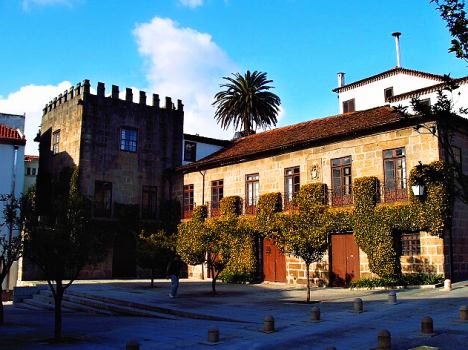
Portugal was born here. In the year 1128, a young prince named Afonso Henriques established his base in Guimarães and began the campaigns that would create an independent kingdom. The city centre is a UNESCO World heritage site of granite medieval buildings, arched alleys, and the Palace of the Dukes of Braganza with its towering brick chimneys. The Castle of Guimarães crowns a hill above the old town, its crenellations outlined against the sky. The Oliveira square holds a centuries-old arcade where locals gather in the evening. Guimarães wears its history with quiet pride. It does not shout about its importance. It simply exists, solid and enduring.
The city of Guimarães lies at the north-western part of Portugal in the province of Minho. It is considered the cradle of the Portuguese nation. Right here was born the first Portuguese King Alfonso I. The historic core of the city has been for its uniqueness inscribe to Unesco World heritage Site in 2001.
Photo licensed under the Creative Commons, created by am_
Guimarães, which is reportedly the oldest city in the whole of Portugal, was built in the middle of slightly hilly landscape. In 1139, Alfonso Henriques proclaimed himself king Alfonso I. and chose Guimarães for his royal seat. Although the capital city of Portugal moved quickly to the city of Coimbra and the seat of a king to the city of Porto, Guimarães remained forever a birthplace of the nation. The proof of the city’s importance is the characteristic shape of the local castle, which appears on the Portuguese coat of arms in the middle of the state flag.
In This Article
The Medieval Streets and the Palace of the Dukes
The city center is full of the narrow medieval streets that are lined with shops and cafes and invite you to a pleasant walk. The oldest street is Rua de Santa Maria, which is paved with cobblestones and decorated with the old houses with ornate statues. It leads from the main square, Largo da Oliveira, along the palace Paço dos Duques up to the castle. The Palace of the Dukes of Braganza, or Paço dos Duques de Bragança, dominates the upper part of the old town. This imposing 15th-century residence was built by Afonso, the first Duke of Braganza, and later served as a military barracks for centuries. Today it has been restored as a museum showcasing period furniture, Flemish tapestries, and a remarkable collection of Persian rugs. The palace kitchens feature enormous fireplaces and copper cookware, while the great hall boasts a magnificent wooden ceiling. From the palace windows, the view stretches across the red-tiled rooftops of the old town to the surrounding hills. Largo da Oliveira, the main square, takes its name from a centuries-old olive tree that once stood here. The arcaded square is surrounded by medieval buildings including the Church of Nossa Senhora da Oliveira, said to have been founded by Afonso Henriques himself.
The Castle, the Chapel, and the Legends of Portugal’s Birth
Castle Castelo de Sao Miguel is composed of huge square castle tower, which is surrounded by eight smaller towers with battlements. It was built in the 10th century to protect the city against attacks of Moors and Normans. About 200 years later, it was spread thanks to the initiative of Henry of Burgundy. According to the legend, Afonso Henriques was born in this castle, and his baptism took place in the tiny Romanesque chapel of Sao Miguel do Castelo, which stands beside the castle walls. The chapel inside has a mysterious character because the floor is made of gravestones of the first Portuguese kings and their ancestors. The castles keep offers panoramic views of the city and the surrounding countryside. During your visit you should not miss a visit to the charming church of São Francisco, which was built in 1400 in the Gothic style. Its interior features a striking Manueline portal and azulejo tile panels depicting scenes from the life of Saint Francis. The church is part of a former Franciscan monastery that now houses a sacred art museum.
Modern Guimarães: Culture, Sports, and Local Life
City of Guimarães is also known for its football club Vitória de Guimarães. The stadium, Estádio D. Afonso Henriques, is located in the northwestern part of Guimarães and is quite large in comparison with the city. The club has a passionate fan base and regularly competes in the top division of Portuguese football. In 2012, Guimarães served as a European Capital of Culture, bringing new museums, performance spaces, and public art to the city. The Centro Cultural Vila Flor, a converted 18th-century palace, hosts concerts, exhibitions, and theatre performances throughout the year. Forests surrounding Guimarães consist mainly of non-native eucalyptus, planted for the paper industry. The current population of the city is more than 52,000 inhabitants. Local cuisine features dishes such as bacalhau à moda de Guimarães, a codfish preparation unique to the region, and vinhos verdes, the young, slightly sparkling wines of the Minho region.
View Guimarães – oldest and one of the most important historical cities of Portugal in a larger map
Does a city’s founding history matter to you or do you just want good food and views? 🏛️
Explore all our Portugal travel guides, from Lisbon hills to the Algarve coast.
Explore More
If you enjoyed this article, you might also like:
