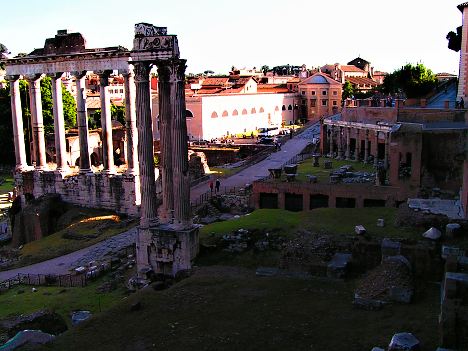
Walk where Caesar walked. The Roman Forum was the beating heart of an empire, a crowded valley of temples, courthouses, and market stalls where senators plotted and citizens argued. Today its broken columns and shattered arches lie open to the sky, scattered among weeds and wildflowers. The Via Sacra still runs its ancient course, worn smooth by sandals and chariot wheels. The Temple of Saturn looms over the rubble. The Arch of Titus commemorates a conquest nearly two thousand years old. Stand at the Rostra and imagine the crowds that once gathered here to hear speeches that changed the world. The stones remember everything.
The heart of ancient Rome is formed by its oldest part – the Roman Forum (Foro Romano in Italian or Forum Romanum in Latin). Here you can find many important buildings of the ancient Rome. In antiquity the area was the center of all events, used mainly by politicians.
Photo by Claire for Europe Explored
In This Article
A Walk Through the Temples and Basilicas of the Forum
The history of the oldest buildings dates back to 7th century BC, to the reign of the first Etruscan king. But first important buildings connected with political, religious and civic life began to appear here during the reign of Julius Caesar. In addition to patrician houses here were built shops, temples, basilicas and markets. The most commonly used building material was marble, gilt metal and cut stones. Construction boom stopped in the early 2nd century AD. The reason was simple – there was no empty space here any more. The Temple of Saturn, with its eight surviving granite columns, dominates the western end of the Forum. It housed the state treasury, the aerarium, where Romes wealth was guarded. Nearby stand the three remaining columns of the Temple of Castor and Pollux, which once served as a meeting place for senators. The basilica Julia, named after Julius Caesar, was a vast hall used for law courts and public gatherings. Only its ground plan remains, marked by broken columns and paved floors. The Arch of Septimius Severus, erected in 203 AD, still stands nearly intact at the north-west corner, its relief panels depicting the emperors military victories in Parthia. The Rostra, the speaker’s platform from which Cicero and Mark Antony addressed the crowds, faces the open space of the Forum.
Decline, Rediscovery, and Archaeological Resurrection
Foro Romano began to lose importance with the fall of the Roman Empire. The buildings then began to decay. Advanced and splendid city turned relatively quickly into ruins. A large fire even help it in the 3rd century. Following several earthquakes and barbarous conquerors destroyed almost the whole area. Marble stones were dismantled and used to build local houses or shipped to other parts of Italy, to build churches and palaces. Finally Foro Romano became untidy overgrown space again. For centuries the Forum was known as the Campo Vaccino, or Cow Field, because local farmers brought their cattle to graze among the ancient ruins. The statues and columns that remained were gradually buried under centuries of soil and debris. In the 18th century, archaeologists discovered this area and immediately started to clean it. Slowly and carefully uncovered the remains of ancient buildings, and finally Foro Romano saw the light of day again. The first comprehensive archaeological survey was carried out at the turn of the 18th and 19th century under the leadership of the Italian archeologist Carlo Fea. In 1803 he discovered the remains of a massive arch Septimius Severus and later of the other temples as well. After these discoveries the place began to attract researchers from all over the world. The main archaeological works were completed in the early of the 20th century when many ruins of temples and basilicas were uncovered.
Visiting the Forum Today: Tips for Travellers
Visitors to Rome now can see at least a fraction of these beautiful ancient monuments that once dominated by Foro Romano. Foro Romano is currently considered one of the most important archaeological sites in the world. Although it cannot amaze visitors with its ancient beauty any more, attracts them with its glory and mysterious atmosphere. The Forum is best visited early in the morning or late in the afternoon to avoid the midday heat and the largest crowds. A combined ticket with the Colosseum and Palatine Hill is available and offers the best value. Allow at least two hours to explore the Forum properly. The entrance near the Arch of Titus leads down the Via Sacra, the main street of ancient Rome, past the basilica of Maxentius with its towering vaulted ceilings. Information boards in multiple languages explain each structure. For a complete experience, climb the Palatine Hill afterwards for a panoramic view of the Forum from above.
View Foro Romano – one of the most important archaeological sites in the world Italy in a larger map
Which ancient site in Rome moves you the most? 🏛️
Explore all our Italy travel guides, from the Dolomites to Sicily.
Explore More
If you enjoyed this article, you might also like:
