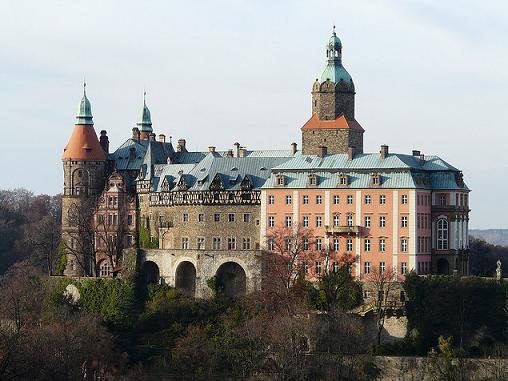
Three storeys of baroque and neo-Renaissance architecture rise above a forested valley in Lower Silesia. Ksiaz Castle is the third largest castle in Poland, a sprawling structure built and rebuilt over seven centuries. The Hochberg family owned it for generations, filling it with art, tapestries, and a library of forty thousand volumes. During the Second World War the Nazis seized the castle and tunnelled beneath it, creating underground chambers whose purpose remains partially mysterious. Today visitors walk through staterooms, climb the tower for panoramic views, and explore the terraced gardens. The castle stands in constant negotiation with its own complicated past.
\n\n
Ksiaz castle is the largest castle in Lower Silesia and the third largest castle in Poland (bigger castles are only Wawel Royal Castle in Krakow and the Crusader castle in Malbork). It is often considered the pearl of Lower Silesia. It lies in the county of Walbrzych, among picturesque forests of Ksiaz Landscape Park (Ksiazanski Park Krajobrazowy) and the valley of the river Pelcznica. The most beautiful view of the castle is from the terraces on so-called Giant Rock (Skala Olbrzyma), where you can get by following the broad path leading through the castle park.
\n
\nPhoto licensed under the Creative Commons, created by Maciej Kasprzyk
\n
The first written mention of the Ksiaz castle dates back to 1288. It was one of several defensive castles built by duke Bolek I “the Cruel”. In 1508 Ksiaz castle fell into the hands of John von Haugwitz, who sold it to Conrad von Hochberg.
\n
Ksiaz castle was rebuilt many times, so it combines many architectural and artistic styles – including the Gothic, Renaissance, Baroque and eclectic elements. The most beautiful part of the castle is certainly Maximilian Hall, which was used for concerts and theater performances, and its interior served as a setting for several movies.
\n
One of the most important and also the most tragic periods in the history of the castle was the time of the World War II. In 1941 Ksiaz castle was occupied by the Nazis. All the valuable works of art, furniture and contents of the castle library where took by Nazis. Many underground corridors were built below the castle, which proves that Nazis prepared here one of the seats of the German dictator Adolph Hitler.
\n
Ksiaz castle combines the history of several nations and many people. In addition to the standard attributes of building castles like beautiful gates, bastions and towers, also hundreds of undiscovered secrets are waiting here for the visitors.
\n
The castle is open daily except for Mondays from 10:00am to 3:00pm (extended in Summer and weekends). You can attend several routes, the basic admission is 20PLN (€5).
\n
For further details visit the official website of Ksiaz castle.
\n
\n
View Ksiaz Castle – one of the largest castles in Europe Poland in a larger map
\n
\n
The Hochberg Family and the Maximilian Hall
\n
The Hochberg family owned Ksiaz Castle from 1509 until 1941, transforming it from a Gothic fortress into a Baroque and Neo-Renaissance residence that reflected their growing status as one of Silesia’s wealthiest noble houses. Prince Hans Heinrich XV von Hochberg was the castle’s most influential builder, enlarging the structure and commissioning the Maximilian Hall in the late 19th century. This grand ballroom rises through two floors with a gilded ceiling, marble fireplaces, and a stage framed by carved wooden panels. The hall hosted performances by the Berlin Philharmonic and visiting opera companies before the First World War. The Hochberg library once held 40,000 volumes, including rare Silesian manuscripts and a Gutenberg Bible that was seized during the war and never recovered. The family art collection included works by Lucas Cranach the Elder and Venetian masters, all of which disappeared after the Nazi occupation. Today the hall is used for classical concerts and weddings, and its restored interiors give visitors a sense of the courtly life that flourished here before the war.
\n
The Nazi Tunnels and World War II Secrets
\n
Between 1941 and 1945, the Nazis transformed Ksiaz Castle into a key component of the Riese project, a vast network of underground tunnels and bunkers built in the Owl Mountains. Excavations beneath the castle reached depths of 15 metres, with two main tunnels extending 80 metres into the hillside. Concrete-lined chambers with reinforced ceilings were designed to withstand aerial bombardment. Historians debate weather the complex was intended as a headquarters for Hitler, a production facility for the V-2 rocket, or a storage depot for looted art and Nazi gold. The SS removed the Hochberg family and stripped the castle of its furnishings, including 27 railway carriages of artwork heading east. After the war, the tunnels were sealed by the Polish army and remained unexplored until 2004, when georadar surveys revealed additional chambers yet to be excavated. Visitors can now tour the accessible sections of the tunnels on a separate guided route, with steel walkways and lighting installed for safety.
\n
Would you rather explore the grand halls above ground or the secret tunnels below? 🏰
\n
Explore all our Poland travel guides, from Kraków square to the Tatra Mountains.
Explore More
If you enjoyed this article, you might also like:
