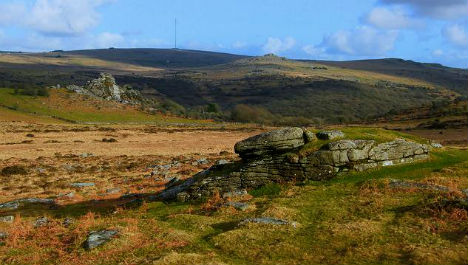
Dartmoor is a vast wild landscape in the heart of Devon, a place where granite tors rise above rolling moorland. The National Park covers almost a thousand square kilometres of open country. This is not a manicured park. It is rough, exposed, and ancient. Wild ponies roam freely across the heather. Stone circles and burial chambers from the Bronze Age dot the hills. The streams cut deep valleys known locally as combes. Hiking here demands respect for the weather, which shifts without warning. But the rewards are immense: silence, space, and a connection to a landscape that has barely changed in thousands of years. Prisoners once laboured on Dartmoor, but today it belongs to walkers.
Dartmoor National Park is a rough landscape of heaths, bogs and granite rocks, located in the county of Devon in southwest England. Granite plane covers an area of approximately 1200 km2 and rises to an altitude of 500-600 meters. In the middle of the landscape you can see the granite rocks called Dartmoor Tors, that look like statues from afar.
The largest of these rocks is called Yes Tor and rises to a height of 620 meters above sea level. The local peat bogs are among the largest in Europe. There are herds of ponies running free across the protected area, which serves also as a granite mine. You can also find here a number of prehistoric monuments.
Photo licensed under the Creative Commons, created by Mark A Coleman
In This Article
Bronze Age Dartmoor: Stone Circles, Hut Circles, and Ancient Settlements
First settlements dating back more than 10,000 years, when Dartmoor was still a densely forested plateau. The felling of local forests started in the Stone Age, when the hunters and gatherers tried to get as close as possible to the animals. Also the first agricultural settlements were established here in the Early Stone Age. During the Bronze Age the landscape was completely without forests, cleared for farming and grazing. There were found the remains of settlements from the Bronze Age, such as houses, yards, burial grounds, megalithic series, stone circles and obelisks having religious significance. Over 5,000 archaeological sites have been recorded on Dartmoor, making it one of the most archaeologically rich landscapes in Europe. The most impressive include the stone circle at Grey Wethers and the Merrivale megalithic complex with its stone row and standing stone over 3 metres tall. There are also the remains of stone walls that were delimiting the pastures and fields, which prove the early human existence. The objects that people used everyday, such as ceramics, various metal objects or bones, were unfortunately not preserved in the acidic soil. What remains are the granite structures, enduring and silent.
Wildlife, Bogs, and Rare Habitats
Dartmoor National Park protects a number of rare habitats. The central part of Dartmoor is composed of a large marshy area. The surrounding terrain is a combination of moorland and meadows, and in the valleys you can find oak forests. Typical for this landscape are also granite rocks, the tors, and roaring rivers falling into deep gorges, cave systems and limestone ridges. There were found the remains of prehistoric animals in the local caves. This collection of the remains is one of the largest in Great Britain and its age is estimated to more than 150,000 years. For example, in a cave called Joint Mitnor Cave were discovered the bones of hippos, hyenas, lions, wild pigs and even Straight-tusked Elephants. The largest part of the national park is covered with the rare blanket bog. Dartmoor bogs have a depth of at least half a metre, but there are also places where they reach even a depth of 7 metres. In the park there is also very rare Tor Royal Bog, covering an area of 8 km2. The park hosts wetland birds including curlews, snipe, and the rare Dartford warbler. The iconic Dartmoor pony roams in herds across the moor.
Walking, Weather, and Practical Advice
Like for the whole Britain, also for this area is typical a fog, which occurs suddenly, absorbs the surrounding countryside and suddenly disappears as well. Dartmoor landscape has always been an inspiration for writers and ideal for creating mystical and sometimes spooky stories. The park is connected with many legends about mysterious unknown characters and bloodthirsty monsters. It is a place where the legend about the Baskervilles Dog was born. There are constant rains, strong winds, foggy weather and damp. Gloomy atmosphere of this area is also doubled with the famous Dartmoor prison, which was built in 1806 here and was used for the prisoners of the Napoleonic wars. The local largest village of Princetown once served as a hostel for prison staff. In the Dartmoor National Park you can even find very interesting sights. The most beautiful and best preserved bridge from all the bridges built in this area during the 13th and 14th centuries is the Postbridge Clapper Bridge, a structure of massive granite slabs supported by stone piers. Since 1951, Dartmoor National Park includes a huge area of the total size of 945 km2. Necessary equipment for hiking along this marshy landscape is the compass and actual map. So do not forget them! Waterproof boots and a reliable map are essential as conditions change within minutes.
View Dartmoor National Park – one of the most renowned picnic places in England United Kingdom in a larger map
Would you brave the weather to summit Haytor or explore a Bronze Age circle? 🏔️
Explore all our United Kingdom travel guides, from London landmarks to the Scottish Highlands.
Explore More
If you enjoyed this article, you might also like:
- Top sights to see in London – United Kingdom – United Kingdom
- Riding High! – Convents, Cathedrals, Monasteries and More | UK – United Kingdom
- Gower Peninsula – Amazing Natural Beauty You’ll Never Forget | Wales, UK – United Kingdom
