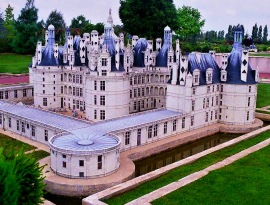
The largest castle in the Loire Valley rises from flat marshland like a mirage of white stone and symmetry. Chambord has 440 rooms, 365 fireplaces, and 84 staircases. The centrepiece is Leonardo da Vinci’s double-helix staircase, where two people can descend without ever meeting. The rooftop terrace offers a forest of turrets, chimneys, and sculpted lanterns that look more like a fantasy city than a roof. The castle was built as a hunting lodge, though the king barely spent forty nights here. It remains a monument to ambition, a Renaissance dream carved in limestone and set against a French sky.
Le Château de Chambord lies in France approximately 180km south of Paris. This marvelous castle came into existence several centuries ago. Le Château de Chambord is the ensemble of conventional French architectural ethos in right combination with classic Italian architecture. However, researchers are not sure who designed this castle. Several princes and royal family members contributed at different times to increase the structural elegance of this royal castle. If you reshuffle historical records, you will learn that King Francois I played a significant role to reshape this castle. Many historians claim that Domenico da Cortona attributed a lot to redesign this building, while others suggest Philibert Delorme or Leonardo da Vinci had an important role in designing the structure.
In This Article
The Double-Helix Staircase and da Vinci’s Genius
The most celebrated architectural feature of Chambord is its double-helix staircase, widely attributed to Leonardo da Vinci, who was a guest of King Francois I at the nearby Chateau du Clos Luce during the final years of his life. The staircase consists of two separate spirals that wind around a hollow central core, allowing two people to ascend or descend simultaneously without ever meeting. The open centre is lit by a lantern tower that rises 32 metres above the roof, flooding the interior with natural light and creating a dramatic vertical space connecting all three floors. The staircase is supported by eight interior columns carved with the salamander emblem of Francois I. Da Vinci’s influence can be seen in the functional logic of the floor plan, the innovative use of double walls for separate circulation routes, and the mathematical precision of the proportions. The keep follows a Greek cross plan that was revolutionary for French chateau architecture, with the staircase at its centre and four equal wings extending outward.
The Rooftop Terrace and the Castle’s Grand Scale
The rooftop terrace of Chambord offers a panoramic walkway through a fantastical landscape of turrets, chimneys, and sculpted stonework that has no equal in French Renaissance architecture. The 32-metre-high lantern tower at the centre is topped with a fleur-de-lis, visible for miles across the flat Loire countryside. From the terrace, visitors can look out over the 5,440-hectare park, the largest enclosed forest park in Europe, surrounded by a 32-kilometre wall. The park was originally designed as a hunting reserve and still shelters wild boar, deer, and numerous bird species. Inside the castle, the 440 rooms are arranged around the central keep, with royal apartments occupying the most luxurious spaces on the first floor. The 365 fireplaces, one for each day of the year, are distributed throughout the building, each decorated with carved stone mantels featuring salamanders and floral motifs. The scale of Chambord is overwhelming: the floor plan covers the same area as the entire village of Chambord itself, and construction consumed an estimated 220,000 tonnes of stone.
Exploring the Estate and Practical Visiting Tips
Le Château de Chambord was confiscated as enemy property in 1915 but after a legal battle, it was returned to the family of the Duke of Parma. Renovation works started after World War II, and today this historical site has become one of the most attractive tourist centres in France. The castle is open year-round, and an admission ticket includes access to the interior rooms, the rooftop terrace, and the surrounding park. A day ticket costs 14.50 euros for adults, with reduced rates for children and families. Audio guides are available in 12 languages and provide detailed commentary on the castle’s history and architecture. The estate offers electric boat rentals on the canal, horse-drawn carriage rides, and bicycle rentals for exploring the forest trails. The French Gardens, replanted in the 18th-century style, offer a pleasant walk from the castle to the canal. Visiting early in the morning or late in the afternoon allows you to experience the castle with fewer crowds and better light for photography. The castle is located about 2 hours from Paris by car, and regional trains from Paris Austerlitz to Blois take about 90 minutes, with local buses running to Chambord from both stations.
Would you rather explore every room at Chambord or picnic in its vast royal gardens? 🏰
Explore all our France travel guides, from Parisian boulevards to Provence lavender.
Explore More
If you enjoyed this article, you might also like:
