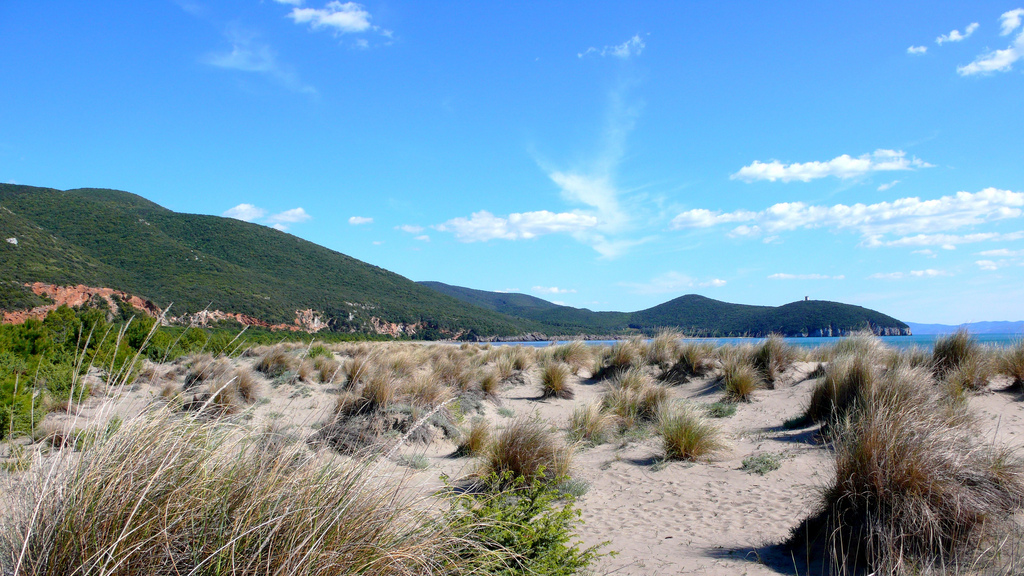
The Mediterranean scrub releases its fragrance as you walk the trails of Parco dell’Uccellina. Rosemary, myrtle, and juniper fill the warm air with scents that have drifted across these coastal hills for centuries. This protected oasis stretches along the Maremma coast of Tuscany, where ancient watchtowers stand guard against the blue expanse of the Tyrrhenian Sea. Herons and flamingos wade through the wetlands while wild boar rustle in the undergrowth. Trails lead through dense forest, past abandoned monasteries, and down to pristine beaches where the only footprints are your own.
Located in Tuscany, Italy as part of the Parco Naturale della Maremma, the Parco dell’Uccellina has grown to become a very popular tourist destination. The Parco dell’Uccellina is a nature reserve that is dedicated to some of the rarest of wild animals in Italy. There are many different species of foxes, boar, deer and birds that can be found within the reserve.
In This Article
Coastal Trails, Wetlands, and Untouched Beaches
The park’s network of walking and cycling trails winds through a remarkable diversity of landscapes within a relatively compact area. The coastal trail, known as the Sentiero delle Torri (Tower Trail), connects a series of medieval watchtowers built along the Maremma coast between the 15th and 16th centuries to defend against Barbary pirate raids. The most famous of these is Torre della Trappola, a striking stone tower that marks the park’s southern boundary and offers sweeping views along the coast. The trail passes through coastal pine forest and maquis shrubland before emerging onto the dunes and marshes of the Trappola wetlands, one of the most important bird habitats in Tuscany. From carefully positioned observation hides, visitors can watch grey herons, little egrets, glossy ibises, and greater flamingos feeding in the shallow lagoons, while peregrine falcons and kestrels hunt overhead.
The park’s beaches are among the most pristine in Tuscany, accessible only on foot or by bicycle. Cala di Forno, a sheltered cove at the end of a three-kilometre walking trail through the forest, is the most beautiful beach in the reserve, a crescent of fine golden sand lapped by crystal-clear water. Because there is no road access, the beach never feels crowded, and on weekdays you may have it entirely to yourself. Marina di Alberese, a larger beach near the park’s visitor centre, offers gentler swimming conditions and is popular with families. The beaches have no facilities, so visitors must carry water and supplies, but the reward is a genuinely wild coastal experience that has become increasingly rare along the Italian coastline.
Ancient History: Caves and Prehistoric Settlements
The hills of Parco dell’Uccellina have been inhabited since the Lower Paleolithic era, with evidence of human settlement stretching back 500,000 years. The most significant archaeological sites are the caves scattered through the limestone cliffs of the Uccellina massif. The Grotta della Fabbrica (Fabbrica Cave) has yielded important finds from the Middle and upper Paleolithic periods, including flint tools and animal bones that document the hunting practices of Neanderthal populations. The Grotta del Golino (Golino Cave), excavated in 1865, contained artifacts from the Middle Paleolithic era, including some of the earliest evidence of human presence in southern Tuscany. The Grotta dello Scoglietto (Scoglietto Cave) has revealed remains from even earlier periods, indicating continuous habitation of these coastal hills throughout prehistoric times.
Later periods are also represented in the park’s archaeological record. The Etruscans established settlements and trading posts along this coast, and their presence is attested by tomb sites and fragments of pottery found throughout the reserve. The Romans built villas and fish-processing facilities near the coast, taking advantage of the rich marine resources of the Tyrrhenian Sea. The medieval period left the most visible marks: the watchtowers, the abandoned Abbey of San Rabano, and the network of stone-built trails that connected the coastal settlements with the inland hill towns. This layering of human history across a still-wild landscape gives Parco dell’Uccellina a depth of character that distinguishes it from more manicured nature reserves.
The Abbey of San Rabano and the Medieval Landscape
The Abbey of San Rabano, dramatically situated on a ridge deep within the park, is the most important historic monument in Parco dell’Uccellina. Founded in the 9th or 10th century by Benedictine monks, the abbey was dedicated to Saint Rabanus Maurus, a learned Anglo-Saxon abbot and theologian. For centuries, the monastery controlled much of the surrounding territory, managing the forests, pastures, and salt pans that sustained the local economy. The abbey was abandoned in the 15th century as the malaria-infested marshes made life increasingly difficult, and its stone walls were gradually reclaimed by the forest. Today, the romanesque church and cloister ruins stand in a clearing surrounded by holm oaks and Mediterranean pines, a hauntingly beautiful testament to the cycles of human ambition and natural reclamation. The abbey can be reached by a moderately challenging hiking trail that climbs through the forest from the park’s main entrance, passing ruined farm buildings and stone terraces that once supported vineyards and olive groves.
Parco dell’Uccellina, Italy by Rik & Ste
Would you rather explore the forest trails or relax on the untouched beaches of this Italian oasis? 🌿
Explore all our Italy travel guides, from the Dolomites to Sicily.
Explore More
If you enjoyed this article, you might also like:
