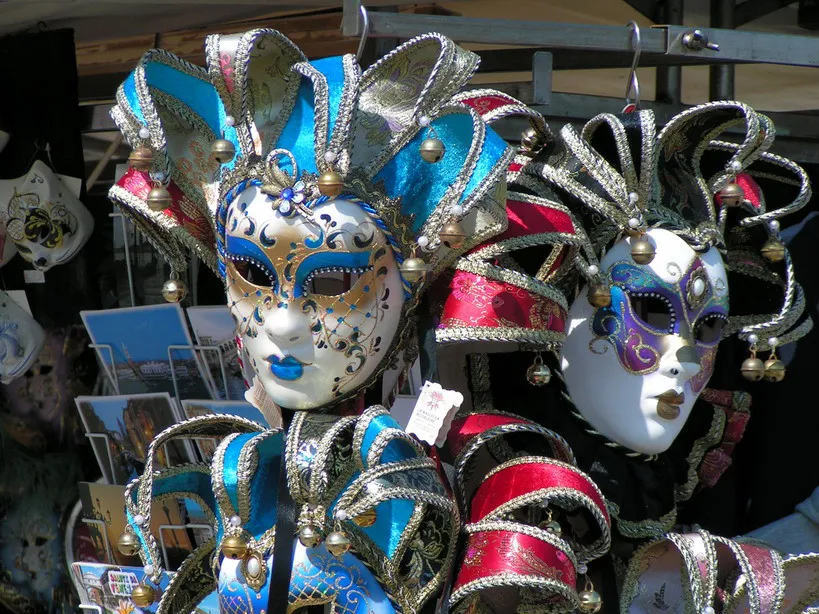
Venice during Carnival is a city wearing a mask both literally and metaphorically. The narrow alleys fill with people in velvet cloaks and feathered headdresses, their faces hidden behind elaborate porcelain masks that turn every encounter into a mystery. The air carries the smell of fried dough and espresso mixed with the brackish scent of the canals at low tide. Musicians play in candlelit courtyards, and masked figures glide across St Marks Square as if stepping out of a painting by Canaletto. Gondolas drift through the winter fog, their passengers unrecognisable beneath costumes that erase all difference between class and century. For two weeks every year, Venice becomes a stage on which everyone is both performer and audience.
In This Article
The History Behind the Carnival Masks
The Carnevale di Venezia traces its origins to 1162, when the Republic of Venice celebrated its victory over the Patriarch of Aquileia with dancing and feasting in San Marco Square. The festival grew over the centuries into an elaborate season of masquerade that attracted visitors from across Europe. By the 18th century, Carnival lasted from October until Lent, a full six months of masked indulgence that dominated Venetian social life. The masks served a practical social function as well as a festive one. They allowed people to gamble at the ridotti, the licensed gambling houses, without revealing their identity. They permitted romantic liaisons that would have been scandalous without the anonymity of the mask. They let nobles walk among commoners and commoners move among nobles in a society otherwise rigidly divided by class and family name. The festival declined after the fall of the Venetian Republic in 1797 when Napoleon conquered the city. The Austrian government banned it outright in 1815, and it remained suppressed for over 160 years. The modern revival began in 1979, when the city government and local cultural associations relaunched Carnival as a celebration of Venetian heritage. It has grown steadily since. Today, more than 30,000 visitors arrive daily during the two-week festival period, and the economic impact on the city runs into tens of millions of euros.
Events, Parades, and the Best Moments
The programme of events runs for roughly two weeks leading up to Shrove Tuesday. The opening ceremony takes place on the Cannaregio Canal with a water parade of decorated boats illuminated by torches. The Festa delle Marie, a highlight of the first weekend, commemorates the rescue of 12 Venetian brides kidnapped by Istrian pirates in the 10th century. Twelve young women in lavish medieval costumes process from San Pietro di Castello to San Marco Square. The Volo dell’Angelo, the Angel Flight, is the most photographed event of Carnival: a performer suspended from a zip line descends from the Campanile in St Mark’s Square to the centre of the piazza, landing gracefully in front of thousands of spectators. The costume contest on the final weekend draws participants in handcrafted 18th-century costumes worth thousands of euros. They pose for photographers in front of the Procuratie Vecchie, competing for prizes in categories including best costume and most elegant couple. The fireworks display on the last night over St Mark’s Basin is visible from anywhere along the Riva degli Schiavoni and the Zattere. Each of Venice’s six sestieri holds its own neighbourhood celebrations with food stalls, street performers, and children’s events in Cannaregio that include a dedicated Carnival for younger visitors with costume competitions and puppet shows.
Masks, Accommodation, and Practical Advice
The mask is the essential accessory of Carnival, and the choice says something about the wearer. The bauta mask covers the entire face with a protruding chin and a wide mouth opening that allows the wearer to eat and drink without removing it. Traditionally worn by men, it was the standard mask for evening excursions. The moretta is an oval mask of black velvet worn only by women and held in place by a button clenched between the teeth, which meant the wearer could not speak. The Medico della Peste, the Plague Doctor mask with its long curved beak, was historically a medical device worn by doctors treating plague patients. The beak was filled with aromatic herbs and vinegar to ward off disease. Buy your mask from a Venetian workshop rather than a souvenir stall. Paper masks cost EUR 5 to EUR 10 and last one evening. Hand-painted ceramic masks from artisans like Ca del Sol or Tragicomica cost EUR 50 to EUR 200 and become keepsakes that hang on walls for years. Book accommodation six to eight months in advance. Hotels charge double the standard rate during Carnival, and a basic double room costs EUR 300 to EUR 500 per night. Apartments rented through agencies in Venice can work out cheaper for groups of four or more, with rates starting at around EUR 150 per person per night.
If you wore a mask at the Venice Carnival, would you play a character or just watch the world go by? 🎭
Explore all our Italy travel guides, from the Dolomites to Sicily.
Explore More
If you enjoyed this article, you might also like:
