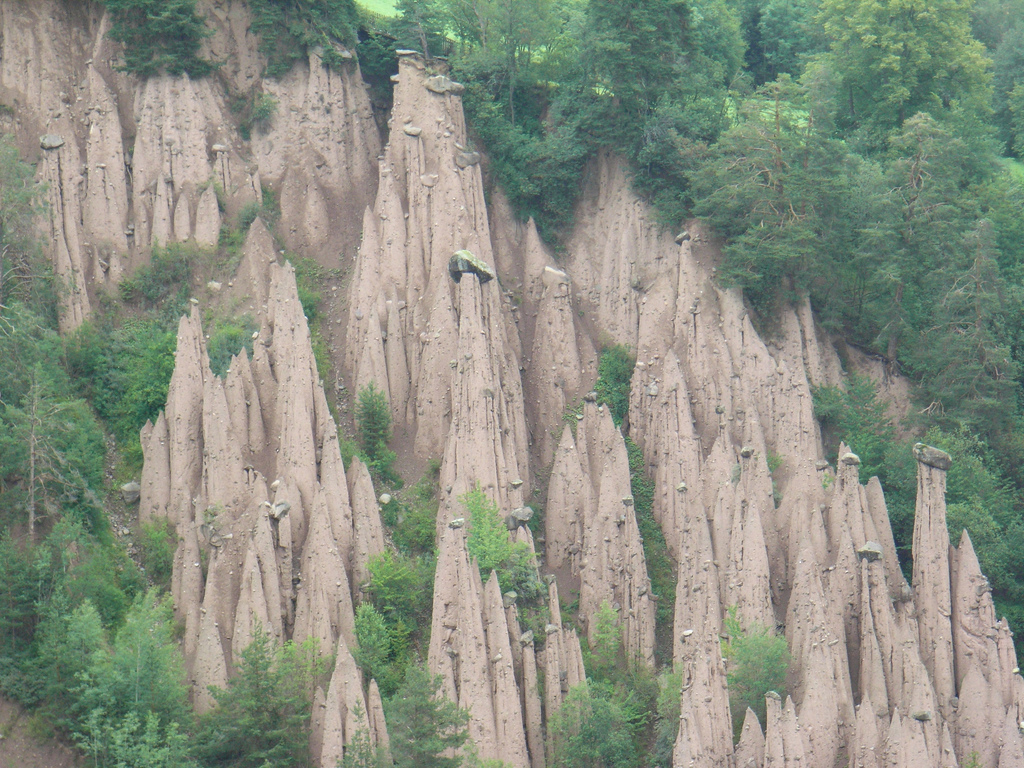
A thousand years of rain and frost, and the glacier that once covered the Ritten plateau melted 10,000 years ago. What it left behind is a forest of earth pillars capped by boulders that look as though a giant dropped them from a great height. The pillars cluster in a ravine above the village of Ritten, or Renon in German, in the South Tyrol region of northern Italy. They are fragile. They are temporary. And they are among the most unusual geological formations you will find anywhere in the Alps.
In This Article
How Were the Earth Pyramids Formed?
These extraordinary formations owe their existence to a combination of glacial deposits, erosion, and the protective cap of a single boulder. During the last Ice Age, glaciers deposited thick layers of moraine across the Ritten plateau. Over millennia, rainwater gradually eroded the softer clay and sediment, but where a large boulder sat atop the mixture, it acted as a natural umbrella, shielding the material beneath from the rain. The result is a cluster of slender, cone-shaped pillars standing proudly across the hillside, some reaching over 30 metres in height. The boulders perched on top appear almost too large for their delicate stems, creating a surreal, almost sculptural landscape that draws geologists and photographers from around the world.
Exploring the Ritten Plateau on Foot
The best way to experience the earth pyramids is on foot, following the designated trails that wind through the Ritten area. Several well-marked paths offer different perspectives of the formations at varying elevations. The Sentiero dei Piramidi trail is the most popular, taking roughly 45 minutes to an hour to complete with several viewing platforms along the way. Along the route, you will pass through alpine meadows dotted with wildflowers in spring and summer, offering panoramic views of the Dolomites in the distance. Local guides are available in the nearby village of Klobenstein, and information boards along the trail explain the geological significance of the site in multiple languages.
Best Time to Visit and Practical Tips
The earth pyramids can be visited year-round, though late spring through early autumn offers the most comfortable hiking conditions. Summer temperatures on the plateau are pleasant, usually hovering around 20 to 25 degrees Celsius, making it an ideal escape from the heat of the valleys below. Autumn brings golden foliage and clearer skies, while winter offers a quieter experience with the possibility of seeing the pillars dusted in snow. Wear sturdy walking shoes and bring water, as there are limited facilities directly on the trail. Entry to the site is free, and parking is available at the trailhead near Klobenstein. Allow at least two hours for the full visit including photographs and stops at the viewing platforms.
How the Pillars Formed
The process that created the Ritten Earth Pillars is called erosion, but that word undersells the patience involved. When the glacier retreated at the end of the last Ice Age, it left behind a thick layer of glacial till: a mix of clay, sand, and gravel compacted under the weight of the ice. Larger boulders, carried down from the mountains by the glacier, sat on top of this till. Rain and meltwater drained around the boulders, carving grooves into the softer material below. The boulder acted as an umbrella, protecting the column beneath it while the surrounding ground washed away. Over millennia, the pillars rose. The tallest exceed 40 metres. The boulders on top can weigh several tonnes.
The Three Main Sites
The pillars are concentrated in three areas around the Ritten plateau. The most accessible is the Lengstein site, a short walk from the village of Lengmoos, where a marked trail leads to a viewpoint above the ravine. The second site is at Klobenstein, the main village on the plateau, where the pillars stand in a wooded side valley. The third and most dramatic is the Katzenbach site, where the pillars are tallest and the ravine deepest. A circular walk from Lengmoos takes in all three sites and takes roughly two hours at a moderate pace. The trail is well maintained but includes some steep sections. The elevation is 1,200 metres, so the air is cooler than in the valley below.
When to Visit
Late spring and early autumn are the best times. May and June bring wildflowers to the meadows above the pillars. September and October deliver clear air and golden light that makes the clay pillars glow. Summer is busy on the plateau but the trail to the pillars is rarely crowded. Winter is possible if you have snowshoes: the trail is not cleared: but the pillars themselves are less visible under snow. The plateau is accessible year-round by the Ritten Cable Car from Bozen, which runs every 15 minutes and takes 12 minutes to climb 950 vertical metres. A round-trip ticket costs €12 as of 2026.
Have you stood at the edge of the ravine and watched a pillar you knew would not exist in another thousand years?
Looking for more European travel inspiration? Check out our other guides and start planning your next European adventure!
Explore all our Italy travel guides, from the Dolomites to Sicily.
Explore More
If you enjoyed this article, you might also like:
