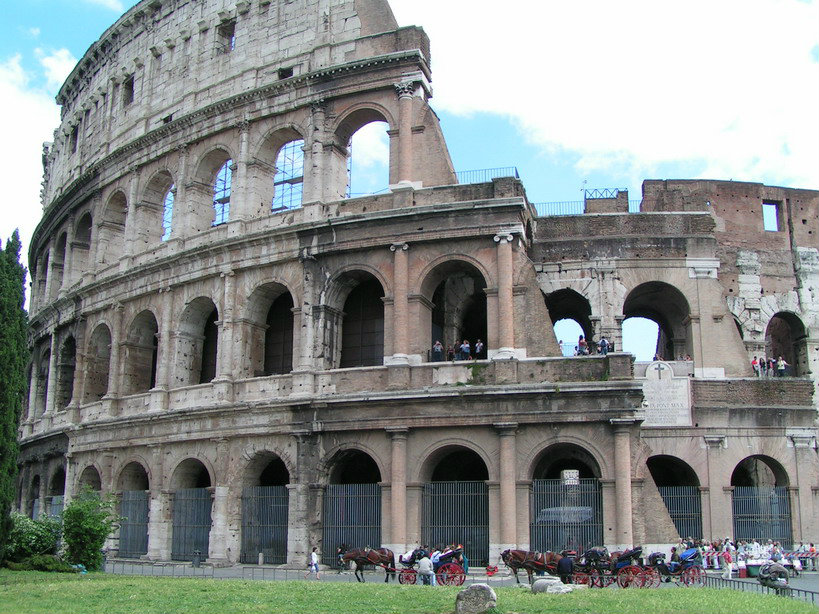
Colosseum – amazing 2000 years old symbol of Rome | Italy

June 10, 2026 by europeexplored No Comments

The Colosseum is 1,935 years old and it is still the largest amphitheatre ever built. The outer wall originally rose 48 metres, the height of a modern 16-storey building, and the arena floor covered 3,357 square metres. It held 50,000 spectators who entered through 80 numbered arches. The building was completed in 80 AD under Emperor Titus, financed by the spoils of the Jewish War, and the inauguration lasted 100 days. Vespasian, who ordered the construction, never saw it finished. The Colosseum is the enduring symbol of what Rome built, what Rome destroyed, and what Rome refuses to let go of.

The Structure: Concrete, Travertine, and a Velarium

The Colosseum was built with travertine limestone quarried from Tivoli, 30 km east of Rome, using 100,000 cubic metres of stone held together by iron clamps (which were removed in the Middle Ages, leaving the pockmarks visible today). The interior uses Roman concrete and brick-faced concrete. The four tiers, labelled I to IV, correspond to the Roman social hierarchy: the emperor and senators on the lowest tier, the plebeians on the top. The velarium, a vast retractable canvas awning, covered the top tier to shade the spectators. It was operated by a detachment of sailors from the Roman navy, who handled the 240 ropes and 320 pulleys. The mechanism was sophisticated enough to adjust the coverage as the sun moved across the arena.

The Games: What Actually Happened in the Arena

The Colosseum hosted gladiatorial combat, animal hunts (venationes), and naval battles (naumachiae). The naval battles involved flooding the arena floor, which was sealed with a waterproof lining, and filling it with water from the Aqua Claudia aqueduct. The last recorded animal hunt was in 523 AD. The last gladiatorial combat is believed to have been outlawed in 435 AD under the Christian emperor Honorius. Over its 400 years of active use, an estimated 400,000 people and 1 million animals died in the arena. The Romans counted the animals. They did not count the gladiators.

The Restoration and the Modern Visit

The Colosseum underwent a major restoration between 2013 and 2016, funded by the Tod’s shoe company with a contribution of 25 million euros. The restoration cleaned the facade and reinforced the structure. The arena floor was partially reconstructed in 2023, with a retractable platform that allows visitors to walk where the gladiators fought. The current entrance fee is 18 euros for adults, including access to the Roman Forum and Palatine Hill. The ticket is valid for two consecutive days. The skip-the-line pass costs 24 euros. The guided underground tour, which includes the hypogeum (the two-level network of tunnels and cages beneath the arena floor), costs an additional 12 euros and must be booked in advance.

What did you feel when you first walked into the Colosseum and looked up at the tiers where 50,000 Romans once sat?


Looking for more Italian travel inspiration? Check out our other guides to Italy and start planning your next European adventure!

There are many buildings that people consider important and significant, but only some of them have become symbols. One of them is undoubtedly the Roman Colosseum. It is interesting that the building was originally named differently and the name of Colosseum is relatively new. But more about that you learn later in this article.

Colosseum, Rome, Italy
Colosseum / Photo by admin

Colosseum dates back to 1st century AD. Specifically, its construction began sometimes after the year 70 during the reign of Emperor Vespasian and was completed in the year 80. Its further modifications followed at the end of the 1st century during Domitian rule.

Colosseum is monumental even today, can you imagine how monumental it was in those ancient times? The building, designed mainly for gladiatorial contests and various public performances, was the largest building ever built in the Roman empire. Colosseum could houses about 50 thousand people (according to the recent estimation but up to 87 thousand people according to an old document), which is astronomic number even today. Its length is 189 meters, the width 156 meters and height 48 meters, and covers an area of ​​6 acres. Unfortunately the building has not been preserved in full, but was destroyed by numerous earthquakes and other impacts. The current outer wall of the Colosseum was originally inside the walls, the original exterior one was 545 meters long.

But now let me return back to the name of the building. At the beginning it was known as Amphitheatrum Flavium (according to the emperors names – Titus Flavius ​​Vespasian and Titus Flavius ​​Domitian). And this name survived for hundreds of years.

Colosseum was used for almost 500 years for its intended purpose, until the 6th century (so more than 100 years after the collapse of Roman Empire). In the Middle Ages it served to various other purposes.

And how Colosseum came to its current name? Not far from it was a huge statue of the emperor Nero. Emperor’s followers variously rebuilt the statue into a god Helios, or they replaced his head with their own heads. Anyway, this statue was called “Colossus.” During the history, however, the statue disappeared and was eventually forgotten, now it just contains remnants of the base. But around the year 1000, for yet unknown reason, its name began to use for Amphitheatrum Flavium, whose original name was later forgotten as well.

However you call it, this is a remarkable work of ancient builders. It is estimated that its creation consumed more than 100,000 cubic meters of travertine and 300 tons of iron clamps (on Colosseum we can observe the decline of architectural skills – older civilizations were able to create even larger structures, but often held and still hold together without using ferrous fasteners). The amphitheater had a smart system of underground tunnels leading right under the arena (the hypogeum), which is now exposed and accessible to all the visitors. There were also other corridors leading in and out of the construction, or through other parts of Colosseum. It has even the elevators and hydraulically powered equipment. The amphitheater included also some other auxiliary buildings.

Colosseum is currently one of the most visited and most admired monuments not only in Rome but throughout Italy. Colosseum is certainly a symbol of the city but sometimes even a symbol of Italy.

Explore More

If you enjoyed this article, you might also like:

Tags: , , , , , , , , , , , , , , , , , , ,

Categories: Italy, Sights, Virtual Travel

Leave a Reply

Your email address will not be published. Required fields are marked *