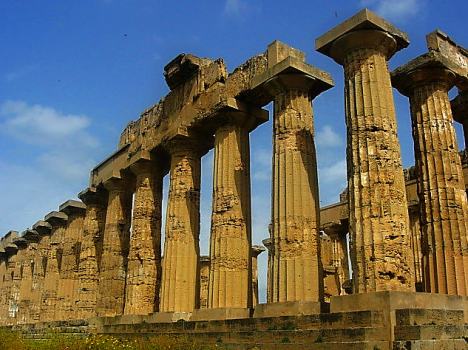
Selinunte is one of the most spectacular ancient Greek archaeological sites in the Mediterranean, yet it remains far quieter than the crowded ruins of Athens or Pompeii. Located on the southwest coast of Sicily, this vast city was founded in the seventh century BC by Greek colonists and grew into a powerful trading centre before being destroyed by Carthaginian forces. The site stretches across a plateau overlooking the sea, dominated by the Eastern Temples, a row of colossal Doric structures whose tumbled columns evoke the scale of classical ambition. Temple G ranks among the largest Greek temples ever built. The nearby museum displays surviving metopes and artefacts that bring the stone ruins back to life.
Selinunte is one of the most important archaeological sites in Sicily. The locality is famous for its spectacular ruins of the ancient Greek city. It was founded in 628 BC by Doric settlers from Megara Hyblaea. It was demolished several times due to the long-term conflict with Carthage and Segesta, and finally destroyed by the Carthaginians in 250 BC. Since then it is devastated.
archaeological site is located west of the railway station Selinunte and consists of two areas: Templi Orientali (Eastern temples) and the Acropolis. Tour through the locations takes 2-3 hours.
Photo licensed under the Creative Commons, created by Chiara Marra
The first area includes three temples, which probably originally had a common protective wall. North Temple, situated at the entrance to the complex, was one of the largest Greek temples ever (113x54metres). Construction began in 550 BC but due to a continuing war threats, the temple was never completed. Only one column survived of the originally 46 columns. On the opposite, southern side of the road leading to the acropolis, is another temple (66x27metres), built between 560-540 BC. It had originally 30 columns. In the purest Doric style is built its southern neighbor (the early 5th century BC). It measures 70x28metres and is reconstructed, so we can admire its 36 columns (four beautiful metopes are stored in the National Museum in Palermo).
From these three temples, you can follow the 1.8 km long winding road leading along one of two Selinunte’s ports to the acropolis. During the way you pass the remains of two other temples that were built in 490 to 480 BC. Then you can find there the Hellenistic temple (the largest and oldest temple in this area, 64x24metres). It dates from the mid-sixth century BC (42 columns of the original 12 left, three metopes are in a museum in Palermo) and finally the last temple (56x24metres) from the years 570 to 554 BC. Furthermore there are the remains of ancient dwellings in the neighborhood. At the northern end of the Acropolis you can see the remains of the former main gate of the ancient fortifications. About a mile away there are the ruins of the Sanctuary of Demeter Malophoros and the remains of three other shrines.
Today the village of Selinunte is a small fishing village with nice beaches.
View Selinunte – ancient Greek archaeological site in Sicily, Italy in a larger map
The Eastern Temples and Temple G
The Eastern Temples are the most immediately recognisable feature of Selinunte. Temple G, the largest of the group, measured 113 metres by 54 metres at its base, making it one of the largest Greek temples ever attempted, comparable in scale to the Temple of Olympian Zeus in Athens. Construction began around 550 BC but was never completed. Of its planned 46 Doric columns, only one remains standing, a single 10-metre drum that gives visitors a sense of the original scale. The column was re-erected in 2020 during a conservation project funded by Europe. The architects employed a distinctive Sicilian style with wider column spacing than mainland Greek temples and a double colonnade around the cella. Temple E, the southernmost of the Eastern group, dates from the early 5th century BC and has been partially reconstructed with 36 columns. Four metopes from Temple E survive in the National Museum of Palermo, depicting the marriage of Hera and Zeus, the Labours of Heracles, and scenes from the Trojan War. These metopes are among the finest examples of Siceliote Greek sculpture, with deeply carved figures that retain traces of their original paint.
The Acropolis and the Sanctuary of Demeter Malophoros
A 1.8-kilometre road from the Eastern Temples leads to the Acropolis, the fortified heart of ancient Selinunte, situated on a plateau overlooking the Mediterranean. The Acropolis contains the remains of five temples built between 580 and 480 BC, defensive walls with towers, and the foundations of residential blocks with visible street grids. The largest temple on the Acropolis, sometimes called Temple O or the Hellenistic Temple, measures 64 by 24 metres and was dedicated to an unknown deity. Beyond the Acropolis walls, a 20-minute walk through scrubland brings you to the Sanctuary of Demeter Malophoros, a sacred area dedicated to the goddess of agriculture and her daughter Persephone. The sanctuary includes a propylon gate, an altar for animal sacrifices, and a small temple with a cella that housed a cult statue. Excavations here uncovered over 12,000 votive terracotta figurines, now displayed in the local museum, showing praying women, fertility symbols, and animal offerings. The museum, adjacent to the site entrance, costs 6 euros and contains a reconstruction of the temple pediments, original clay antefixes, and the famous Selinunte metopes that were not taken to Palermo.
Would you rather explore Greek ruins in Sicily or mainland Greece itself? 🏛️
Explore all our Italy travel guides, from the Dolomites to Sicily.
Explore More
If you enjoyed this article, you might also like:
