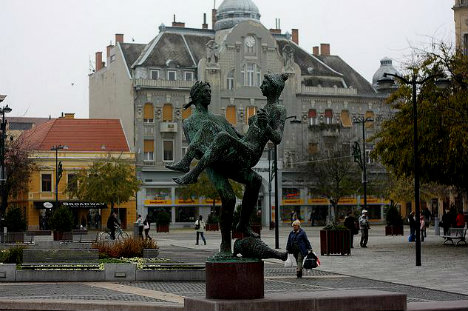
Szombathely claims the title of Hungary’s oldest city, founded by the Romans in 45 AD as Savaria on the Amber Road that linked the Baltic to the Mediterranean. The Iseum, a reconstructed sanctuary of the Egyptian goddess Isis, stands where Roman worshippers once gathered. The ruins of a mosaic-floored palace lie beneath the main square. Baroque and Neoclassical facades line the pedestrian streets, their warm yellow and cream colours glowing in the afternoon sun. Szombathely is a border city, close to Austria, and its atmosphere blends Central European elegance with Hungarian heartiness. The past feels very close here.
\n\n
Szombathely is a city located in the western part of Hungary, near the Hungarian-Austrian border. City with the original name of Savaria was founded in 43 AD and its residents enjoyed the same rights as Roman citizens. They profited from the Amber Road and such could build a beautiful city.
\n
The oldest city of Hungary was known as Savaria – the capital of Pannonia. It has been an important city since the very beginning. There were built the imperial residences, public baths and amphitheater. From Roman times you can see the preserved Savaria Mithraeum shrine, which was discovered during the construction of a new shopping center in 2008.
\n
\nPhoto licensed under the Creative Commons, created by János Tamás
\n
In This Article
Roman Savaria: The Garden of Ruins and the Iseum
\n
In one area of excavation (Romkert Templom tér) you can find the remains of the Forum, which belonged to a civilian city. There are also fragments of the largest mosaic of the Lieutenant-Governor’s Palace. Majority of the most important Roman monuments, including remains of Roman road signs, customs, shops and the medieval castle walls, can be seen in the so-called Garden of Ruins. This open-air archaeological park preserves the foundations of public buildings, columns, and stone inscriptions that document the daily administration of the provincial capital. The most remarkable Roman monument in Szombathely, however, is the Iseum, a reconstructed sanctuary dedicated to the Egyptian goddess Isis. The original temple was built in the 2nd century AD and was one of the largest shrines to an Oriental cult in the entire Roman Empire. The reconstruction, completed in 2011, uses glass and steel to protect the original foundations while recreating the temple’s dimensions and form. Visitors can see the remains of the sacrificial altar, the cella where the statue of Isis stood, and the drainage system used for ritual water ceremonies. The Iseum also hosts exhibitions of Roman artefacts and occasional classical music concerts.
\n
The Savaria Museum and the Roman Amber Road
\n
Once you are in Szombathely you should visit Savaria Museum, which takes care of the fortress foundations, findings from the Mercury Temple and public baths, and almost fifty metres long part of two thousand years old Amber Road. The Amber Road was one of the most important trade routes of the ancient world, connecting the Baltic Sea, where amber was collected, with the Mediterranean civilizations that prized it. The section preserved in the museum cellar shows the original stone paving, with wheel ruts worn by centuries of carts. The cellar is full of Roman altars and blue glass vials found during excavations in Savaria. The first floor of the museum provides an overview of local history, including the collection dedicated to the Romanesque church of Jak. Jak is the nearby small village boasting a Benedictine church, which is one of the finest examples of Hungarian Romanesque architecture, with twin towers and carved stone portals dating from the 13th century.
\n
Baroque Szombathely: The Cathedral and the Synagogue
\n
In Szombathely there is also a huge cathedral designed in 1791 by Melchior Hefele for Bishop János Szily. This Bishop’s double-towered cathedral was covered with stucco and frescoes by Franz Anton Maulbertsch and supported by large marble pillars. It is the largest Baroque church in Hungary. Its interior is decorated with frescoes, paintings and sculptures, which were, however, in 1945 seriously damaged during a bombing and are still restoring. The restoration has been painstaking, with conservators working to recover the original colours of Maulbertsch’s ceiling paintings. The cathedral square, Széchenyi István tér, is the heart of modern Szombathely, lined with cafes, restaurants, and shops in Baroque and Neoclassical buildings. The city also contains a beautiful 19th-century synagogue, restored after decades of neglect, which now serves as a cultural centre hosting concerts and exhibitions. Those are just few of lots of sights you can see here. Szombathely is really worth a visit!
\n
View Szombathely – the oldest city in Hungary in a larger map
\n
\n
Have you visited any of Europe’s oldest cities? 🏺
\n
Explore all our Hungary travel guides, from Budapest baths to the Great Plain.
Explore More
If you enjoyed this article, you might also like:
