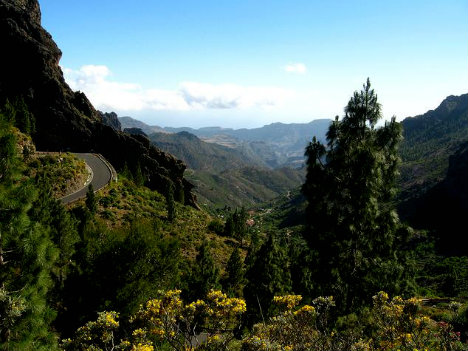
Within a single day on Gran Canaria, you can stand atop a pine-covered mountain peak and then dip your toes into Sahara-warmed sand dunes. This island condenses ecosystems like no other in the Canary archipelago: lush banana plantations in the north, dramatic rock formations in the interior, and resort-lined beaches stretching along the southern coast.
\\n\\n
The island of Gran Canaria is the most diverse island of the whole archipelago – Canary Islands. Often referred as a miniature continent, not only because of the diversity of landscape and environment, but also climate. Once you visit Gran Canaria you feel like you visited three continents instead of one island. There are the sand dunes like in Africa (called Dunas de Maspalomas), mountainous inland and freshwater reservoirs, as can be found in continental Europe, and deep canyons in you can evoke America.
\\n
\\nPhoto licensed under the Creative Commons, created by Hector Garcia
\\n
Canary Islands also feature rocky volcanic peaks. The one on the island of Gran Canaria is called Pico de las Nieves. Its slope descends to the ocean and is cut by numerous canyons. The island is divided into two climatic zones. North is more fertile and wetter, while south is more dry and warmer. Actually, we can say that the whole island is quite diverse.
\\n
In This Article
Best Beaches in Gran Canaria
\\n
Playa Amadores – Beach with white sand lined with various shops and restaurants, has a reputation as one of the most beautiful in the whole of Gran Canaria. Playa Amadores is located near the center of Puerto Rico. Interesting is, that the beach which is located among the rocks has been created artificially to meet the requirements of even the most demanding clientele. The calm, turquoise waters make it ideal for swimming and families with children. Sun loungers and umbrellas are available for rent, and the beachside promenade is lined with restaurants serving fresh seafood and Canarian cuisine.
\\n
Playa del Ingles – The longest beach on the island, located in the middle of Maspalomas. Playa del Ingles is the most visited beach of Gran Canaria with its wide range of services. The beach stretches for over 2.7 kilometres backed by dunes and resort hotels, merging south into the protected Maspalomas sand dunes.
\\n
\\nPhoto licensed under the Creative Commons, created by Juan Sosa
\\n
Inland Treasures: Mountains, Forests, and Charming Towns
\\n
Las Palmas When you visit Las Palmas you should definitely pay for a sightseeing tourist bus. It runs from the city station and take you to all the places that are worth seeing. Additionally, you can easily get off the bus any time, and later get in (with the same ticket) the next bus. The old town of Vegueta features cobbled streets, colonial buildings, and the Casa de Colón where Columbus is said to have stayed. The Cathedral of Santa Ana dominates the square.
\\n
The historic city of Telde
\\nAbout 13 km south of Las Palmas you can see the second largest city on the island – Telde. There is a picturesque basilica of San Juan Bautista, one of the oldest churches in the Canary Islands, built in the 15th century on the site of a former Guanche settlement. Telde also has the widest coastal strip on Gran Canaria with many diverse beaches (such as Hombre, Melenara etc.), each offering different conditions for swimming and water sports.
\\n
Artenara
\\nArtenara is a beautiful mountain village at 1,270 metres, the highest on the island, offering stunning views of forested hills and mountain lakes. The Tamadaba Natural Park surrounds it with Canarian pine forests. Artenara is also known for its cave houses carved into volcanic tuff, some converted into restaurants and accommodation.
\\n
Puerto de Mogan
\\nThe next stop you should certainly do in a picturesque port of Puerto de Mogan. It is indeed a picturesque town where you can meet with genuine Canarian residents and taste some of the local specialities in one of many nice restaurants. Known as “Little Venice” for its canals and flower-bedecked balconies, Puerto de Mogan has a colourful Friday market that attracts visitors from across the island. It is an island full of souvenirs and Spanish specialties. People in Gran Canaria are very hospitable and respectful.
\\n
Do not miss also the botanical garden Jardin Canario in the town of Alta Tafira (southwest of Las Palmas). Admission is free and you can see all the original flora here.
\\n
Activities and Practical Information
\\n
There are two famous ports suitable for Yachtsmen – Puerto Rico and Puerto de Mogan. You can find here both a school for sailors, as well as for divers. Puerto de Mogan is also a paradise for fishermen, because there are strong ocean flows that bring a food for fish. Grand Canaria offers ideal conditions for golf fans, you can even organize your own golf tournament here. The hot favorite for accommodation on this island are well-furnished cave houses. Gran Canaria is the third largest island of the Canary Islands, it is also one of the most popular and therefore most vibrant tourist destinations in this area. The capital is Las Palmas. Varied landscape consists of sand dunes which you can enjoy from the camel back, palm and pine groves, and also of inland mountain forests. Thanks to the favorable climate the island is also suitable for banana trees. Very famous is spectacular botanical garden Palmitos Park – an artificial oasis in the canyon near Playa del Inglés.
\\n
View Gran Canaria – the most diverse island of Canary Islands Spain in a larger map
\\n
\\n
Which Gran Canaria landscape would you explore first: dunes or pine forest? 🏔️
\\n
Explore all our Spain travel guides, from Barcelona Gaudí to Andalusia plazas.
Explore More
If you enjoyed this article, you might also like:
