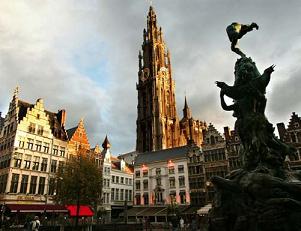
The Scheldt River carries ocean-going vessels into the heart of Antwerp, a city that has been a centre of global trade for five centuries. This Belgian port ranks among the largest in Europe, handling over 200 million tons of cargo each year. But Antwerp is far more than its docks. The old town centres on the Grote Markt, a square surrounded by ornate guild houses and dominated by the towering Cathedral of Our Lady, home to masterpieces by Rubens. Diminutive alleys lead to hidden courtyards and the city’s famous diamond district, where billions of euros in precious stones change hands each year.
In This Article
Cathedral of Our Lady and the Rubens Masterpieces
The Cathedral of Our Lady in Antwerp is the tallest Gothic church in the Low Countries. Its single completed spire reaches 123 metres into the sky, and a second spire of equal height was planned but never built due to lack of funds. Construction began in 1352 and continued for 169 years, with the building finally consecrated in 1521. The interior houses four masterpieces by Peter Paul Rubens, the Flemish Baroque painter who lived and worked in Antwerp during the 17th century. The most famous of these is The Elevation of the Cross, a triptych painted between 1610 and 1611 for the cathedral’s high altar. The central panel depicts Christ being raised on the cross, with the muscular straining of the executioners contrasting against the pale, serene body of Christ. The painting is remarkable for its dramatic use of light and shadow, a technique Rubens learned during his eight years studying in Italy. Opposite hangs The Descent from the Cross, widely considered Rubens’s greatest masterpiece, completed in 1614. The composition is a diagonal line of grief: the white cloth supporting Christ’s body runs from the upper left to the lower right, drawing the viewer’s eye through every expression of sorrow on the faces surrounding him. The cathedral also contains a richly carved Baroque pulpit, a monumental organ with 90 registers and 5,770 pipes, and a treasury displaying reliquaries, chalices, vestments, and devotional objects spanning six centuries. Entry costs 12 euros, and audio guides are available in eight languages. The cathedral square, the Groenplaats, is lined with cafes where visitors can sit and admire the facade with a Belgian beer in hand.
The Diamond District: The World Centre of the Diamond Trade
Antwerp has been the global centre of the diamond trade for more than 500 years. The Diamond District, centred on Hovenierstraat and the nearby Pelikaanstraat, occupies just two square blocks near the Central Station, yet it handles approximately 84 percent of the world’s rough diamonds and 50 percent of all cut diamonds. The trade is concentrated in the hands of a few thousand traders, many from Orthodox Jewish, Jain Indian, and Armenian communities who have been in the business for generations. Transactions worth millions of euros are conducted on trust, often with nothing more than a handshake and a whispered price. The district operates on a 24-hour cycle, coordinating with diamond exchanges in Mumbai, New York, and Tel Aviv. The DIVA museum, located at Suikerrui 17-19, tells the story of Antwerp’s diamond heritage through a collection of 1,500 objects. The permanent exhibition includes raw diamonds straight from the mine, cut and polished stones of exceptional quality, and finished jewellery spanning five centuries. One gallery focuses on the science of diamond cutting, using interactive displays to demonstrate how the angles of a cut determine the stone’s brilliance. Another gallery addresses the ethical dimension of the trade, including the problem of conflict diamonds and the development of the Kimberley Process certification system. Entry costs 14 euros. For visitors who want to see diamond cutters at work, several workshops in the district offer viewing windows where you can watch the precise art of faceting transform a rough stone into a brilliant gem. The entire process, from planning the cut to polishing the final facet, can take several weeks for a single stone.
Antwerp’s Cultural Scene, Shopping, and Nightlife
Beyond the cathedral and the diamonds, Antwerp is a city of culture and style. The fashion scene is world-renowned, having produced the Antwerp Six, a group of avant-garde designers who graduated from the Royal Academy of Fine Arts in the 1980s and put the city on the global fashion map. The ModeMuseum, or MoMu, on the Nationalestraat showcases contemporary fashion and has become a pilgrimage site for fashion enthusiasts from around the world. The city’s art scene extends beyond Rubens; the Museum of contemporary Art Antwerp, known as M HKA, presents rotating exhibitions of modern and contemporary art, and the FotoMuseum celebrates photography from the 19th century to the present day. The nightlife in Antwerp is concentrated around the Grote Markt, the Meir shopping street, and the renovated docklands of t Eilandje in the north. This former port area has been transformed into a lively district of bars, clubs, and restaurants housed in converted warehouses. The MAS Museum, a striking red sandstone tower on the old docks, offers a rooftop panoramic view of the entire city and harbour. The museum’s exhibitions cover Antwerp’s maritime history, its role in global trade, and the cultural diversity that has defined the city for centuries. The Zurenborg district, east of the city centre, is famous for its Art Nouveau architecture and quiet streets lined with townhouses that rival anything in Brussels or Paris.
Would you visit Antwerp for the port, the art, or the diamonds? 💎
Explore all our Belgium travel guides, from Bruges canals to Brussels Grand Place.
Explore More
If you enjoyed this article, you might also like:
- Belgium – heart of Europe – Belgium
- Bruges – Venice of the North | Belgium – Belgium
- Gravensteen Castle in Belgium – Belgium
