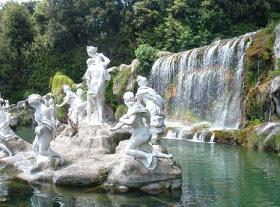
Scale meets spectacle at the Royal Palace of Caserta, a colossal eighteenth century residence that rivals Versailles in ambition. The palace stretches over an astonishing forty seven thousand square meters, with twelve hundred rooms connected by a grand staircase that seems to ascend into infinity. Behind the palace, the English Garden unfolds as a masterpiece of landscape design, with cascading waterfalls, classical statues, and exotic plant species arranged around ornamental lakes. King Charles VII of Naples envisioned this palace as the centerpiece of a new capital. Walking through its halls and gardens, you feel the weight of royal ambition in every marble corridor.
In This Article
The History and Architecture of the Royal Palace
The Royal Palace of Caserta (Reggia di Caserta) is the former Baroque residence of the Bourbon family, situated in the town of Caserta in Campania, southern Italy. It ranks among the largest and most extensive constructions in Europe and was the largest palace and one of the largest buildings erected in Europe during the 18th century. King Charles VII of Naples (later Charles III of Spain) commissioned the architect Luigi Vanvitelli to begin construction in 1752, inspired by the grandeur of Versailles and the Royal Palace of Madrid. Charles wanted a palace that would rival the great courts of Europe and serve as a symbol of Bourbon power in the Kingdom of Naples. In 1759, Charles III succeeded to the Spanish throne and could no longer manage both kingdoms, leaving the unfinished palace to his son Ferdinand, who became Ferdinand IV of Naples.
The ground plan measures 247 by 184 metres, and the palace contains 1,200 rooms spread across five floors. The grand staircase, considered one of the most beautiful in Europe, connects the various levels with marble balustrades and vaulted ceilings adorned with frescoes. The palace chapel, modelled after the Palace of Versailles’s chapel but with distinct Neapolitan flourishes, features a stunning altar and detailed religious paintings. The palace was designated a UNESCO World heritage Site in 1997, recognised for its outstanding universal value as a masterpiece of Baroque and Neoclassical design. Vanvitelli’s layout was so well conceived that the building continues to function effectively as an administrative and cultural centre, housing government offices alongside the museum spaces, a testament to the enduring quality of its design.
The magnificent Park and Gardens
The Royal Palace of Caserta has one of the most scenic parks in the world, scattered with fountains, waterfalls, and ornamental basins. The gardens, partly English and partly inspired by French models, are adorned with statues created by the finest Neapolitan sculptors under the guidance of Carlo Vanvitelli, Luigi’s son. The central avenue extends three kilometres from the palace gate to the Great Waterfall, flanked by formal parterres, wooded groves, and a series of decorative pools and fountains. Although the original design was much more ambitious, economic constraints led to some reductions, but the result remains breathtaking. The park features several notable fountains, including the Fountain of Diana and Actaeon, depicting the mythological scene of the hunter surprised by the goddess; the Fountain of Venus and Adonis; the Fountain of the Dolphins; the Fountain of Aeolus; and the Fountain of Ceres. Each fountain tells a classical myth through its sculptural groups, and the waterworks were designed to operate entirely by gravity, a remarkable engineering achievement for the 18th century.
The English Garden, a later addition commissioned by Queen Maria Carolina, offers a more naturalistic landscape with exotic plant species, winding paths, artificial ruins, and a picturesque lake. This section of the park reflects the Romantic taste for wild, untamed nature that swept through European garden design in the late 18th century. The 120-hectare park can be explored on foot, by bicycle, or via the shuttle service that runs along the main avenue connecting the key points of interest. A stroll through the entire length of the park, from the palace to the Great Waterfall and back via the English Garden, makes for a wonderful half-day outing, with plenty of shaded benches along the way where visitors can rest and admire the views.
Visiting the Palace and Practical Information
A visit to the Royal Palace of Caserta requires at least half a day to appreciate both the interior and the park. The palace apartments showcase the Bourbon court’s lavish lifestyle, with the Throne Room, the Palatine Chapel, and the private quarters of the royal family among the highlights. The palace is located about 30 kilometres north of Naples and is easily reached by train from Naples Central Station, making it an ideal day trip from the city. Trains run frequently from Napoli Centrale to Caserta station, with the journey taking approximately 40 minutes. Combined tickets for the palace and park are available, and guided tours provide historical context that enriches the experience. The palace also houses the Italian Air Force Academy and occasionally hosts state functions, adding a layer of living history to its walls. The best times to visit are spring and autumn, when the gardens are at their most colourful and the weather is mild for walking the long avenues between the fountains. Summer visits are best undertaken early in the morning or late in the afternoon to avoid the midday heat, while winter offers the advantage of smaller crowds and a quieter, more contemplative atmosphere in the grand halls.
View The Royal Palace of Caserta with the Park in Italy in a larger map
Would you explore all twelve hundred rooms of this palace, or is the garden more your style? 🏛️
Explore all our Italy travel guides, from the Dolomites to Sicily.
Explore More
If you enjoyed this article, you might also like:
