London has 8.9 million residents, 170 museums, and roughly 10,000 restaurants. The Tube moves 3 million people every weekday. The city is a collection of villages that grew together over 2,000 years, and the top sights are not a checklist to be ticked. They are the places worth slowing down for. Here are the ones that justify your time.
\\n\\n
In This Article
The British Museum: Two Million Years Under One Roof
\\n
The British Museum in Bloomsbury holds over 8 million objects spanning two million years of human history. The Great Court, covered by a glass-and-steel roof designed by Norman Foster in 2000, is the largest covered public square in Europe. The must-see items on a first visit are the Rosetta Stone (196 BC, the key to deciphering Egyptian hieroglyphs, in the Egyptian Sculpture Gallery), the Parthenon Marbles (the Elgin Marbles, 5th century BC, taken from the Parthenon in Athens by Lord Elgin between 1801 and 1805), and the Lewis Chessmen (12th century walrus ivory chess pieces found on the Isle of Lewis, Scotland, in 1831). Entry is free. The museum receives 6 million visitors per year. Visit on a weekday at 10am to avoid the worst crowds.
\\n\\n
The Tower of London: A Fortress with Nine Lives
\\n
The Tower of London has served as a royal palace, a prison, an arsenal, a mint, a zoo, and a jewel house since William the Conqueror built the White Tower in 1078. The Crown Jewels, including the Imperial State Crown set with 2,868 diamonds, are housed in the Jewel House. The ravens, six of them, are kept under royal decree. The legend says that if the ravens leave the Tower, the kingdom will fall. The Yeoman Warders, known as Beefeaters, have guarded the Tower since 1485. Their guided tour, the Yeoman Warder Tour, lasts 45 minutes and is included in the admission price. The entrance fee is 33.60 pounds for adults.
\\n\\n
Westminster Abbey: Every Coronation Since 1066
\\n
The Abbey on the north bank of the Thames has hosted every English and British coronation since William the Conqueror in 1066. It holds 3,300 burials, including Chaucer, Darwin, Newton, and Dickens. Poet’s Corner alone contains memorials to over 100 writers. The Gothic architecture, built between 1245 and 1272 under Henry III, features the tallest Gothic nave in England at 31 metres. The Cosmati pavement, a 13th-century mosaic floor in front of the high altar, is made of coloured glass, stone, and gold. Entry is 27 pounds for adults. The Abbey receives 1.5 million visitors annually.
\\n\\n
The South Bank: Culture on the Thames
\\n
The South Bank stretches 2.3 km from the London Eye to Tower Bridge along the southern side of the River Thames. The National Theatre, the Tate Modern (housed in the former Bankside Power Station, opened in 2000), the Shakespeare’s Globe Theatre (a reconstruction of the 1599 original, built in 1997), and the BFI IMAX cinema are strung along the river. The walk itself, between the Jubilee and Millennium Bridges, is one of the best free experiences in London. Street performers, pop-up food markets, and views of the Houses of Parliament across the river make every visit different. The South Bank was redeveloped for the Festival of Britain in 1951 and has been London’s cultural spine ever since.
\\n\\n
Which London sight lived up to its reputation and which one did not match the hype?
\\n
\\n
Looking for more British travel inspiration? Check out our other guides to the United Kingdom and start planning your next European adventure!
London is not only England’s capital but also the biggest city in Western Europe. A huge sprawling, buzzing metropolis that offers the budding traveller a wide range of activates to keep them occupied. But like any big city London hotels, food and tourist activities can cost a pretty penny, so you have to pick and choose what you need to do.
\\n
But where should you go and what should not be missed? There is so much to do you can’t cram it into one trip. Well to help you along here are my top five recommendations.
\\n
1) Buckingham Palace
\\nBuckingham Palace has served as the official London residence of Britain’s sovereigns since 1837 and is the current residence of Queen Elizabeth II. Though much of it remains private the state rooms are open to public view during the summer season. It will also play host to the Royal family during the wedding of Prince William and Kate Middleton, where they will stand on the balcony and wave to well wishers immediately after their wedding ceremony at Westminster Abbey.
\\n

\\nPhoto licensed under the Creative Commons, created by shining.darkness
\\n
Read more about Buckingham Palace here.
\\n
2) The Collegiate Church of St Peter, Westminster Abbey, as it is also known, is the traditional place of coronation and burial site for English monarchs. It is a place steeped in history and one that is well worth a visit – though don’t forget it is closed to the public when hosting special events so don’t try and sneak in to see Will and Kate tie the knot!
\\n

\\nPhoto licensed under the Creative Commons, created by Hyougushi
\\n
Read more about Westminster Abbey here.
\\n
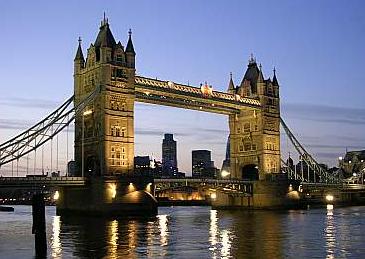
3) The Tower Of London and Tower Bridge
\\nAnother one of the City’s iconic buildings find out all about London’s grizzly past (and watch out for ghosts!) at the Tower Of London and the nearby Tower Bridge. The Tower was founded by King William the Conqueror in 11th Century and has served as, among others, a royal palace, fortress, prison and place of execution. The crown Jewels are also stored here and the ghost of Anne Boleyn, beheaded in 1536 for treason against King Henry VIII, is said to walk around the tower carrying her head under her arm.
\\n

\\nPhoto licensed under the Creative Commons, created by Edwin Lee
\\n
4) London Eye
\\nIf you are lucky, and get to the wheel during a clear day you can see up to 50 kilometres far. It provides you a great view of Westminster and Buckingham Palace. This attraction is very popular among tourists, so during the visit you should count with the long queues, but also a strong inspection of you and your bag.
\\n

\\nPhoto licensed under the Creative Commons, created by Martie Swart
\\n
You can read more about London Eye here.
\\n
5) Wembley Stadium
\\nOk, football may not be for everyone but if you are a sports fan the Wembley Stadium – the home of English football – should not be missed. The iconic twin towers were demolished in 2000 along with the rest of the aging stadium and have been replaced with a state-of-the-art 90,000 capacity arena. There is though a museum detailing the history of the ground and English football in general, well worth it.
\\n

\\nPhoto licensed under the Creative Commons, created by Martin Pettitt
\\n
6) Endless Museums – for free
\\nEven if you saved cash by booking your accommodation at Hotels.com and were savvy with your tourist cash. If your wallet is still a little light then don’t fret, there are endless other things that can be done for free. Not least London’s excellent collection of Museums such as the British Museum, the Natural History Museum, Tate Modern and the National Gallery – all with free entry. There are also endless parks and green spaces dotted across the city if you are lucky and visit London on those rarest of days – hot and sunny!
\\n
7) Trafalgar Square & Nelson’s Column
\\nTrafalgar Square is located in Westminster and commemorates the victory in the Battle of Trafalgar, which took place in 1805. In the middle of Trafalgar Square stands Nelson’s Column, which is surrounded by fountains and four huge bronze statues of lions. Trafalgar Square is the vibrant heart of London and the best starting point for exploration of its central part.
\\n
\\n\\n
Explore More
\\n
If you enjoyed this article, you might also like:
\\n
- \\n
- Charming Chantilly | France – France
- Selinunte – ancient Greek archaeological site in Sicily, Italy – Italy
- Torre de Hércules – the oldest active lighthouse in the world | Spain – Sights
\\n
\\n
\\n
\\n