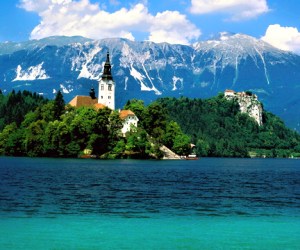
Slovenia is a small country with great nature, a green jewel tucked between the Alps, the Mediterranean, and the Pannonian Plain that crams an extraordinary diversity of landscapes into an area smaller than Wales: Alpine peaks (the Julian Alps and Triglav, the national symbol), turquoise rivers (the Soča, arguably the most beautiful river in Europe), a tiny but exquisite stretch of Adriatic coastline, the subterranean wonderland of the Karst (more than 10,000 caves, including the spectacular Postojna Cave and the UNESCO-listed Škocjan Caves), and Ljubljana, one of Europe’s smallest and most charming capital cities, whose car-free centre is presided over by a fairy-tale castle and criss-crossed by the willow-lined Ljubljanica River. Slovenia’s slogan, “I Feel Slovenia”, is marketing fluff and yet it captures something real: this is a country that you feel, a country whose love of the outdoors (hiking is essentially the national religion, and with the Alps and the forests of the Karst on the doorstep, it is easy to understand why) and whose commitment to sustainability (Ljubljana was the European Green Capital in 2016) create a genuine sense of harmony between the built and natural environment. Slovenia is also, like its neighbour Croatia, a country still in the process of being discovered by mass tourism, for now, the crowds are manageable, the prices fair, and the sense of authenticity high.
Quick Facts: Slovenia Travel Guide
- Best time to visit Slovenia: May–September for hiking, the lakes, and the best weather; July–August is peak season in Lake Bled and the Julian Alps (book accommodation ahead); the Soča Valley is at its most beautiful in May–June when the snowmelt turns the river an impossible shade of turquoise; September–October for the autumn colours in the Alps and the grape harvest in the wine regions of Goriška Brda and the Vipava Valley; December for Ljubljana’s atmospheric Christmas market along the river; the caves are open year-round
- Top attractions in Slovenia: Lake Bled, the island church, the clifftop castle, and the surrounding mountains make this Slovenia’s most famous image (arrive early, by 9am the lake path is busy); Lake Bohinj, Bled’s quieter, wilder sibling in the Triglav National Park, preferred by Slovenians themselves; Predjamski Grad, the castle built into a cave mouth that has to be seen to be believed (read our Predjama Castle guide →); the Postojna Cave and the nearby Škocjan Caves (UNESCO); the Soča River Valley, the turquoise river, the town of Bovec (adventure sports capital), and the WWI history of the Isonzo Front; Ljubljana, the castle, the Triple Bridge, and the riverside café culture; and Piran, the tiny Venetian-style port on Slovenia’s 47 kilometres of coastline
- How to get to Slovenia: Ljubljana Jože Pučnik Airport (LJU) has European connections; Venice Marco Polo (VCE), Trieste (TRS), and Zagreb (ZAG) are alternative gateways within 1.5–2 hours of Ljubljana; Ljubljana is well-connected by train to Vienna (~6h), Zagreb (~2.5h), and Budapest (~8h)
- Currency: Euro (€)
- Language: Slovenian, a Slavic language with strong Italian and German influences; English is widely spoken, especially among younger Slovenians
- Best for: Hikers, cave enthusiasts, romantics (Lake Bled and the Soča Valley are honeymoon-worthy), and anyone seeking an Alps-meets-Mediterranean experience in a country where everything is within a two-hour drive
Slovenia, officially the Republic of Slovenia, is a young country in Central Europe touching the Alps and bordering the Mediterranean. Slovenia borders Italy on the west, the Adriatic Sea on the southwest, Croatia on the south and east, Hungary on the northeast, and Austria on the north. The capital and largest city of Slovenia is Ljubljana.
Slovenia covers an area of 20,273km2 and has a population of 2.06 million. Around 40% of Slovenia’s land mass is elevated land – mostly in the form of mountains and plateaus – which is located in the interior regions of the country. The highest point of Slovenia is the 2,864m high Mount Triglav, the lowest point is the Adriatic Sea at sea level. The Slovenian coast is 47 km long and is very charming.
The majority of the population speaks Slovene which is also the country’s official language. Other local official languages are Hungarian and Italian.
As the vacation centers are mainly used Isola and Portoroz. On the way to the sea, we recommend a small break in Lipica, where they still kept the pride of Slovenia, known for white Lipizzaners. In Slovenia there is one of the largest cave systems in the world – Postojna Jama, a 20-kilometer system of tunnels, and the nearby medieval castle Predjamski. At the north east of the country you can visit beautiful Triglav National Park and Lake Bled, like cut from a fairy tale. In the middle of Lake Bled there is Bled island with the ancient castle on it.
Slovenia may be, more than any other country, marked as a “thermal paradise“. An incredible amount of thermal springs are mainly located in the northeast of the country where you can find lots of of spas.
Slovenia is a beautiful country with lots of undiscovered beauty, suitable for all romantic souls, and especially those who want to enjoy well deserved vacation.
Slovenia is a country of high mountains, is full of forests and lakes, impressive cave systems, medicinal springs and crystal clear sea. It has great culinary traditions, within which you can taste fine wines or traditional fruit brandy, combined with excellent food coming from the sea, rivers, forests and green meadows. It is a country where on a relatively small area there is everything one needs to spend an active holiday.
Have you rowed to Bled’s island church, hiked the Soča Valley’s turquoise river, or explored Slovenia’s underground wonders? Share your Slovenian adventures in the comments! 🇸🇮
Explore all our Slovenia travel guides, from the Julian Alps to the Adriatic coast.
Explore More
If you enjoyed this article, you might also like:
- Germany – rich and the most populous country of Europe – All Countries
- Malta – diving paradise – All Countries
- Vrtoglavica Cave – cave with the deepest single vertical drop (pitch) in the world | Slovenia – Nature
