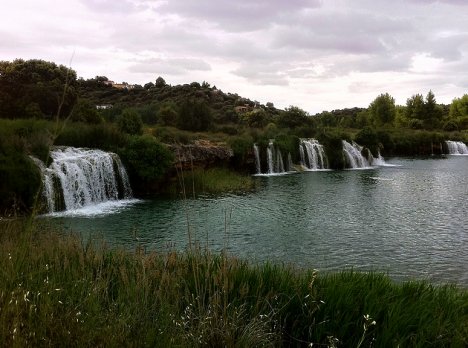
The Ruidera Lagoons (Lagunas de Ruidera) are a unique natural wonder in central Spain, a chain of 15 interconnected turquoise-blue lakes stretching for 30 kilometres along the Pinilla River valley on the border of Castilla–La Mancha, formed by travertine barriers that create a natural staircase of cascading pools reminiscent of Plitvice Lakes on a smaller, more intimate Spanish scale. This Natural Park, declared a Biosphere Reserve by UNESCO, is one of the most beautiful inland swimming and kayaking destinations in Spain, and one of the least known to international visitors outside of Spain.
In This Article
Quick Facts: Ruidera Lagoons
- Best time to visit: June–September for swimming in the lakes; the water is fresh and clear, and the surrounding landscape of olive groves and vineyards is typically La Mancha, flat, golden, and beautiful in its austerity
- How to get there: ~2.5 hours from Madrid by car (~2 hours from Albacete); the lagoons are near the town of Ruidera
- Activities: Swimming, kayaking, hiking the sendero del río Pinilla trail, and visiting the Cave of Montesinos (a site from Cervantes’ Don Quixote)
Ruidera Lagoons (Lagunas de Ruidera) is a unique natural park located in the southern part of Spain, 240km south of Madrid and 270km west of Valencia. Natural park consists of 16 lagoons located above the La Mancha plain and covers an area of more than 38 square kilometres. The lagoons are connected by waterfalls, rivers and underground streams and the area is considered as the source of Guadiana River.

Photo licensed under the Creative Commons, created by fraboof
Ruidera Lagoons are also called “The mirrors of La Mancha.” The natural park has been established in 1979. Its largest lakes are Laguna Colgada and Laguna del Rey. There are lots of tourists visiting this place every year, so this area offers a number of accommodation possibilities. You can find here small hotels, restaurants, camping sites and private villas, located mostly in or around Ruidera town. You can get to the lagoons from Villahermosa or Tomelloso towns.
The local climate is Mediterranean, characterized by strong fluctuations in temperature, maximum of 43 ºC and minimum of -13 °C, an average annual temperature is around 14 ºC, being the hottest month of July and the coldest month of January. The total rainfall is low, reaching around 400mm per year.
Ruidera Lagoons are considered one of the most interesting natural spaces and beautiful wet lands in the Iberian Peninsula.
View Ruidera Lagoons in Spain in a larger map
The Chain of Fifteen Lakes Explained
The Ruidera Lagoons form a remarkable hydrological system in which fifteen interconnected lakes cascade down the valley in a natural staircase, each separated by travertine barriers that have formed over thousands of years. These barriers are created by calcium carbonate deposits left behind by the water as it flows over mosses and aquatic plants, slowly building up natural dams that trap the water behind them and create distinct lake levels. Each lake has its own character, depth, and water colour, ranging from deep emerald green to brilliant turquoise depending on the mineral content and depth. The largest lakes are Laguna Colgada and Laguna del Rey, both popular for swimming and kayaking during the summer months. Unlike Plitvice Lakes in Croatia, which the system superficially resembles, visitors to Ruidera are permitted to swim in most of the lagoons, making this a uniquely interactive natural experience.
Flora, Fauna and the Landscape of La Mancha
The Ruidera Lagoons sit at the heart of the La Mancha plain, a landscape immortalised by Miguel de Cervantes in Don Quixote and known for its wide horizons, olive groves, and vineyards. The lagoons themselves create a rich wetland ecosystem that supports a surprising diversity of wildlife in an otherwise dry region. Birdlife is particularly abundant, with herons, egrets, kingfishers, and the rare white-headed duck all making their home among the reeds and open waters of the lakes. The surrounding vegetation includes holm oaks, gall oaks, and Mediterranean scrub, with tamarisk trees lining the water’s edge. The climate is continental Mediterranean, characterised by hot summers that can reach 43 degrees Celsius and cold winters that occasionally drop to minus 13 degrees Celsius. The water that feeds the system comes from underground aquifers that collect rainfall from the nearby Sierra de Alcaraz mountains, emerging through springs that maintain a steady flow even during the driest months.
Don Quixote’s Connection and Cultural Attractions
The Ruidera Lagoons occupy a special place in Spanish literary history as the setting for several episodes of Miguel de Cervantes’ Don Quixote, the most famous work of Spanish literature. The nearby Cave of Montesinos, which overlooks one of the lagoons, is the site where Don Quixote descended into the underworld in one of the novel’s most memorable chapters. The surrounding region of Castilla-La Mancha is dotted with windmills, castles, and whitewashed villages that evoke the world of the ingenious gentleman of La Mancha. The town of Ruidera itself offers a range of accommodation from small family-run hotels to camping sites and private villas, with local restaurants serving traditional Manchego cuisine including grilled lamb, pisto manchego, and the region’s famous Manchego cheese. Visiting the lagoons in conjunction with the windmills of Consuegra or Campo de Criptana creates a perfect weekend itinerary combining nature and Spanish cultural heritage.
Have you swum in the Ruidera Lagoons or discovered Spain’s inland lakes? Share your Castilla–La Mancha discoveries in the comments! 💧
Explore all our Spain travel guides, from Barcelona Gaudí to Andalusia plazas.
Explore More
If you enjoyed this article, you might also like:
