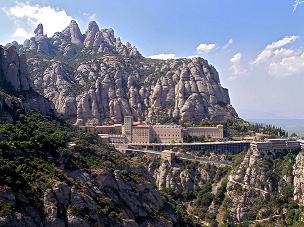
The mountain range rises 1,236 metres above the Catalan lowlands, 50 km northwest of Barcelona. Montserrat means “serrated mountain” and the shape is unmistakable: a jagged ridge of grey conglomerate rock that looks like a saw blade against the sky. The Benedictine monastery, Santa Maria de Montserrat, has been here since 1025. The mountain holds the statue of La Moreneta, the Black Virgin, patron saint of Catalonia. Every year, 2.5 million visitors make the journey up the mountain.
In This Article
The Black Virgin: La Moreneta
The statue of the Virgin of Montserrat, carved from poplar wood in the 12th century, stands 95 cm tall. The black colour of the face and hands is caused by the oxidation of a varnish layer, possibly from candle smoke accumulated over centuries. The legend says the statue was discovered by shepherds in 880 after they saw a light descending from the sky. A chapel was built on the spot. The statue sits above the altar in the sanctuary, accessible by a staircase built in 1946. Visitors touch the sphere held in her right hand, which has been polished smooth by 70 years of fingers. The entrance to the sanctuary is free. The queue to touch the Virgin’s sphere averages 20 minutes in peak season.
The Monastery: A Thousand Years of Benediction
The monastery was founded in 1025 by Abbot Oliba, who also founded the monasteries of Santa Maria de Ripoll and Sant Miquel de Cuixa. The current basilica was built between 1560 and 1592, with the facade reconstructed in the 19th century after Napoleonic troops destroyed the original. The basilica measures 70 metres long and 40 metres wide. The Escolania de Montserrat, the boys’ choir, has sung here since the 14th century. The choir consists of 50 boys aged 9 to 14 who board at the monastery school. Their daily performance, Salve Regina and Virolai, is at 1pm and 7pm. The monastery complex includes a museum with works by El Greco, Caravaggio, Picasso, Dali, and Monet.
The Rock Formations: What to Hike and Where to Look
Montserrat’s rock formations were created by erosion of a conglomerate delta deposited 20 million years ago. The most famous, Sant Jeroni, is the highest point at 1,236 metres. The hike from the monastery to the top takes 90 minutes along the Sant Miquel path, a stone staircase cut into the cliff. The view from the summit includes the Pyrenees on a clear day, the island of Mallorca on very clear days, and the entire Barcelona coastline. The Santa Cova path leads from the monastery to the cave where the Virgin was discovered according to tradition. The funicular, the Funicular de Sant Joan, climbs 262 metres in 3 minutes and costs 6.50 euros return.
What did you feel at Montserrat when you first saw the mountain or touched the Virgin’s sphere?
Explore all our Spain travel guides, from Barcelona Gaudí to Andalusia plazas.
Explore More
If you enjoyed this article, you might also like:
