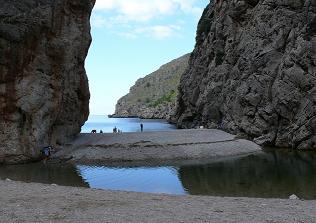
Rushing water echoes between towering limestone walls as you enter the Torrent de Pareis Gorge on Mallorca’s rugged coast. This dramatic canyon, carved by a torrent over millions of years, narrows to a passage where the sky becomes a sliver of brilliant blue high above. Smooth pebbles crunch beneath your feet as you follow the dry riverbed toward the sea. The walls rise over two hundred metres on either side, their surfaces weathered into fantastical shapes by wind and water. At the gorge’s end, the Mediterranean appears suddenly, turquoise waves lapping at a pebble beach enclosed by stone giants.
Geology and Natural Formation
Torrent de Pareis is one of the largest Mediterranean gorges and canyons, a dramatic incision in the landscape that offers some of the most spectacular scenery on the island. It is located on the west coast of the Spanish island of Mallorca, near the village of Sa Calobra, within the Serra de Tramuntana mountain range, a UNESCO World heritage site valued for its cultural and natural significance. Torrent de Pareis got its name from the stream Pareis that carved the canyon over millions of years through the limestone bedrock, slowly cutting down through the rock as the island rose from the sea due to tectonic forces. The most interesting entry into the canyon is by the sea from the village of Sa Calobra through two narrow tunnels carved into the rock, which were created to provide access to the coast for local fishermen. These tunnels lead to the coast where the stream Pareis flows into the sea, creating a stunning contrast between the dark interior of the canyon and the bright Mediterranean beyond. In summer the stream dries up along its course, allowing tourists to bathe on the beautiful pebble beach at the mouth of the canyon. It is also possible to enter the Torrent de Pareis from the upper village of Escorca, following the dry riverbed downstream. The entire canyon is 7 km long, and the total height from the sea to the highest point is 720 metres. The canyon is surrounded by steep rocky walls that in the deepest places reach a height of 400 metres, creating a sense of being enclosed by the mountain itself. At the bottom of the canyon you can see a small salt lake created by the sea tide, where the water rises and falls with the rhythm of the Mediterranean.
The Gorge Hike and Sa Calobra Beach
The Torrent de Pareis hike begins at Escorca village, descending through the gorge to the sea along a route that demands respect for the power of nature. The route covers 8 kilometres over three to four hours, requiring sturdy footwear for boulder-hopping over smooth limestone that can be treacherous when wet. The best months are March to June and September to October when temperatures are moderate and the stream bed is dry, avoiding both the summer heat and the winter rains that can make the gorge dangerous. In the canyon walls you can find caves that were dug by rainwater seeping through the limestone over thousands of years, which has also created many water tunnels and deep lakes hidden within the canyon system. During your hike through Torrent de Pareis you will see huge rocky blocks, pieces of canyon walls that broke off over the years due to erosion and fell to the ground, creating obstacles that hikers must navigate around. The entire area of Torrent de Pareis has been declared a significant natural heritage site for its geological and biological value, protecting the unique ecosystem that has developed in this sheltered environment. The hike ends at Sa Calobra beach, a pebble cove enclosed by 200-metre cliffs where hikers can cool off in the Mediterranean after their strenuous descent. Return transport to Escorca requires a pre-arranged taxi, as there is no regular public transport connecting the beach to the mountain village. The bus from Port de Soller costs 3 euros and runs three times daily during the summer season, making it possible to complete the hike without a car.
View Torrent de Pareis Gorge – Mallorca’s greatest natural wonder | Spain in a larger map
Have you ever hiked through a gorge that opened onto a hidden beach? 🌊
Explore all our Spain travel guides, from Barcelona Gaudí to Andalusia plazas.
Explore More
If you enjoyed this article, you might also like:
