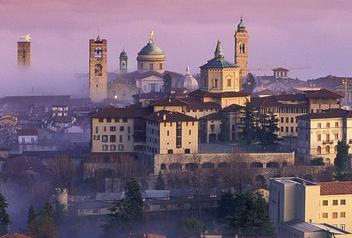
Bergamo is one of northern Italy’s most beautiful and authentic cities, a tale of two levels: the Citta Alta (upper City), an enchanting medieval and Renaissance hill town enclosed by 16th-century Venetian walls (a UNESCO World heritage site), and the Citta Bassa (Lower City), a lively modern Lombard city whose Piazza Matteotti and elegant streets provide a striking contrast to the ancient world above. The funicular from the lower town to the Citta Alta is one of the most dramatic urban entries in Italy, 16th-century bastions, terracotta rooftops, and, on a clear day, the distant peaks of the Alps and the skyscrapers of Milan, 50 kilometres to the southwest.
In This Article
Exploring the Citta Alta: A Walk Through Medieval Bergamo
The upper city is where Bergamo reveals its true character. Enclosed within Venetian walls constructed in the 17th century, the Citta Alta is a labyrinth of narrow cobblestone alleys, hidden courtyards, and grand piazzas. Piazza Vecchia forms the social and architectural heart of the upper town, flanked by the Palazzo della Ragione, the Palazzo Nuovo (now the Biblioteca Angelo Mai), and the Torre Civica. Climbing the tower rewards visitors with a panoramic view that stretches from the terracotta rooftops of Bergamo to the distant spires of Milan’s skyscrapers and, on exceptionally clear days, the snow-capped peaks of the Alps. The basilica di Santa Maria Maggiore, begun in the 12th century, is a masterwork of Romanesque architecture with a richly decorated interior that includes Renaissance tapestries and a cosmatesque marble floor. Next to it stands the Cappella Colleoni, a jewel of Renaissance art built as a mausoleum for the condottiero Bartolomeo Colleoni, its polychrome marble facade one of the most photographed sights in northern Italy. Walking the Venetian walls at sunset, when the stone glows pink in the fading light, is one of the most romantic experiences Lombardy has to offer.
The Citta Bassa and Modern Bergamo
Below the walls, the lower city pulses with a different energy. Bergamo’s modern centre revolves around Piazza Matteotti and the elegant Via XX Settembre, where shops, cafes, and restaurants cater to both locals and visitors. The lower city is where most of Bergamo’s 120,000 inhabitants live and work, and it offers a genuine taste of contemporary Lombard life. The Accademia Carrara, one of Italy’s finest art galleries, houses a collection of masterpieces by Botticelli, Bellini, Raphael, and Titian, assembled by the Carrara family over centuries. Nearby, the Galleria d’Arte Moderna e Contemporanea (GAMeC) provides a striking contrast with its exhibitions of 20th-century and contemporary works. The two galleries together span seven centuries of artistic production, making Bergamo a surprising destination for art lovers. The funicular that connects the two cities runs every few minutes and is included in the urban transport ticket, making it easy to move between the medieval and the modern in a single day. The lower city also offers excellent shopping, from high-street brands to independent boutiques selling local crafts and food products.
Getting There and When to Visit
Bergamo is exceptionally well connected. Bergamo Orio al Serio Airport (BGY) is a major hub for Ryanair and other budget carriers, with frequent flights from cities across Europe. The airport is only 15 minutes from the city centre by bus, making Bergamo one of the most accessible destinations in northern Italy. From Milan, regional trains reach Bergamo in approximately 45 minutes, departing from Milano Centrale. The best times to visit are spring and autumn, when the temperatures are mild and the crowds are thinner than in high summer. Late afternoon is the golden hour for the Citta Alta, when the light turns the Venetian walls a warm pink and the terracotta rooftops glow. Bergamo rewards visitors who linger, offering a blend of art, history, and everyday Italian life that is increasingly rare in Italy’s more famous tourist cities. The city also serves as an excellent base for exploring the nearby lakes and mountains of Lombardy, with Lake Como and Lake Iseo both within easy reach.
For those with more time, the valleys of the Bergamo Alps offer excellent hiking and skiing opportunities throughout the year, with trails that start just north of the city and lead into some of Lombardy’s most spectacular mountain scenery.
Have you taken the funicular to Bergamo’s Citta Alta or discovered Lombardy’s walled hill town? Share your Bergamo discoveries in the comments! 🏛️
Explore all our Italy travel guides, from the Dolomites to Sicily.
Explore More
If you enjoyed this article, you might also like:
