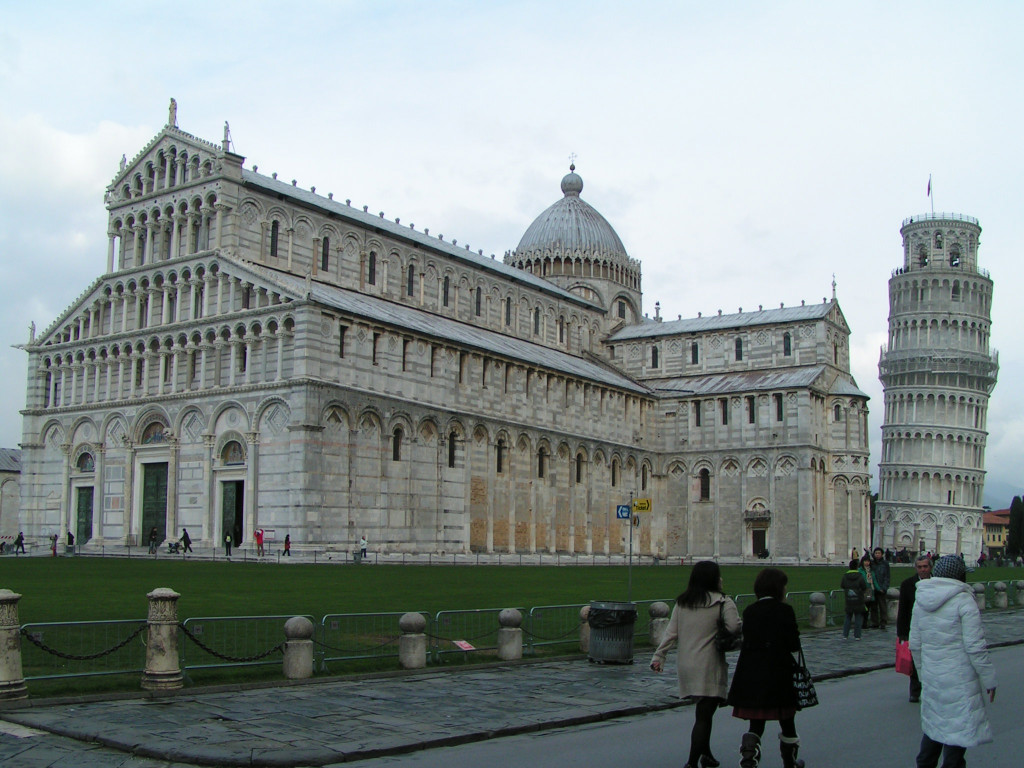
The Leaning Tower of Pisa is one of those rare landmarks that looks almost unreal when you first see it in person. The tilt is so pronounced, so deliberate, that your brain struggles to accept that this is a genuine architectural anomaly rather than an optical illusion. Standing in the Piazza dei Miracoli, the Field of Miracles, you are surrounded by four magnificent structures that together form one of the most extraordinary architectural ensembles in Europe. The cathedral, the baptistery, the campanile, and the monumental cemetery each tell a chapter of Pisa’s story, a story of maritime power, artistic ambition, and a foundation that gave way beneath a tower that was never meant to lean.
In This Article
The Engineering Behind the Lean
The tower began to lean even before its construction was complete. Work started in 1173 on a solid foundation of only three metres, set into soft ground consisting of clay, sand, and silt. By the time the third storey was completed around 1178, the tower was already tilting to the south. Construction was halted for almost a century, allowing the soil to settle, which may have saved the tower from collapsing entirely. When work resumed, builders attempted to compensate by making the upper floors slightly taller on the short side, but this only added a curve to the shaft. The tower continued to move over the centuries, reaching a maximum tilt of 5.5 degrees before major stabilisation work between 1990 and 2001 reduced it to a safer 3.97 degrees. Engineers removed soil from beneath the north side and added counterweights, a delicate procedure that took over a decade to perfect.
Climbing the Tower and Exploring the Square
Visitors can climb the 294 spiral steps to the top of the tower, a journey that takes you through seven bell chambers and past windows that offer increasingly impressive views over the city. The climb is surprisingly disorienting because the lean creates a sensation of being pulled to one side, and the steps are worn smooth by centuries of feet. Tickets must be booked in advance and are limited to around 40 people per half-hour slot. The cost is approximately 20 euros for adults. Children under eight are not permitted to climb. The surrounding Piazza dei Miracoli is free to enter at all times. The cathedral, with its magnificent marble facade and Giovanni Pisano’s pulpit, is well worth a visit, as is the baptistery, which boasts exceptional acoustics that are demonstrated by staff singing a few notes during your visit.
Practical Information for Your Visit
Pisa is easily reached by train from Florence in about one hour or from Rome in under three hours. The tower is a 20-minute walk from Pisa Centrale station through streets lined with shops and cafes. The best time to visit is early morning or late afternoon, both for the quality of the light and to avoid the crowds that swell between late morning and mid-afternoon. Spring and autumn offer the most pleasant weather, with summer temperatures regularly exceeding 30 degrees Celsius in July and August. Allow a full two to three hours to explore the entire Piazza dei Miracoli complex. If you have time, the rest of Pisa offers a quieter, more authentic Tuscan experience than its famous neighbour Florence, with a lively student population and excellent restaurants along the Arno riverbanks.
Have you stood beneath the Leaning Tower and looked up at its improbable angle? What did you think when you first saw it in person?
Along the banks of where the Arno and Serchio Rivers combine and meet with the Tyrrhenian Sea is where you will find the ancient Italian town of Pisa. The city itself was made famous for the Leaning Tower of Pisa and every year tens of thousands of visitors make their way to the city to see its main attraction. But Pisa has a lot more to offer other than just the famous tower. In fact, there are more than 20 other historic buildings, palaces and bridges located throughout the city that date back hundreds of years.
Pisa, Tuscany, Italy / Photo by admin
There are many famous universities and other institutes of higher learning located in Pisa. The 12th century University of Pisa is the most famous of the institutes in the city. However, you can also find the Sant’Anna School of Advanced Studies and the Napoleonic Scuola Normale Superiore di Pisa in the Italian city of Pisa.
The city dates back to the days of the Greek Empire. There have been a number of artefacts uncovered over the years which have confirmed this. The most important of these is the discovery of an Etruscan necropolis back in 1991. This means that Pisa can be easily dated back to the 5th century B.C.
Pisa was known as an important port city for the Roman Empire. Known back in 89 B.C. as Portus Pisanus, the city played an important role in the Roman naval battles against the Carthaginians, Gauls and Ligurians. Pisa would continue to be a prosperous city and home to the Italian Naval fleets until 1284 when the Genoese fleet defeated Albertino Morosini at the Battle of Meloria.
The famous 67 meter tall leaning tower of Pisa took an amazing 344 years to build. The construction of the tower began in 1173 and by the time that the second floor was added in 1178, the tower began to sink as a result of the small foundation.
