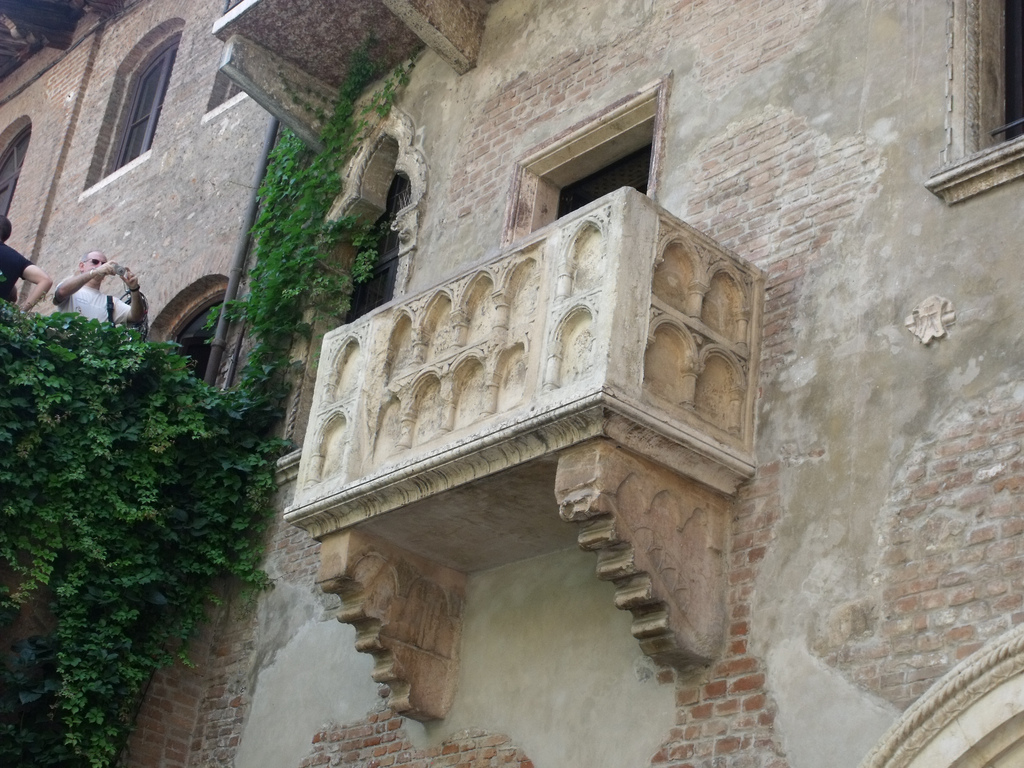
About 30 km from Lake Garda you can find the second largest city of Venice area. Verona is the capital of the province of Verona located in northeastern Italy. The world’s awareness gained mainly as the scene of Shakespeare’s famous tragedy Romeo and Juliet. In 2000, the historic centre was included into a UNESCO World heritage list.
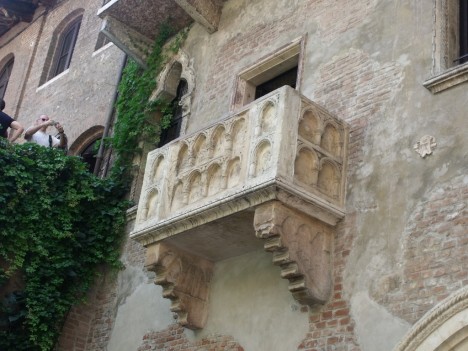
Famous Balcony, Juliet’s House, Verona, Italy by Elliott Brown
In ancient times, there was a Roman colony at the site of Verona, which over time turned into a prominent city-state’s and a capital of the whole region. Greatest importance, however, Verona got in the Middle Ages, when the invaders’ king Theodor changed its status to a royal city. At that time the city was under rule of Scaliger’s, later Milanese Visconti’s and finally it fell under the Venetian Republic, and remained so until the advent of Napoleon. It then came under Austrian power, which lasted until the unification of Italy in 1866.
Verona currently has around 270 thousand inhabitants, it is a very prosperous city and a center of culture. It is also one of the most beautiful historic cities of northern Italy and has a lot to offer. It is often referred to as the “Gateway to Italy”. If exploring the city, you will be surprised as the most of the monuments and museums are located relatively close together, so it is pleasant and easy walk.
In This Article
The Arena and Roman heritage
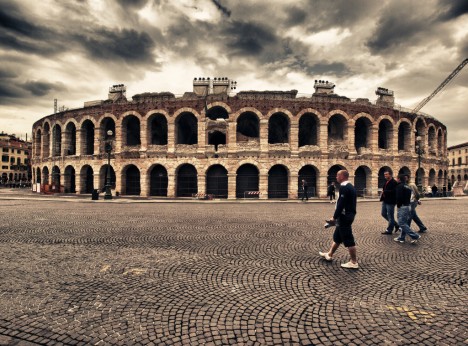
Verona Arena, Italy by Kevin Poh
The most visitors begins their tour at the famous Arena in Piazza Bra. Arena comes from the 1st century AD and after the Roman Colosseum and Capua, near Naples, it is the third largest amphitheater in Italy. The arena is very well preserved, it lacks only the third layer, destroyed by the earthquake in 1183. It has stone seats and can holds more than 20 thousand spectators. It was used for public executions, fairs, theater and opera performances and bullfighting. At present, this amphitheater is mainly used for the famous summer opera festival.
Beyond the Arena, Verona retains several Roman landmarks that reveal its ancient past. The Porta Borsari, a 1st-century gate that once marked the entrance to the city along the Via Postumia, still stands with its distinctive arched windows. Nearby, the Porta Leoni offers another glimpse into Roman design, with fragments of the original gate embedded within medieval buildings. The Roman Theatre, built in the 1st century BC on the hillside of Colle San Pietro, is less visited but equally impressive and offers wonderful views across the Adige River. These remnants remind visitors that Verona was a significant settlement long before the Scaligeri and the Venetians left their mark.
Piazza delle Erbe and the Medieval Heart
Then you can take a walk through the pedestrian zone of Via Mazzini, which is lined with many souvenir shops. This street leads to Piazza delle Erbe, the medieval heart of the city. Long ago there was a Roman Forum, now you will find bustling marketplaces here, cafes and buildings of different styles. There is e.g. a beautiful brick house Casa dei Mercanti of 1301, which served as a exchange and later as warehouse for buyers. The centre of the square is decorated with several monuments, such as Capitello, Berlina, Colona di San Marco and a beautiful fountain from 1523 with the statue “Madonna Verona”.
The square is surrounded by an eclectic mix of architecture that tells the story of Verona’s layered history. On the northern side stands the Palazzo della Ragione with its towering Torre dei Lamberti, while the frescoed Casa Mazzanti and the Baroque Palazzo Maffei add colour and character. The market stalls that fill the square each morning sell fresh produce, local cheeses, and souvenirs, creating a lively atmosphere that has persisted for centuries. Just off the square, the Arco della Costa leads toward the Piazza dei Signori, passing under a whale rib bone suspended from the archway. Local legend claims that the bone will fall on the head of the first person to pass beneath it who has never told a lie.
Piazza dei Signori and Juliet’s Verona
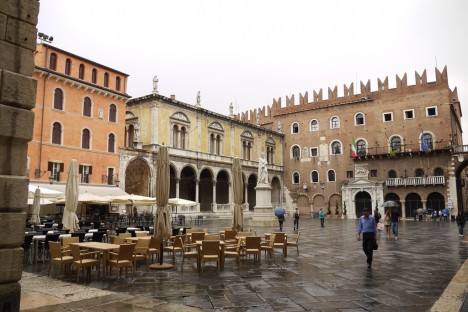
Piazza dei Signori, Verona, Italy by Richard, enjoy my life!
Once you walk through the arch, you get to the Piazza dei Signori, which was in the past the main square of Verona. It is dominated by banded Palace Palazzo del Comune, whose construction started in 1193. It served as a city hall, but later was used as the Court. On the right you can see the tower Torre dei Lamberti, of which you can enjoy a superb view of the city. Other important monuments are the brick palace Palazzo degli Scaligeri and Renaissance Loggia del Consiglio. In the middle you can see a statue of Dante from 1301.
No visit to Verona is complete without paying homage at the Casa di Giulietta, the supposed home of Shakespeare’s Juliet. While the balcony and statue are a modern addition from the early 20th century, the building itself dates back to the 13th century and belonged to the Dal Cappello family. Visitors crowd into the small courtyard to touch the bronze statue of Juliet for good luck in love and to leave notes on the walls. For a quieter experience, the nearby basilica of San Zeno Maggiore is a masterpiece of Romanesque architecture, featuring bronze doors carved with biblical scenes and a serene cloister that feels a world away from the bustle of the city centre.
What to visit in Verona
- Piazza dei Signori
- Porta Borsari
- Verona Arena
- basilica di San Zeno
- Ponte Scaligero
- Statue of Dante Alighieri
- Sant’Anastasia church
- The Balcony of Juliet’s house
Explore all our Italy travel guides, from the Dolomites to Sicily.
Explore More
If you enjoyed this article, you might also like:

Bookmarked this for our upcoming trip to Verona. The detailed suggestions on where to go and what to prioritise are exactly what we needed. We only have a few days there so every recommendation counts. Thank you!