
The roar of water crashing over a 165-metre drop fills the air long before you reach the viewpoint. The Cascata delle Marmore is one of those rare human creations that rivals nature itself, a spectacular man-made waterfall that has been in operation for over 2,000 years. The ancient Romans engineered this cascade as part of a drainage project to divert water from the Velino River into the Nera River below, solving a flooding problem in the Rieti valley while creating one of the most impressive waterfalls in Europe. Today, the falls are a scheduled attraction, with water released at specific times through a series of gates that control the flow.
In This Article
The Scheduled Release and Viewing Points
The waterfall operates on a scheduled basis, with water released at set times announced by a siren that echoes through the valley. The release typically occurs several times daily during the high season, with additional evening releases in summer that are illuminated by floodlights. When the gates open, the water builds from a gentle cascade to a full-volume torrent over approximately 15 minutes, filling the entire gorge with mist and the deep rumble of falling water. The main viewing platform, located at the base of the falls, is the most popular spot and offers the closest view of the cascading water. For a higher vantage point, the trail on the opposite side of the gorge provides a panoramic view of the entire three-tiered cascade dropping into the lush valley below.
Walking Trails and Activities
The park surrounding the waterfall offers several walking trails of varying difficulty. The Path of the Lower Viewpoint is an easy 20-minute walk suitable for all ages, while the more challenging Path of the Three Waterfalls takes you behind the cascading water and up the side of the gorge for a closer view of the geology that shaped this extraordinary landscape. The Balzo dell’Aquila, or Eagle’s Leap, viewpoint offers the most dramatic perspective, requiring a moderately steep climb of about 30 minutes from the car park. Kayaking and white-water rafting are available on the Nera River downstream of the falls during the release times, offering an adrenaline-fuelled perspective on the power of the water. Adrenaline seekers can also try the via ferrata route that climbs the cliff face beside the waterfall.
Practical Information
The Cascata delle Marmore is located in the Umbria region, approximately 10 kilometres from the city of Terni and 90 minutes from Rome by car. Regular bus services connect Terni station to the waterfall, making it accessible without a car. The entrance fee is approximately 10 euros for adults, with discounts for families and children. The best time to visit is spring and early summer, when the surrounding vegetation is lush and the flow of the Nera River is at its strongest. The waterfall is at its most spectacular during the scheduled releases, so check the timetable on the official website before planning your visit. Allow two to three hours to explore the park and its viewpoints thoroughly.
Have you ever stood at the base of the Cascata delle Marmore and felt the spray of a waterfall built by the ancient Romans? What did you think of this remarkable feat of engineering?
Created back in the days of the great Roman Empire, the manmade falls known as Cascate delle Marmore were created. At more than 165 meters in height, the Marmore’s Falls is one of the tallest waterfalls in Europe. Cascate delle Marmore is also known as the tallest in the world when it comes to manmade falls. The falls are composed of three sections of which the largest is the topmost which strands at 83 meters in height.
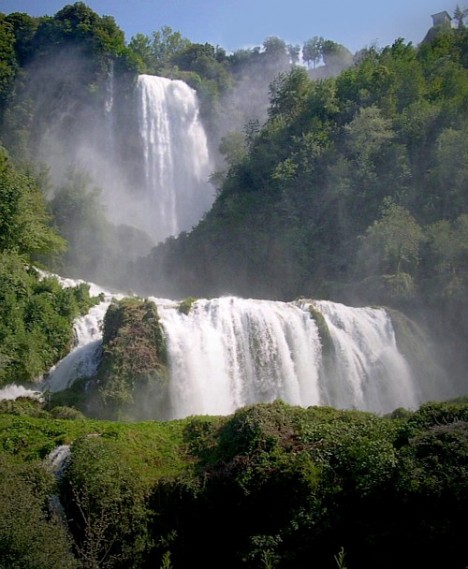
Cascate delle Marmore, Italy by Zumzum
Initially built as am means of reducing the threat of malaria back in 271 B.C., the Cascate delle Marmore was formed when a canal was created to drain the wetlands over the edge of the cliffs. The flood waters drained into the Nera River which can be found at the bottom of the cliffs. The falls are now a very popular tourist attraction in the area.
The Cascate delle Marmore can be found about 8 kilometers from the city of Terni. The falls are fed by the Velino River which also flows through the nearby hydroelectric power station. The flow of water through the Cascate delle Marmore is controlled based on a preset schedule. This is so that the tourists can still marvel at the falls, while not overly affecting the power generation of the plant. Most tourists to the area make their plans ahead of schedule to ensure they are there the moment the gates are opened and the water starts gushing down the Cascate delle Marmore.
Built back in 1929, the Galleto power plant is fed by Piediluco Lake and produces 530 megawatts of power for the cities around the area. During the slow times of the day, when power generation is not as important, the falls are turned on. This occurs daily between noon and 1 as well as between 4 and 5 in the afternoon.
