Poloniny National Park is Slovakia’s most remote and wild protected area, a UNESCO-listed wilderness of primeval beech forests, high mountain meadows (poloniny), and traditional wooden churches in the far northeast of the country, where the borders of Slovakia, Poland, and Ukraine meet. Designated a UNESCO World heritage site as part of the “Ancient and Primeval Beech Forests of the Carpathians,” Poloniny is a place where European bison have been successfully reintroduced, wolves and bears still roam, and traditional Rusyn culture survives in the scattered mountain villages.
In This Article
Primeval Forests and Wildlife of the Eastern Carpathians
Poloniny National Park protects the largest complex of primeval beech forests in Slovakia, a remnant of the ancient woodlands that once covered much of temperate Europe. These forests, designated a UNESCO World heritage site as part of the transnational “Ancient and Primeval Beech Forests of the Carpathians” serial property, have never been logged or commercially exploited, and they contain trees that are over 300 years old, towering up to 50 metres in height. Walking through the Stužica and Havešová reserves, which form the core of the UNESCO site, you experience a forest ecosystem that has functioned without human interference for centuries. Fallen trees are left to decay naturally, providing habitat for fungi, insects, and the organisms that drive the forest’s nutrient cycle. The stillness and scale of these primeval groves, where shafts of sunlight pierce a dense canopy and the forest floor is carpeted with ferns and mosses, create an atmosphere of profound natural peace.
The park is one of the best places in Europe to see wildlife in its natural habitat. European bison, which went extinct in the wild in the early 20th century, were successfully reintroduced to Poloniny in 2004, and a herd of around 40 animals now roams the mountain meadows. Brown bears, wolves, lynx, and wildcats inhabit the deeper forests, though sightings require patience and often luck. The park’s rivers and ponds support populations of otters, beavers, and the endangered Carpathian newt. Birdwatchers come for golden eagles, eagle owls, black storks, and the elusive Ural owl. The best times for wildlife observation are early morning and late evening, and the park’s network of remote trails offers excellent opportunities for quiet, self-guided exploration.
The Mountain Meadows: Poloniny in Bloom
The park takes its name from the “poloniny,” the high mountain meadows that cover the ridges and upper slopes of the Bukovské vrchy range, offering some of the most spectacular wildflower displays in Central Europe. In late spring and early summer, these meadows erupt in colour: purple crocuses, yellow gentians, pink dianthus, and the white umbels of Carpathian hogweed create a shifting carpet of blooms that attracts butterflies and bee-eaters. The most beautiful poloniny can be found near Pľaša, Ďurkovec, Riaba skala, and Kamenná lúka, where the open pastures offer panoramic views across the forested ridges to the Polish and Ukrainian borders. Hiking across these meadows, with the scent of wild thyme and the sound of cowbells from traditional summer pastures, feels like stepping into a landscape unchanged for centuries.
The highest peak in the park is Kremenec at 1,221 metres, the easternmost point of Slovakia and the tripoint where the borders of Slovakia, Poland, and Ukraine converge. A wooden platform marks the spot, and the hike to the summit passes through dense beech forest and open poloniny before emerging at the ridge, where the view stretches across three countries. The park’s extensive trail network, centred on the villages of Nová Sedlica and Runina, includes routes suitable for day hikes and multi-day treks, and several marked cycling trails offer an alternative way to explore the remote valleys.
Rusyn heritage: Wooden Churches and Village Life
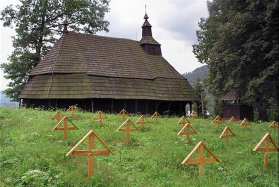
The Poloniny region is also remarkable for its cultural heritage. The scattered villages of the Slovak far east are home to the Rusyn minority, a Slavic people with their own language, traditions, and Eastern Catholic faith. The most visible expression of Rusyn culture is the wooden churches (tserkovs) found in Topoľa, Uličské Krivné, Ruský Potok, and Jalová. These extraordinary structures, built entirely of wood without metal nails, date from the 18th century and combine Byzantine, Gothic, and Carpathian folk architectural traditions. Their triple-domed silhouettes against the Carpathian skyline are the iconic image of the region, and the interiors are adorned with painted iconostases and frescoes that are masterpieces of folk religious art. Several of these churches are part of the UNESCO World heritage listing for Wooden Tserkvas of the Carpathian Region in Poland and Ukraine. The village of Nová Sedlica, the easternmost settlement in Slovakia, offers traditional accommodation and local food, providing a base for exploring this unique corner of Europe.
View Poloniny National Park in Slovakia in a larger map
Have you explored Poloniny or discovered Slovakia’s far east? Share your wilderness experiences in the comments! 🐺
Explore all our Slovakia travel guides, from the High Tatras to Bratislava charm.
Explore More
If you enjoyed this article, you might also like:
