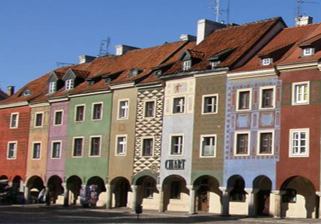
Poznań is one of Poland’s most dynamic and historically significant cities, a vibrant commercial and cultural hub in the west of the country whose magnificent Renaissance Old Market Square (Stary Rynek), with its famous mechanical goats that butt heads at noon on the Town Hall tower, is one of the most beautiful public spaces in Poland. As the historic capital of the Wielkopolska (Greater Poland) region and one of the oldest cities in the country, it was here that Poland’s first cathedral was built and the Polish state was effectively born in the 10th century. Poznań combines a rich medieval heritage with a thriving contemporary food, arts, and university scene that makes it one of Poland’s most rewarding city breaks.
In This Article
The Old Market Square: Renaissance Splendour and Mechanical Goats
Poznań’s Old Market Square (Stary Rynek) is one of the largest and most beautiful medieval market squares in Europe, a vast open space surrounded by colourful burgher houses representing Gothic, Renaissance, and Baroque styles. At its centre stands the Old Town Hall, a masterpiece of Renaissance architecture rebuilt by the Italian architect Giovanni Battista di Quadro after a fire in 1536. Its elegant triple-storey loggia, crowned by an ornate attic parapet, is one of the finest examples of Italian Renaissance architecture north of the Alps. The town hall tower rises 61 metres above the square and houses a clock mechanism connected to the famous Poznań Goats, a beloved local tradition that draws crowds daily.
At precisely noon each day, a small door above the clock face opens and two mechanical goats emerge to butt heads exactly twelve times. The tradition dates from the 16th century, but the current mechanical goats were installed in 1913. According to local legend, the goats were added to the clock mechanism by a chef who, having burned the venison he was preparing for a feast, substituted a pair of goats he found in the garden. The goats escaped during the meal and ran up the town hall tower, and the amused mayor ordered their image immortalised in the clock. The Poznań Goats Festival, held annually in June, celebrates this quirky tradition with parades and concerts throughout the city.
Cathedral Island: The Birthplace of Poland
Ostrów Tumski (Cathedral Island), the oldest part of Poznań, is where the Polish state was born in the 10th century. It was here that Mieszko I, the first historical ruler of Poland, built his fortified stronghold and accepted baptism in 966 AD, an event that marks the Christianisation and founding of the Polish state. The Poznań Cathedral, officially the Archcathedral basilica of St. Peter and St. Paul, is the oldest cathedral in Poland. Although its current Gothic form dates from a 14th-century rebuilding, the crypt contains the remains of the original 10th-century baptistery, one of the most significant archaeological sites in Polish history. The golden chapel within the cathedral holds the tombs of Mieszko I and his son Bolesław the Brave, the first crowned King of Poland.
Walking across the bridge to Ostrów Tumski feels like moving between two eras. The island retains a quiet, contemplative atmosphere compared with the vibrant bustle of the city centre. The Cathedral Museum displays liturgical treasures and archaeological finds from the early medieval period. The nearby fragment of 10th-century defensive walls is one of the oldest surviving fortifications in Poland. On summer evenings, concerts of organ and sacred music are held in the cathedral, their sound echoing across the island as the sun sets over the Warta River.
Modern Poznań: Culture, Commerce, and St. Martin’s Croissants
Poznań is not merely a city of medieval history. With a population of over 530,000 and a student body of more than 130,000, it is one of Poland’s most energetic cities. The Imperial Castle, built for the German Emperor Wilhelm II in 1910, now houses a cultural centre with concert halls, galleries, and cinema screenings. The Malta district, centred around an artificial lake, has been transformed into a recreation zone with a ski slope, ice rink, and thermal baths. Poznań International Fair grounds host trade events throughout the year, maintaining the city’s historic role as a commercial crossroads between Eastern and Western Europe.
No visit to Poznań is complete without tasting the rogale świętomarcińskie (St. Martin’s croissants), the city’s most famous culinary speciality. These crescent-shaped pastries filled with white poppy seeds, almonds, walnuts, and dried fruit are protected by European geographical indication status, meaning they can only be made in Poznań and the surrounding Wielkopolska region. The best rogale are baked fresh daily and served warm from bakeries around the Old Town. Poznań’s thriving restaurant scene has earned the city a reputation as one of Poland’s top food destinations.
View Poznań – Lively commercial city with plenty of museums and great entertainment options in Poland in a larger map
Have you watched the goats on Poznań’s Town Hall or discovered Wielkopolska’s historic capital? Share your Poznań experiences in the comments! 🐐
Explore all our Poland travel guides, from Kraków square to the Tatra Mountains.
Explore More
If you enjoyed this article, you might also like:
