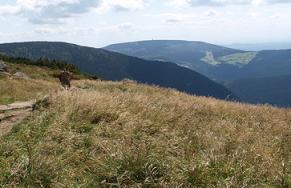
Krkonoše National Park (Karkonosze in Polish) is the oldest national park in the Czech Republic and one of Central Europe’s most beloved mountain destinations, a dramatic granite and schist range on the Czech-Polish border whose highest peak, Sněžka (1,603m), crowns a landscape of glacial cirques, alpine meadows, and the unique subarctic tundra ecosystem that exists nowhere else in Central Europe. A UNESCO Biosphere Reserve and the mythical home of Krakonoš, the mountain spirit of Czech folklore, Krkonoše offers year-round outdoor adventure from skiing to summer hiking on hundreds of kilometres of trails.
In This Article
The Unique Natural heritage of Krkonoše
What makes Krkonoše extraordinary among Central European mountain ranges is its subarctic tundra ecosystem, a remnant of the last Ice Age that survives only on the highest plateaus above the tree line. Here, at elevations above 1,300 metres, you find plant species normally associated with the Arctic Circle: dwarf willow, alpine bearberry, and the endemic Krkonoše saxifrage, a small white-flowered plant that grows nowhere else on Earth. The glacial cirques carved into the northern slopes such as the Sněžné jámy (Snow Pits) and Obří důl (Giant’s Valley) hold snow well into summer and shelter rare alpine plants that have persisted since the Pleistocene.
The park’s geological diversity is equally impressive. The granite and schist bedrock has been sculpted by millennia of glacial activity into dramatic rock formations, including the striking “rock towns” of granite pillars and towers that rise from the forest like petrified giants. The highest peak, Sněžka at 1,603 metres, straddles the Czech-Polish border and offers panoramic views across both countries. At its summit, a distinctive weather station shaped like a UFO has become an unlikely icon of the park. The source of the River Elbe (Labe), the longest river entirely within the Czech Republic, rises on the slopes of the neighbouring mountain, and the Labský vodopád (Elbe Waterfall) plunges 35 metres over a granite cliff into a misty gorge below.
Hiking, Skiing, and Outdoor Adventures
Krkonoše National Park offers over 800 kilometres of marked hiking trails, ranging from gentle valley walks suitable for families to challenging ridge traverses that require good fitness and sure footing. The most popular long-distance route is the Krkonoše Ridge Trail, which follows the main crest of the mountains from Harrachov in the west to the eastern slopes of Sněžka, offering continuously changing views of the Czech and Polish sides. Along the way, mountain huts (boudy) provide shelter, hot meals, and the famous Krkonoše herbal liqueur. The Jilemnice part of the trail passes through the Labský důl, one of the most beautiful glacial valleys in Central Europe.
In winter, Krkonoše transforms into the Czech Republic’s premier ski destination. Špindlerův Mlýn, the largest resort, offers 25 kilometres of groomed slopes and extensive cross-country trails that connect with the Polish ski centres of Karpacz and Szklarska Poręba. Pec pod Sněžkou, at the foot of the Czech Republic’s highest peak, provides direct cable car access to the summit ridge and offers some of the most challenging downhill runs in the park. Cross-country skiers can explore hundreds of kilometres of tracks that wind through frozen forests and across snowy plateaus, with the Krkonoše Cross-Country Ski Trail linking all the major resorts in a circuit of over 100 kilometres. Spring brings wildflower displays to the alpine meadows, while autumn paints the beech forests in shades of gold and copper.
Myths, Legends, and Mountain Culture
The folklore of Krkonoše is dominated by the figure of Krakonoš (known as Rübezahl in German), a mountain spirit who has guarded these peaks for centuries. Depending on the story, Krakonoš appears as a giant, a monk, or a wandering herbalist, rewarding the kind-hearted and punishing the greedy. His legend is celebrated at the Krakonoš Summer Festival in Vrchlabí, and his image appears on signs, souvenirs, and local products throughout the region. The park’s distinctive wooden architecture, with elaborately decorated mountain chalets, reflects the traditions of German and Czech settlers who have lived in these mountains since the Middle Ages, and several open-air museums preserve the material culture of this unique highland community.
View Krkonoše National Park in Czech republic in a larger map
Have you hiked Krkonoše or skied the Czech Republic’s highest mountains? Share your mountain experiences in the comments! ⛰️
Explore all our Czech Republic travel guides, from Prague spires to Moravian wine country.
Explore More
If you enjoyed this article, you might also like:
