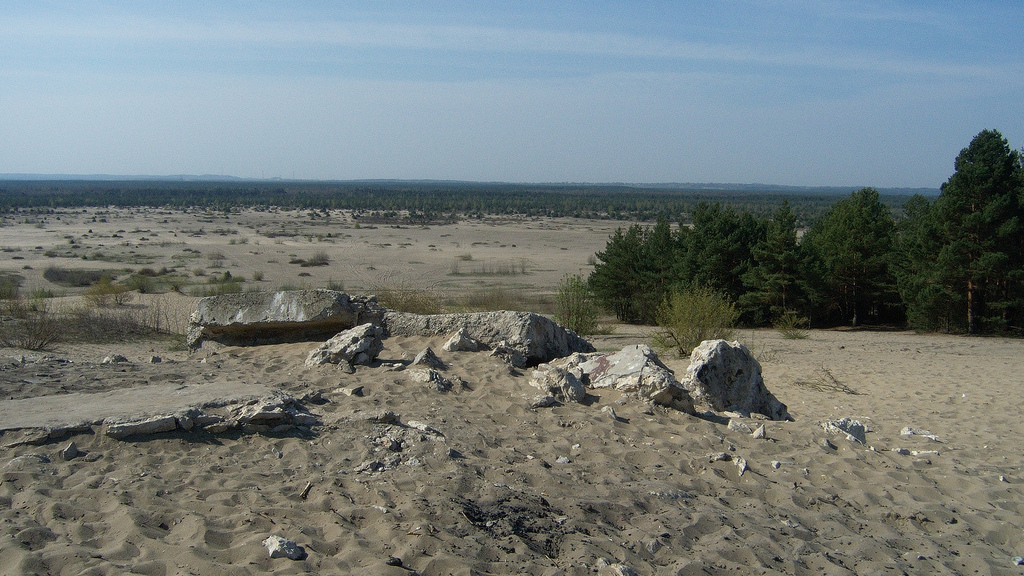
Sand stretches across the landscape in a place that should not exist. Błędów Desert covers about 33 square kilometres of southern Poland, a geological anomaly in the green heart of Europe. Loose sand shifted by wind creates dunes reminiscent of the Sahara. The desert formed centuries ago when deforestation and mining stripped the land of its topsoil, leaving a sandy wasteland behind. Today, the area attracts hikers, photographers, and military training exercises. The contrast between the pale sand and the surrounding pine forests is startling. On hot summer days, the air shimmers with heat haze. Bird species adapted to arid conditions nest here, far from their typical ranges. This accidental desert is one of Europe’s most unusual landscapes.
Błędów Desert (or Pustynia Błędowska in Polish) is a unique desert area in central Europe. It is located outside of the city of Olkusz, northwest of Krakow in southern Poland. Błędów Desert covers an area of 32 km2 with the sand, which particularly in the summer creates the perfect illusion of the African desert. You can admire here the sand dunes, as well as to experience mirage.
Photo licensed under the Creative Commons, created by Grzegorz
According to an ancient legend, Błędów Desert was created by the devil, who tore the bag of sand at the local church tower.
In fact, the sand is the remaining of melting glaciers. However it overgrown after some time. The present appearance of the countryside made people already in the thirteenth century, when they began to use land here, water and cut down forests. A narrow layer of the soil was destroyed and the sand appeared again. At the beginning of the 19th century, the desert had 80 km2. Now the sand is overgrowing again, and the desert is shrinking.
Since 2010, some projects have been initiated to save this unique area. Błędów Desert is often referred to as the Polish Sahara. This similarity is often used by the filmmakers. In the past, it was a training area for army. Today, you can find here the remains of fortifications however the part of the desert is still a military area.
Błędów Desert is best accessible from the village of Chechlo and Klucze, where you can follow the tourist trail. A popular way to see the beauty of this unique European piece of desert is from horseback.
View Błędów Desert – a unique desert area in central Europe Poland in a larger map
The Geology Behind the Polish Sahara
The sand of Błędów Desert originated from glaciers that covered this region during the Pleistocene ice ages. As the ice sheets retreated around 12,000 years ago, they left behind vast deposits of sand and gravel. For thousands of years, this landscape was stabilised by vegetation. However, in the 13th century, heavy deforestation for mining and smelting operations in the Olkusz region removed the protective tree cover. Without roots to hold the soil, the thin layer of topsoil eroded away, exposing the sand beneath. Wind and water then shaped the sand into the dunes visible today. At its maximum extent in the early 19th century, the desert covered nearly 80 square kilometres. Today, natural vegetation is slowly reclaiming the area, and conservation projects aim to preserve a portion of the open sand landscape as a unique geological and ecological site. The sand layer varies in depth from 5 to 70 metres, with the deepest deposits found in the central dune field.
Flora, Fauna, and Visiting the Desert
Despite its barren appearance, Błędów Desert supports a surprising variety of life adapted to dry, sandy conditions. The grey hair-grass and sand sedge are among the first plants to colonise the shifting dunes. In spring and summer, splashes of colour appear from sand-loving species like the sea holly and the rare sand pink. Animal life includes the sand lizard, the European nightjar, and several species of solitary bees and wasps that nest in the loose sand. The desert is also an important stopover for migratory birds, including the tawny pipit and the northern wheatear. For visitors, the best approach is from the village of Chechlo, where a marked educational trail leads into the heart of the dune field. The trail is 3.5 kilometres long and takes about an hour to walk. Horseback riding tours are available from local stables and offer a memorable way to experience the desert. The site is free to enter and accessible year-round, though summer offers the most dramatic desert atmosphere with shimmering heat haze and warm sand beneath your feet.
Would you visit a desert in the middle of Europe if given the opportunity? 🏜️
Explore all our Poland travel guides, from Kraków square to the Tatra Mountains.
Explore More
If you enjoyed this article, you might also like:
